
Does Gold Perform Well During Deflation?
Table of Contents
- Gold During Deflation: The Core Distinction
- Gold Price During Deflation: Why Results Vary
- Gold During a Recession: Historical Patterns
- Gold vs. Cash During Deflation: A Direct Comparison
- Gold Performance During the Great Depression
- Real Returns vs. Nominal Returns: What Matters
- Building a Deflation-Resistant Portfolio
- Frequently Asked Questions
Last Updated: October 8, 2026
Gold During Deflation: The Core Distinction
When prices fall across the economy, investors face a puzzle. Gold’s reputation as an inflation hedge is well-established, but the question of whether does gold perform well during deflation requires separating what actually happens from conventional wisdom.
Deflation is a sustained decline in the general price level of goods and services. During these periods, the purchasing power of cash rises simply by holding it. Gold doesn’t automatically deliver the same protection during deflation that it does during inflation, and understanding why matters for anyone building a resilient portfolio.
At My Gold Book, we explore how economic conditions shape the value of precious metals. Our guide helps readers understand gold’s role across different economic scenarios, crucial for deciding whether to collect or invest in gold.
Gold Price During Deflation: Why Results Vary
The price of gold during deflation depends on forces that often work against each other. Unlike inflation, where rising prices typically support gold’s value, deflation creates competing pressures that can push gold either way.
When deflation takes hold, several dynamics emerge at once. Real interest rates tend to rise as nominal rates fall but prices drop faster, creating headwinds for gold, which generates no yield. At the same time, deflationary periods often bring economic uncertainty and financial stress, which typically drive investors toward safe-haven assets like gold.
The net effect depends on which force dominates. In mild deflation with stable financial conditions, gold may struggle as investors prefer cash. In deflationary spirals with banking crises or market turmoil, gold often rallies as investors flee to safety. This explains why gold’s performance during deflation is less consistent than during high inflation.
Gold performs best during deflation when it’s paired with other assets. A portfolio holding both gold and bonds tends to weather deflationary periods better than gold alone, since bonds typically appreciate when deflation takes hold.
Gold During a Recession: Historical Patterns
Recessions and deflation are related but distinct, and conflating them is the most common error in gold analysis. A recession is a contraction in economic activity, typically two consecutive quarters of declining real output. Deflation is a sustained decline in the general price level. Some recessions bring deflation, some inflation, some neither.
Consider the divergence across modern downturns. The 1973-1975 recession brought stagflation, and gold rose sharply as investors sought protection from eroding purchasing power. The 2001 recession was mild and disinflationary; gold rose modestly.
The pattern is not ‘recession equals gold up.’ Gold tends to perform well when a downturn brings falling real interest rates, financial-system stress, or currency debasement fears, and struggles when a downturn is orderly, real rates are rising, and cash offers a positive real return.
Deflationary recessions split into two types. In a ‘benign’ one, prices drift down slowly, credit markets function, and investors hold cash and high-quality government bonds; gold typically lags.
Don’t assume gold always rises during recessions. If a recession occurs without significant financial stress or market panic, gold may actually decline as investors rotate toward cash, short-dated Treasuries, or other assets offering positive real yields. The relationship is strong during crises but weak during routine downturns.
When evaluating any recession, ask three questions before assuming gold will help: Are real interest rates falling or rising? Is the banking system under stress? Is the currency itself in question? Gold’s historical edge appears when at least two of those three answers point toward stress.
Recessions are not a single scenario. The deflationary, crisis-driven variety is where gold has historically earned its safe-haven reputation. The mild, orderly variety is where cash and short-term government debt have historically done the heavier lifting.
Gold vs. Cash During Deflation: A Direct Comparison
During deflation, cash gains purchasing power automatically, a dollar in your pocket buys more next year than today. This is gold’s core challenge during deflationary periods.
Gold produces no yield. It sits in a vault generating no income, and during deflation, when cash is appreciating in real terms, this becomes a significant disadvantage. An investor holding cash sees purchasing power rise simply by waiting; an investor holding gold sees no such automatic gain.
However, this assumes deflation remains stable and orderly. If it accelerates into a spiral or accompanies financial crisis, the calculus shifts. During the Great Depression, deflation was severe and chaotic: banks failed, credit collapsed, and the financial system broke down. In that environment, holding physical gold proved far more valuable than cash in a failing bank or bonds from struggling corporations.
| Asset | Deflation Scenario | Performance | Key Risk |
|---|---|---|---|
| Cash | Mild, stable deflation | Strong (purchasing power rises) | Counterparty risk if held in banks |
| Gold | Mild, stable deflation | Weak (no yield, no appreciation) | Opportunity cost vs. cash |
| Cash | Severe deflation with crisis | Weak (bank failures, capital controls) | System risk |
| Gold | Severe deflation with crisis | Strong (safety, no counterparty risk) | Volatility |
The practical insight: during benign deflation, cash often outperforms gold. During deflationary crises, gold often outperforms cash. Understanding these dynamics is key to making informed decisions.
Gold Performance During the Great Depression
The Great Depression offers the most direct historical example of severe deflation in the modern economy. Prices fell roughly 25% between 1929 and 1933, accompanied by banking collapse, unemployment exceeding 25%, and widespread financial panic.
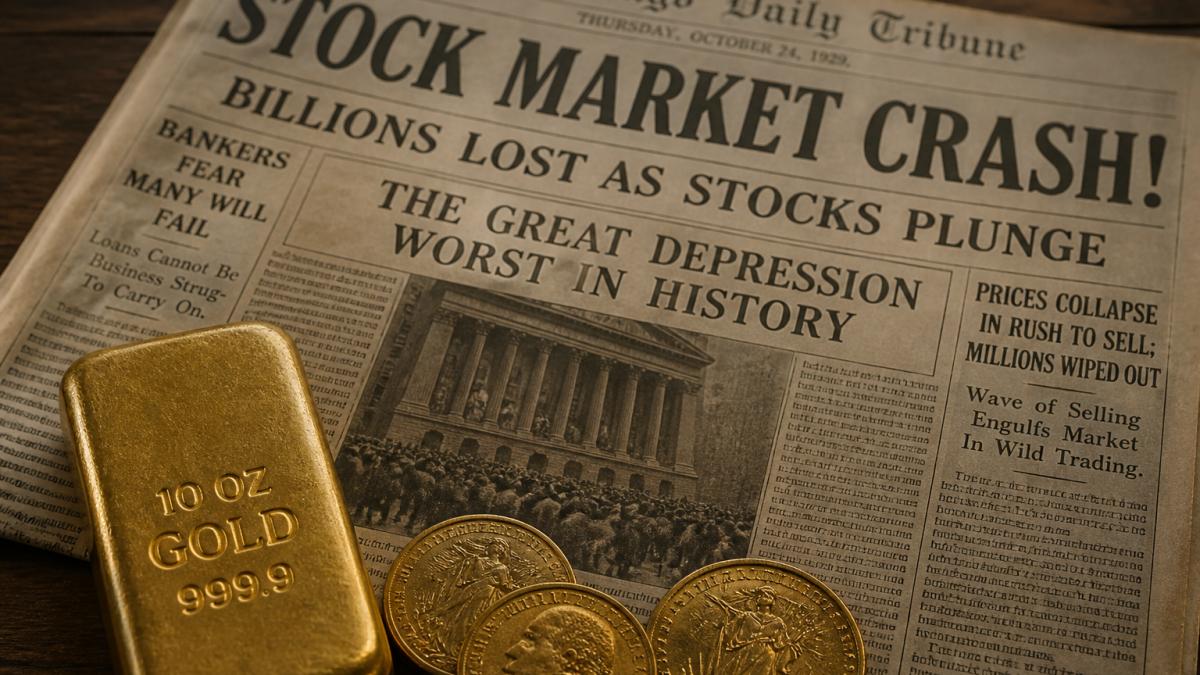
Gold’s performance during this period reveals important truths about its deflation behavior. The U.S. was on the gold standard, so the dollar was backed by gold reserves.
Click Here To Order Your Copy →
Before the gold standard was abandoned, gold held its value remarkably well. Stocks collapsed roughly 90% from peak to trough, corporate and municipal bonds defaulted at alarming rates, and real estate plummeted.
Investors who held physical gold during the Depression preserved wealth that stock, corporate bond, and real estate holders lost. However, government policy can restrict that protection.
The takeaway from the Great Depression is clear: during severe deflationary crises, gold serves as a genuine hedge. During stable, mild deflation, its advantage disappears.
Real Returns vs. Nominal Returns: What Matters
A nominal return is the simple change in price: if gold rises from $2,000 to $2,200 per ounce, that’s a 10% nominal return. A real return adjusts for inflation or deflation: if prices fall 5% over the same period, the real return is roughly 15%.
During deflation, this distinction becomes critical. Suppose gold’s price falls 5% nominally but overall prices fall 10%. Gold’s real return is positive: it gained purchasing power even though its price declined.
This changes how to evaluate gold’s performance. Many analyses focus on nominal price movements, concluding gold “underperformed” during deflation because its price fell. But if prices in general fell faster, gold actually outperformed in real terms, preserving and even enhancing purchasing power.
The challenge is that real returns are harder to measure and easier to misinterpret. During the Great Depression, nominal gold prices were fixed by policy, but real returns were strongly positive because everything else deflated.
What matters for your portfolio is real purchasing power, not nominal price. During deflation, focus on real returns: how much can you actually buy with your gold, not just what its price tag says.
Building a Deflation-Resistant Portfolio
Understanding the specific forces deflation sets in motion is crucial for making informed decisions about gold. Those forces pull in different directions, and understanding them helps in assessing gold’s role.
The competing forces during deflation are:
- Falling prices raise real interest rates. If nominal rates are near zero and prices fall, the real cost of holding cash rises. That is a headwind for gold, which pays no yield.
- Falling prices raise the real value of debt. Debtors, households, firms, and governments, face heavier real burdens. That stress often triggers defaults, bank losses, and a flight to safe collateral, which is a tailwind for gold.
- Currency strength. Deflation is often accompanied by a stronger domestic currency, which mechanically pressures the dollar price of gold. This is a headwind.
- Lower nominal rates. Central banks typically cut rates in deflationary downturns, which reduces the opportunity cost of holding gold. This is a tailwind.
- Liquidity stress. In the acute phase of a deflationary crisis, investors sell what they can, not what they want. Gold can be sold off alongside everything else in a dash for cash before recovering. This is a short-term headwind that often reverses.
- Safe-haven demand. Once the initial liquidation passes, gold’s lack of counterparty risk tends to attract capital. This is a tailwind.
Because these forces operate on different timelines, the same asset can fall in the first weeks of a deflationary shock and rise over the following quarters. A deflation-resistant portfolio is built to survive the liquidation phase and participate in the recovery.
Asset-class roles during deflation:
- Cash and cash equivalents provide the most direct deflation protection because purchasing power rises automatically. The risks are counterparty exposure if held in a failing bank and the possibility of capital controls or deposit freezes in extreme scenarios.
- Government bonds, particularly longer-dated Treasuries, typically appreciate as nominal yields fall and the real value of fixed payments rises. They are the classic deflation hedge, but they carry duration risk if the deflationary episode is short and rates snap back.
- Gold serves as the crisis hedge within the deflation basket. It tends to lag in benign deflation and lead in disorderly deflation. Its role is not to beat cash in every deflationary month but to preserve purchasing power when the financial system itself is in question.
- Equities generally fall during deflationary contractions, though defensive sectors and dividend payers can hold up better than the broad index. Equities are not a deflation hedge; they are the growth engine that funds the rest of the portfolio.
- Real estate and commodities tend to decline during deflation and are generally poor hedges for that specific scenario.
- Inflation-linked bonds actually underperform during deflation because their principal and coupon adjustments move with the price level.
Forms of gold exposure behave differently. Physical bullion carries no counterparty risk but has storage, insurance, and bid-ask costs. Gold exchange-traded products offer liquidity and low transaction costs but introduce custodian and issuer risk, and can trade at premiums or discounts to net asset value during stress.
A workable framework, not a fixed formula:
- A meaningful allocation to government bonds, sized to the investor’s tolerance for duration risk.
- A cash reserve sufficient to cover near-term obligations and to deploy into dislocated assets.
- A gold allocation sized to the investor’s concern about financial-system stress rather than to a fixed percentage. Investors who view a deflationary crisis as a real possibility tend to hold more; those who view deflation as a mild, manageable drift tend to hold less.
- A diversified equity core for long-term growth and inflation protection in the scenarios where deflation does not materialize.
The My Gold Book guide explores gold’s role within a broader investment strategy, examining not just deflation but also inflation, stagflation, and normal conditions. Understanding gold’s actual behavior across these scenarios, and the forces that drive it in each, helps investors decide based on evidence rather than assumptions.
Frequently Asked Questions
Does gold go up or down during deflation?
Gold’s performance during deflation is mixed and depends on the specific deflationary environment. In some deflation scenarios, gold prices fall because investors sell to raise cash, and real interest rates rise, making non-yielding assets less attractive. In others, gold may hold value or appreciate if deflation is accompanied by economic crisis and investors seek safe-haven assets. The key distinction is between nominal price (what you pay) and real purchasing power (what it buys), which can move in opposite directions.
How does gold compare with cash during deflation?
Cash gains purchasing power during deflation because prices fall across the economy, meaning each dollar buys more goods. Gold’s nominal price may decline, but its real value depends on the deflation’s severity and cause. In mild deflation, cash outperforms gold. In severe deflation with financial instability, gold may preserve wealth better than cash held in failing institutions. During the Great Depression, gold held its purchasing power better than cash for those who owned it, though nominal prices fell.
What happened to gold during the Great Depression?
Gold’s nominal price remained relatively stable during the Great Depression, but its real purchasing power strengthened as prices fell across the economy. Investors who held physical gold preserved wealth better than those holding cash in failing banks or stocks. Gold’s resilience during this period demonstrated its value during severe economic crisis, though policy intervention complicated its role.
Can gold protect my portfolio during a deflationary recession?
Gold can provide some portfolio protection during deflationary recessions, but its effectiveness depends on the recession’s characteristics. Gold typically performs better when deflation is accompanied by financial instability, currency concerns, or geopolitical volatility. In mild deflationary recessions with stable institutions, cash and government bonds may offer better returns. Understanding gold’s role across different scenarios helps in managing the uncertainty of deflationary periods.