
Biblical Significance of Gold: History & Meaning
Table of Contents
- Gold as a Symbol of Divine Glory and Holiness
- Gold in the Tabernacle and Temple
- The Incorruptibility and Purity of Gold
- History of Gold as Currency and Wealth
- Spiritual Meaning of Gold and Silver in Scripture
- Refining Gold: A Metaphor for Spiritual Testing
- The Dark Side: Gold and Idolatry
- Earthly Riches Versus Heavenly Value
Last Updated: August 18, 2026
Gold as a Symbol of Divine Glory and Holiness
The biblical significance of gold extends far beyond its material worth. Throughout Scripture, gold represents the divine nature and the manifest presence of God, a metal so associated with holiness that its very appearance signals the sacred. When Moses encountered God at the burning bush, he removed his sandals because he stood on holy ground. When gold appears in biblical narrative, it carries the same weight of reverence.
Gold’s incorruptible nature made it the perfect earthly representation of God’s eternal glory. Unlike silver, which tarnishes, or other metals that corrode, gold remains unchanged by time and the elements. This incorruptibility became a metaphor for divinity itself, something that cannot decay, fade, or diminish. The ancient world recognized this property, and biblical writers deliberately chose gold to symbolize what is eternal and unchanging about God’s character.
In Revelation, the Apostle John describes the heavenly city with streets of pure gold, not because heaven is a treasure vault, but because gold visually communicates purity, incorruptibility, and divine glory in a way no other material could. The choice was theological, not economic. Gold’s brightness and reflective quality made it ideal for catching and reflecting light, a fitting symbol for a God described as dwelling in unapproachable light.
The connection between gold and holiness appears consistently across biblical literature. When something is described as gold or covered in gold, the text signals that it belongs to the sacred realm, that it has been set apart for divine purposes. This wasn’t arbitrary symbolism. The ancient Near East, in which biblical culture was rooted, understood gold as the metal of gods and kings, the substance most worthy of divine presence.
Gold in the Tabernacle and Temple
The Tabernacle, described in Exodus, was essentially a portable sanctuary where God’s presence dwelt among the Israelites. Nearly every sacred object within it was overlaid with or made of gold. This wasn’t decoration, it was a statement about the nature of worship itself. The materials used in worship had to reflect the holiness of the one being worshipped.
The Ark of the Covenant and Mercy Seat
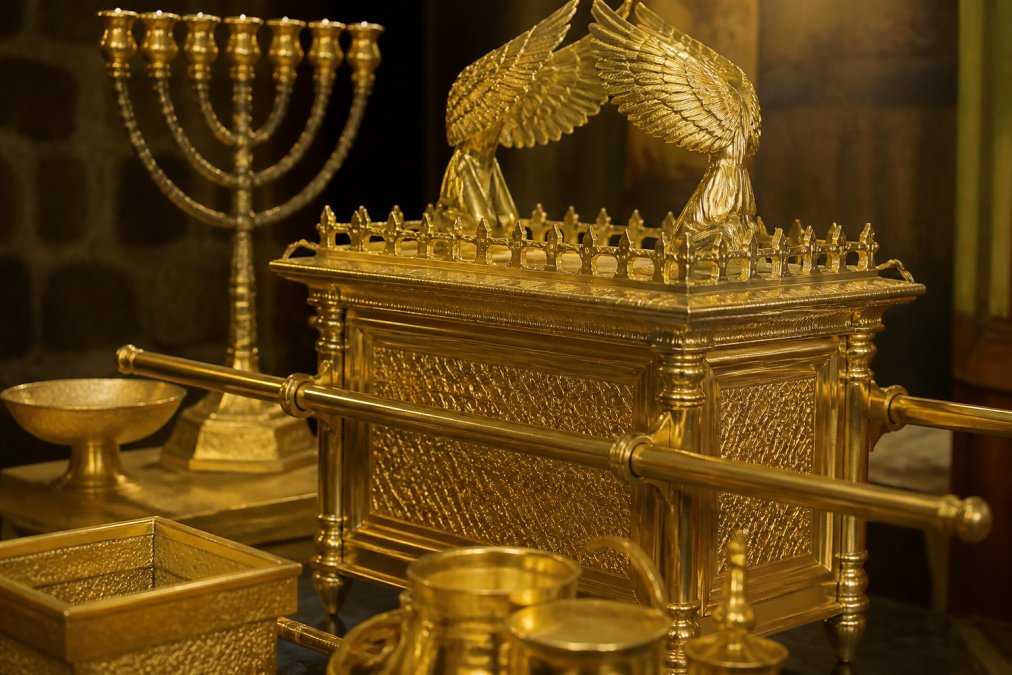
The Ark of the Covenant stands as the most significant gold object in biblical history. Constructed from acacia wood and overlaid with pure gold inside and out, the Ark held the two tablets of the Law, the foundation of God’s covenant with Israel. The mercy seat, or kapporet in Hebrew, sat atop the Ark as a lid of pure gold. This wasn’t merely functional; it was the place where God’s presence was believed to dwell, where the high priest entered once yearly to make atonement for the sins of the people.
The mercy seat’s gold construction carried profound theological meaning. The word "mercy" translates the Hebrew concept of divine compassion and forgiveness. That this seat, this symbol of God’s willingness to forgive, was made of pure, incorruptible gold communicated something essential: God’s mercy is eternal, unchanging, and as precious as the finest metal known to humanity.
The Golden Altar and Lampstand
Inside the Tabernacle stood the golden altar of incense, overlaid with pure gold. This altar represented the prayers of God’s people rising to heaven, a fragrant offering that ascended before the throne of God. The choice of gold for this altar was significant: prayers, like gold, were understood to be precious and eternal, worthy of the finest material.
The golden lampstand, or menorah, consisted of a central stem with six branches, each holding a lamp. The entire structure was hammered from a single piece of pure gold. The menorah provided light within the Tabernacle, symbolizing God’s guidance and the illumination that comes from divine presence. Its gold construction meant that the light it provided was itself a reflection of God’s glory, light bouncing off the sacred metal, filling the holy space.
When Solomon built the permanent Temple in Jerusalem, the use of gold expanded dramatically. The Temple’s interior was lined with cedar wood overlaid with pure gold. The walls, the floor, even the hinges of the doors, all were covered in gold. Archaeological evidence from the Ancient Near East confirms that such lavish use of gold in religious structures was understood as a way of honoring the deity. The expense was intentional; the glory of the Temple reflected the glory of the God it housed.
The Incorruptibility and Purity of Gold
Gold’s physical properties made it theologically perfect for biblical symbolism. Pure gold never rusts, tarnishes, or decays. It can be melted and reformed, but it cannot be corrupted or destroyed. This incorruptibility became a natural symbol for God’s eternal nature and the permanence of divine truth.
The refining process for gold also held spiritual significance. When gold ore is heated to extreme temperatures, impurities burn away, leaving only pure metal. This process became a metaphor for spiritual purification and testing. The prophet Malachi wrote of God as a refiner’s fire, burning away impurity from his people. The image would have resonated powerfully with an ancient audience familiar with the goldsmith’s craft.
The purity of gold was measured in karats, a system that existed in biblical times. Pure gold was considered the most valuable precisely because it contained no mixture, no dilution. In Scripture, this concept of purity extended beyond the metal itself to spiritual and moral purity. When biblical writers wanted to describe something as genuinely pure, free from corruption or mixture with evil, gold provided the perfect metaphor.
History of Gold as Currency and Wealth
Long before modern currency systems, gold served as the standard measure of wealth and value. In the ancient world, including the biblical period, gold was not merely precious, it was the basis of economic power. Kings and nations measured their strength partly by their gold reserves. This economic reality shaped how biblical writers understood and described wealth.
The history of gold as currency demonstrates why it held such cultural significance in the biblical world. Gold’s scarcity, its resistance to decay, and its universal recognition as valuable made it ideal for trade and wealth storage. Unlike grain or other perishable goods, gold maintained its value across generations and across borders. A merchant could carry gold across continents and know it would be recognized as valuable everywhere.
This economic prominence meant that when biblical texts discussed wealth, they often referenced gold specifically. The Queen of Sheba’s visit to Solomon included a gift of 120 talents of gold, an amount so staggering it demonstrated both her nation’s wealth and her respect for Solomon’s power. Gold wasn’t just valuable; it was the visible sign of power, prosperity, and divine blessing.
Spiritual Meaning of Gold and Silver in Scripture
While gold dominated biblical symbolism, silver held its own spiritual significance, often representing redemption and atonement. The thirty pieces of silver paid to Judas for betraying Jesus carried deep symbolic weight, silver, the metal of redemption, used to purchase the betrayal of the Redeemer himself.
The spiritual meaning of gold and silver in Scripture often appears in parallel passages. In Proverbs, wisdom is described as more valuable than gold or silver. The comparison elevates wisdom above even the most precious materials humanity knew. This pattern appears repeatedly: whatever is compared to gold or silver is being elevated as supremely valuable.
Gold also symbolized testing and approval. In 1 Peter, the apostle writes that faith, "more precious than gold," is being tested by fire. The metaphor draws on the goldsmith’s refining process, faith, like gold, becomes more pure and valuable through testing. This spiritual meaning of gold and silver extended into the practical lives of believers, reminding them that trials served a refining purpose.
Click Here To Order Your Copy →
Refining Gold: A Metaphor for Spiritual Testing
The process of refining gold provided biblical writers with a powerful metaphor for spiritual growth and purification. When gold ore is heated, impurities separate from the pure metal. The goldsmith must repeat this process multiple times, each heating removing different impurities, until only pure gold remains.
This process became a metaphor for how God works in human lives. The prophet Isaiah wrote of God testing his people as gold is tested in fire. The trials and difficulties believers face serve a purifying purpose, they burn away spiritual impurity, revealing and strengthening faith. This wasn’t presented as punishment, but as refinement, a process that increases value rather than diminishing it.

The metaphor appears consistently across Scripture because it resonated with the lived experience of people in the ancient world. They understood the goldsmith’s craft. They knew that gold became more valuable through the refining process, not less. When spiritual writers applied this image to faith and character, the audience immediately grasped the meaning: difficulty and testing were not signs of God’s abandonment, but evidence of his investment in their spiritual growth.
The duration and intensity of the refining process also carried meaning. Gold that required extensive refining was understood as containing more impurity, while gold that refined quickly was purer to begin with. Applied spiritually, this suggested that some believers might require more testing than others, not because God loved them less, but because they had more spiritual impurity to remove.
The Dark Side: Gold and Idolatry
For all its positive symbolism, gold also represented the deepest spiritual danger: idolatry. The most famous example appears in Exodus 32, when the Israelites, impatient for Moses’ return from Mount Sinai, demanded that Aaron create a golden calf for them to worship. Aaron collected their gold jewelry and fashioned an idol.
This account reveals the spiritual paradox of gold. The same metal that represented God’s glory could become an object of false worship. The golden calf wasn’t merely a statue, it represented the human impulse to replace the invisible God with something visible and tangible, something that could be controlled and manipulated.
Throughout biblical history, gold idolatry recurs. King Jeroboam set up golden calves at Dan and Bethel, creating alternative worship sites to compete with the Temple in Jerusalem. The prophets condemned this repeatedly, not because gold itself was evil, but because it had been redirected toward false worship. The metal’s value and beauty made it particularly dangerous as an idol, it could seduce people into thinking they were honoring something worthy.
The New Testament also warns against the spiritual dangers of wealth, often symbolized by gold. Jesus taught that no one can serve two masters, God and wealth. The wealthy young ruler in the Gospels couldn’t follow Jesus because his attachment to his possessions was too strong. Gold, as the ultimate symbol of wealth, became a warning about divided loyalty and misplaced trust.
Earthly Riches Versus Heavenly Value
One of Scripture’s most consistent themes contrasts earthly wealth with heavenly treasure. While gold represented the highest earthly value, biblical writers insisted that spiritual wealth infinitely exceeded material wealth. This wasn’t anti-wealth sentiment exactly, but a call to proper priorities and understanding of what truly matters.
Jesus taught his followers to "store up treasures in heaven, where moth and rust do not destroy." The contrast is explicit: earthly treasures, even gold, are temporary and subject to decay and theft. Heavenly treasures, spiritual growth, character, eternal relationship with God, are permanent and indestructible. The comparison doesn’t condemn gold; it contextualizes it as ultimately insignificant compared to what lasts forever.
The Apostle Paul wrote that the love of money is the root of all evil, not money itself, but the love of it, the elevation of it to ultimate importance. Gold, as the supreme symbol of wealth, embodied this temptation. The warning wasn’t that gold was inherently corrupt, but that human hearts could become corrupted by pursuing it above all else.
This theme reaches its culmination in Revelation’s vision of the heavenly city, where gold covers the streets, not because heaven is wealthy in the economic sense, but because gold’s incorruptibility and beauty make it a fitting material for the eternal realm. In heaven, gold loses its value as currency and becomes simply what it always was spiritually: a symbol of purity, glory, and the divine nature.
Understanding the biblical significance of gold reveals how ancient writers used material reality to communicate spiritual truth. Gold’s incorruptibility, its value, its use in sacred spaces, and its refining process all carried theological meaning. Yet the warnings about idolatry and the repeated insistence that spiritual wealth exceeds earthly riches remind us that gold, for all its biblical importance, ultimately points beyond itself to realities that cannot be measured in material terms.
For those interested in exploring gold’s multifaceted role in Scripture and history more deeply, My Gold Book’s comprehensive guide offers extensive research into how gold shaped religious practice, economic systems, and spiritual understanding across biblical history. My Gold Book provides context that helps readers understand not just what the Bible says about gold, but why these ancient writers chose this particular metal to symbolize the divine. The book’s balanced approach, authored by researcher Douglas Ginter, examines gold’s role in culture and religion while also addressing its significance as a modern investment and its comparison to contemporary assets. Whether you’re exploring biblical history, considering gold as a long-term investment hedge, or simply curious about how precious metals shaped human civilization, My Gold Book connects these threads into a coherent narrative that enriches understanding of both ancient Scripture and present-day economic realities.
Frequently Asked Questions
What does gold symbolize spiritually in the Bible?
Gold represents divine glory, holiness, and incorruptibility throughout Scripture. It symbolizes God's eternal nature and the purity of His presence. In the Tabernacle and Temple, gold covered the most sacred objects, signifying that these items existed in God's realm. Gold also represents spiritual refinement, just as natural gold is purified through fire, believers are refined through trials. Additionally, gold symbolizes prosperity and divine favor, reflecting God's blessing on His people.
Why is gold frequently associated with the presence of God?
Gold's association with God's presence stems from its unique properties: it is incorruptible, does not tarnish, and reflects light brilliantly. These qualities mirror the eternal, unchanging nature of divinity. In biblical accounts, God's glory often appears as brilliant light, gold's reflective nature makes it the ideal material to represent this manifestation. The Holy of Holies, the innermost sanctuary where God's presence dwelt, was overlaid with pure gold, establishing a direct connection between the metal and divine habitation.
How was gold used in the construction of the Tabernacle?
Gold played a central role in the Tabernacle's most sacred elements. The Ark of the Covenant was constructed of acacia wood and overlaid with pure gold, both inside and outside. The mercy seat, where God's presence manifested, was made entirely of gold. The golden lampstand (menorah) and the altar of incense were also crafted from gold. These items were not merely decorative; they signified sanctification and the separation of holy space from the ordinary world. Only the high priest could approach these golden objects in the Holy of Holies.
What is the Hebrew meaning of the word for gold?
The Hebrew word for gold is 'zahav,' which appears throughout the Old Testament to describe both the physical metal and its symbolic significance. The term carries connotations of preciousness, value, and desirability. In biblical context, zahav represents not just material wealth but divine favor and spiritual value. The frequency with which zahav appears in descriptions of the Tabernacle and Temple emphasizes gold's role as a conduit between the earthly and divine realms, making it far more than a mere commodity in biblical symbolism.
This article was written using GrandRanker