
How to Set Stop Loss Orders for Gold
Table of Contents
- What a Stop Loss Order Is and Why It Matters for Gold Trading
- Understanding Stop Price and Trigger Price Mechanics
- Gold Stop-Loss Placement: Finding the Right Price Level
- Gold Volatility and Stop-Loss Distance: Sizing Your Protection
- Stop-Loss Order Examples for Gold: Practical XAU/USD Scenarios
- Trailing Stop-Loss for Gold: Protecting Profits as Prices Rise
- Step-by-Step: Placing Your Stop Loss Order on a Trading Platform
- Common Mistakes and Risk Management Best Practices
- Frequently Asked Questions
Last Updated: October 12, 2026
What a Stop Loss Order Is and Why It Matters for Gold Trading
Learning how to set stop loss orders for gold means understanding that a stop loss order automatically sells your gold position when the price drops to a specific level, closing the trade before losses grow.
Think of it as insurance: buy gold at $2,050, set a stop at $2,000, and if gold falls to that price your position sells automatically instead of collapsing to $1,900 or lower.
Gold can swing 20-30 dollars in a single session. Without a stop loss, a small dip becomes catastrophic; with one, your maximum loss is known and controlled.
Stop loss orders matter most when trading XAU/USD, where small price moves create large dollar swings. A 1% move in gold can wipe out 10% of your account if you’re not protected.
Set your stop loss BEFORE you enter the trade, not after. Deciding on your exit price in advance removes emotion from the decision. Emotional traders move their stops when they should hold them, turning small losses into large ones.
Understanding Stop Price and Trigger Price Mechanics
The stop price (also called the trigger price by some brokers) is the level where your stop loss order becomes active. When gold trades at or below it, the order executes.
In practice: buy gold at $2,050 with a stop price of $2,000. Gold falls to $2,001, then $2,000.50, nothing happens. When gold touches $2,000, your order triggers and sells at the next available price.
That next price is crucial: your stop loss guarantees execution at $2,000, not the exact price. In fast markets you might sell at $1,998 or $1,995, the gap between your stop price and actual exit price is slippage.
Gold experiences slippage during high-volatility periods. When major data releases hit (inflation reports, Fed announcements), gold can gap down so fast your stop triggers after price has moved past your level.
A stop-limit order adds a limit price: set a stop at $2,000 and a limit at $1,995. The order triggers at $2,000 but only sells at $1,995 or better.
The trade-off: stop-limit orders prevent terrible fills but can fail when you need them most, while standard stop orders always execute but may slip.
During major gold market events (like a central bank policy shift), slippage can be 10-20 dollars per ounce. Your stop-loss order will execute, but not at your intended price. Always account for possible slippage when setting your stop level.
Gold Stop-Loss Placement: Finding the Right Price Level
Your stop placement determines your maximum loss per trade. Too close and normal noise triggers it; too far and you risk too much capital on one trade.
Gold volatility varies by session. London opens at 3 AM Eastern, New York at 8 AM, and Asian markets run overnight, each with different volume and price patterns.
During the London-New York overlap (8 AM to 11:30 AM Eastern), gold is most liquid and can move 15-25 dollars per ounce in an hour. During Asian hours (11 PM to 6 AM Eastern), it moves slower and spreads widen.
Swing highs and swing lows are key technical levels, the highest price before a fall and the lowest before a rise.
Example: gold rises from $2,000 to $2,080, pulls back to $2,050 (swing low). You buy at $2,050 with a stop at $2,040. If gold falls below $2,040, the uptrend has failed and your stop protects you from a larger reversal.
Support and resistance work the same way: if gold trades between $2,020 and $2,060, a stop below support (say, $2,010) makes sense, if support breaks, the pattern has failed.
| Stop-Loss Placement Strategy | Best Used When | Risk Level |
|---|---|---|
| Just below swing low | Trading a bounce off support | Low to moderate |
| Just below resistance level | Breaking above resistance | Moderate |
| Fixed percentage below entry (2-3%) | Quick day trades | High |
| Below major technical level | Swing trading longer timeframes | Moderate |
Gold Volatility and Stop-Loss Distance: Sizing Your Protection
Gold volatility determines how far your stop should sit from entry: high volatility requires wider stops, low volatility allows tighter ones.
Gold’s volatility changes seasonally: quiet summer months (June-August) average 10-15 dollars per ounce daily, while winter and election years can spike to 30-40 dollars.
The gold spread also affects stop placement. During London-New York hours it’s typically $0.50-$1.00 per ounce; during Asian hours it widens to $2-$3, meaning more slippage on your stop.
Your stop distance should account for both volatility and spread. If gold moves 20 dollars daily with a $2 spread, a 15-dollar stop is too tight, 25-30 dollars makes more sense.
Position sizing connects to stop distance: with a $10,000 account risking $100 per trade (1% of capital), your stop distance determines your position size.
Example: gold at $2,050, risking $100 with a 30-dollar stop ($2,020).
Most traders start with 2-3% account risk per trade, $200-$300 on a $10,000 account, giving enough room for a realistic stop without getting whipsawed by normal volatility.
Stop-Loss Order Examples for Gold: Practical XAU/USD Scenarios
Scenario 1: Long Trade on Inflation Concerns
You believe inflation will stay high, so you buy one micro contract at $2,030 with a stop at $2,005 (25-dollar stop, $250 account risk).
Gold rises to $2,080, then the Fed signals rates might fall and gold drops to $2,040, your stop hasn’t triggered and you’re still up. Gold keeps falling to $2,005; your stop executes at $2,004 (slight slippage), a $260 loss. You protected your account and moved on.
Scenario 2: Short Trade on Fed Tightening
You expect the Fed to raise rates, so you short one micro contract at $2,060 with a stop at $2,090 (30-dollar risk, $300).
Gold falls to $2,020, then upside data surprises and gold jumps to $2,085. Your stop triggers at $2,090; you close at $2,089 for a $290 loss. The trade worked until it didn’t, your stop limited the damage.
Scenario 3: Trailing Stop on a Strong Uptrend
Gold is rising at $2,050, so you buy with a 30-dollar trailing stop (initial stop $2,020).
As gold climbs to $2,080, $2,100, then $2,130, your stop trails up to $2,050, $2,070, then $2,100. When gold reverses to $2,100, your stop executes, locking in a $50 profit per ounce ($5,000 on one micro contract).
Trailing Stop-Loss for Gold: Protecting Profits as Prices Rise
A trailing stop moves up automatically as price rises, locking in profits while giving your trade room to breathe.
Trailing stops work best in trending markets: as gold rises steadily the stop rises with it, and when gold reverses the stop executes and you exit with a profit.
The trailing distance is how far below current price your stop sits, a 30-dollar distance means your stop is always 30 dollars below gold’s highest price.
Gold rises from $2,050 to $2,100 with a 30-dollar trailing stop at $2,070. Gold rises to $2,120, moving your stop to $2,090. Gold falls to $2,095, the stop holds at $2,090, then hits $2,090 and executes.
Trailing stops prevent giving back all your profits: without one you might ride gold from $2,050 to $2,130, watch it fall to $2,060, and exit with barely any gain.
The downside: temporary pullbacks can hit trailing stops. Gold rises from $2,050 to $2,100 with a 20-dollar trailing stop at $2,080.
Choose your trailing distance by volatility: 15-20 dollars in calm markets, 25-35 in volatile ones. Tighter stops get hit by noise more often; wider ones give back more profits.
Trailing stops are best for strong, steady trends. Use them when gold is making higher highs and higher lows. Avoid them in choppy, sideways markets where gold bounces up and down.
Step-by-Step: Placing Your Stop Loss Order on a Trading Platform
Most platforms follow the same basic process for placing a stop loss order; steps vary slightly by broker but the logic is identical.
Click Here To Order Your Copy →
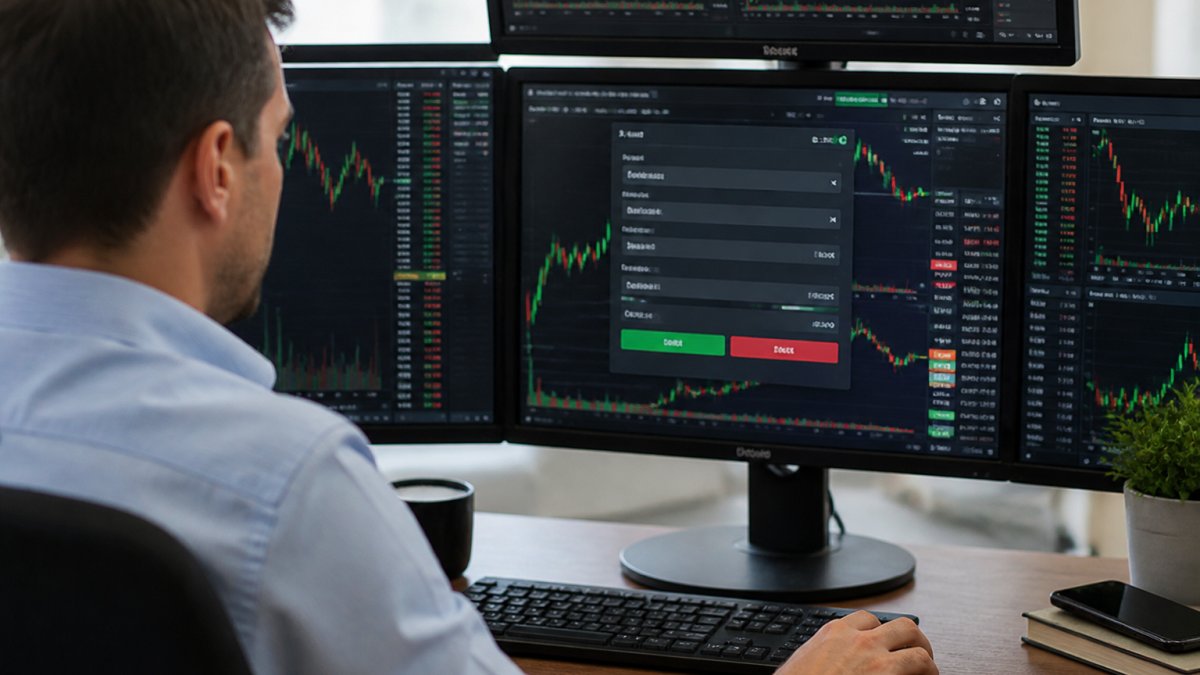
Step 1: Open Your Trading Platform
Log into your broker’s platform, web or mobile, the process is the same.
Step 2: Find the Gold Contract
Search for XAU/USD (spot gold) or GC (gold futures); your broker’s symbol lookup will find the right contract.
Step 3: Open the Order Entry Screen
Step 4: Select “Stop Loss” or “Stop Order”
Change the order type from “Market” to “Stop Loss” or “Stop Order” (some platforms say “Stop” or “Stop-Market”).
Step 5: Enter Your Stop Price
Type where you want the stop to execute, long at $2,050 risking $30 means entering $2,020. Double-check it; a typo costs real money.
Step 6: Enter Your Quantity
Specify your contract count. Start small, one micro contract is a good starting point.
Step 7: Review and Submit
Review order type, quantity, stop price, and direction, then click “Submit” or “Place Order.”
Step 8: Confirm Execution
Your stop loss is now active and should appear under “Open Orders” or “Pending Orders.” If gold hits your stop price, it executes automatically.
Interfaces differ, but the core steps are identical. Practice on a free demo account before trading real capital.
Common Mistakes and Risk Management Best Practices
Mistake 1: Stop Loss Too Close to Entry
Traders set stops 5-10 dollars from entry, then get stopped out by normal noise.
Solution: Match stop distance to volatility and session.
Mistake 2: Moving Your Stop Loss After Entry
Gold moves against you, you panic, and you move your stop further away, now risking $500 instead of $300. This defeats the purpose.
Mistake 3: Ignoring Gold’s Session Behavior
Gold trades 24/5, and each session differs:
- Asian session (11 PM-6 AM Eastern): Low volume, wide spreads, slow movement
- London session (3 AM-11:30 AM Eastern): High volume, sharp moves, tight spreads
- New York session (8 AM-5 PM Eastern): Highest volume, most volatility
A stop that works in quiet Asian hours is unrealistic in London. Your stops should reflect current conditions.
Mistake 4: Not Accounting for Slippage
A stop at $2,000 may exit at $2,000 in calm markets but $1,995 or lower when volatile.
Risk Management Best Practices
Practice 1: Risk a Fixed Percentage Per Trade
Decide your account risk before trading, commonly 1-2% per trade, or $100-$200 on a $10,000 account.
Practice 2: Set Your Stop Loss Before Entering the Trade
Decide entry and stop prices before you buy or sell, while you’re thinking clearly.
Practice 3: Use the Same Stop Distance Across Similar Trades
Consistency matters: use 25-30 dollar stops during London hours and 15-20 during Asian hours.
Practice 4: Track Your Stops
Keep a trading journal with entry price, stop price, actual exit price, and whether the stop executed or you exited manually.
Understanding how to set stop loss orders for gold is foundational to trading safely. Gold is volatile and moves quickly.
Frequently Asked Questions
How do you set a stop-loss order for gold?
To set a stop-loss order for gold, log into your trading platform, select a gold contract (typically XAU/USD), choose your entry price and position size, then enter a stop price below that entry point for long positions. Confirm the order type (standard stop or stop-limit), and submit. Most brokers allow you to set the stop when opening the position or add it after execution. Always verify the stop price is entered correctly before confirming.
Where should I place a stop-loss when trading gold?
Place your gold stop-loss below a recent swing low for long trades, or above a swing high for short trades. Gold’s typical daily volatility ranges from $5 to $15 per ounce depending on market conditions and session. Account for spreads (usually $0.30 to $0.50 on XAU/USD) so your stop isn’t triggered by normal price noise. Use technical support and resistance levels as anchors, and ensure your stop distance aligns with your account risk tolerance.
What is the difference between a stop-loss order and a stop-limit order?
A stop-loss order becomes a market order once the stop price is hit, guaranteeing execution but potentially at a worse price than your stop if gold gaps sharply. A stop-limit order converts to a limit order at your specified price, protecting you from slippage but risking no execution if gold gaps past your limit. For gold, stop-limit orders are safer during volatile sessions but may leave you exposed if the market gaps; standard stop orders execute but can slip in fast-moving conditions.
How do volatility and spread affect stop-loss distance for gold?
Gold volatility directly impacts how far your stop should be from entry. During calm sessions, a $10 stop distance may suffice; during high-volatility periods (such as around FOMC announcements), you may need $20 or more to avoid false triggers. Spreads also matter: if your broker’s XAU/USD spread is $0.50, set your stop at least $1.00 away from support to account for spread widening. Tighter stops increase the risk of premature exit; wider stops increase potential loss per trade.