
When to Buy and Sell Gold Assets: 2026 Guide
Table of Contents
- When to Buy and Sell Gold Assets: A Repeatable Process
- Gold Price Trends: What Actually Moves the Market
- The Best Time to Buy Gold for Your Portfolio
- The Best Time to Sell Gold: Signals and Scenarios
- Gold Selling Taxes and Recordkeeping
- Net Proceeds: The Number That Decides Buy or Sell
- Risk Management and Portfolio Allocation
- Conclusion: Build a Plan, Not a Prediction
- Frequently Asked Questions
Last Updated: October 12, 2026
When to Buy and Sell Gold Assets: A Repeatable Process
Most people asking when to buy and sell gold assets want a date or a signal. That moment does not exist reliably, and chasing it is how investors buy high and sell low.
This guide lays out a repeatable process for both sides of the trade: what moves gold prices, how to read the spot price and buy-sell spread, how taxes and fees eat into proceeds, and how to size gold within a portfolio.
Why Market-Peak Predictions Fail
Nobody rings a bell at the top. Gold hit record highs in recent years, and every time it does, commentary declares the peak has arrived.
The problem is structural: gold responds to inflation data, rate decisions, currency strength, and global uncertainty, often at once.
A better approach: decide in advance what would make you buy, and what would make you sell. Then follow your own rules.
The Five-Step Decision Framework
Use the same five steps whether buying or selling, to keep emotion out of the decision.
- Define your goal. Hedge against inflation? Diversify? Fund a near-term expense?
- Check your numbers. Current spot price, dealer premiums, and estimated net proceeds.
- Review market conditions. Inflation trend, interest rates, and the dollar’s strength.
- Compare your options. Hold, buy more, sell part, or sell all.
- Act on your plan. Not on a headline.
Write these steps down before you need them. A plan made in calm conditions beats a panicked decision.
Gold Price Trends: What Actually Moves the Market
Four forces drive most of gold’s price action: inflation, interest rates, the strength of the dollar, and fear.
Inflation, Interest Rates, and Economic Uncertainty
Gold has historically held value when inflation erodes purchasing power, but the relationship is not mechanical. When rates rise, bonds and savings pay more, and gold, which pays no yield, becomes less attractive.
Economic uncertainty cuts the other way: during crises, investors move toward stable stores of value, so gold demand tends to rise even when the economy looks weak.
How to Read the Spot Price and Buy-Sell Spread
The spot price is the current market price for one troy ounce of gold, before any dealer markup. It changes constantly during trading hours.
The buy-sell spread is the gap between what a dealer charges you to buy and what they’ll pay when you sell.
According to the World Gold Council’s guidance on gold pricing, the spot price reflects wholesale trading between major market participants, while retail buyers and sellers typically pay or receive something different once dealer costs are included.
The Best Time to Buy Gold for Your Portfolio
The best time to buy gold is when it fits your plan, not when the chart looks exciting. That usually means buying on a schedule rather than in one lump, but a schedule alone is not a strategy. You also need a target allocation, buy triggers, and a rule for when gold runs up or falls.
Start With a Target Allocation, Not a Price
Before buying a single ounce, decide what percentage of investable assets you want in gold. Most who use gold as a hedge keep it to a single-digit slice, then rebalance when it drifts.
If your target is 5% and gold’s rally pushes it to 8%, your plan says trim. If a pullback drops it to 3%, your plan says add.
Three Concrete Buy Triggers
- Your allocation has fallen below target. The most mechanical trigger: rebalancing forces you to buy when gold is out of favor.
- Real yields are falling. Gold pays no yield, so it looks more attractive when inflation-protected Treasuries return less. Negative real yields shrink gold’s opportunity cost.
- The dollar is weakening. Gold is priced in dollars, so a softer dollar often coincides with higher gold prices. A sustained drop in the dollar index signals building demand.
A fourth, softer trigger: inflation is rising faster than interest rates. When the gap between the two widens, gold has historically held value better than cash.
Dollar-Cost Averaging vs. Lump Sum
Dollar-cost averaging means buying a fixed dollar amount at regular intervals. It spreads your entry across many prices and removes the pressure to pick a bottom, the right default for most investors building a position over time.
A lump sum can make sense when you have a large amount of cash and your allocation is far below target. Lump-sum buying wins when prices rise; averaging wins when they fall.
What Most Guides Miss
A pullback is not automatically a bargain. If you own gold for long-term hedging, the entry date matters far less than owning it at all. The bigger risk is not buying slightly high, it is owning no gold when you need the hedge.
Set a fixed monthly or quarterly purchase amount and stick to it regardless of headlines. Investors who buy on a schedule avoid the two most common mistakes: buying everything at a peak and buying nothing while waiting for a dip.
The Buy, Hold, or Sell Decision in One Place
Use the same three questions whether adding, holding, or trimming:
- Is my allocation on target? If yes, hold. If below, buy. If well above, sell part.
- Has my reason for owning gold changed? If the hedge is no longer needed, that is a sell signal regardless of price.
- What are my net proceeds after costs? Never buy or sell without running the numbers.
That framework replaces “is now the right time?” with rules you can actually follow.
The Best Time to Sell Gold: Signals and Scenarios
The best time to sell gold is when your reason for holding it changes. That is a personal trigger, not a market one.
Sell when:
- You need the money for a planned expense
- Your gold allocation has grown well past your target
- You’re rebalancing toward other assets
Wait when:
Click Here To Order Your Copy →
- You’re selling only because the price dropped
- You haven’t calculated your net proceeds
- The sale is driven by fear or a headline
For investors comparing gold to modern alternatives, the same discipline applies. A balanced view of gold’s role, including how it stacks up against Bitcoin, helps you decide whether to sell, hold, or shift your allocation.
Gold Selling Taxes and Recordkeeping
Gold selling taxes depend on what you sold, how long you held it, and how it’s classified. In the U.S., gains on precious metals are generally treated as collectibles for tax purposes, which can mean a higher rate than standard long-term capital gains.
Good recordkeeping makes this manageable. Keep:
- Purchase receipts with dates and prices
- Dealer statements for every buy and sell
- Shipping and insurance costs
The IRS guidance on capital gains and collectibles is the place to verify current treatment before you file.
Net Proceeds: The Number That Decides Buy or Sell
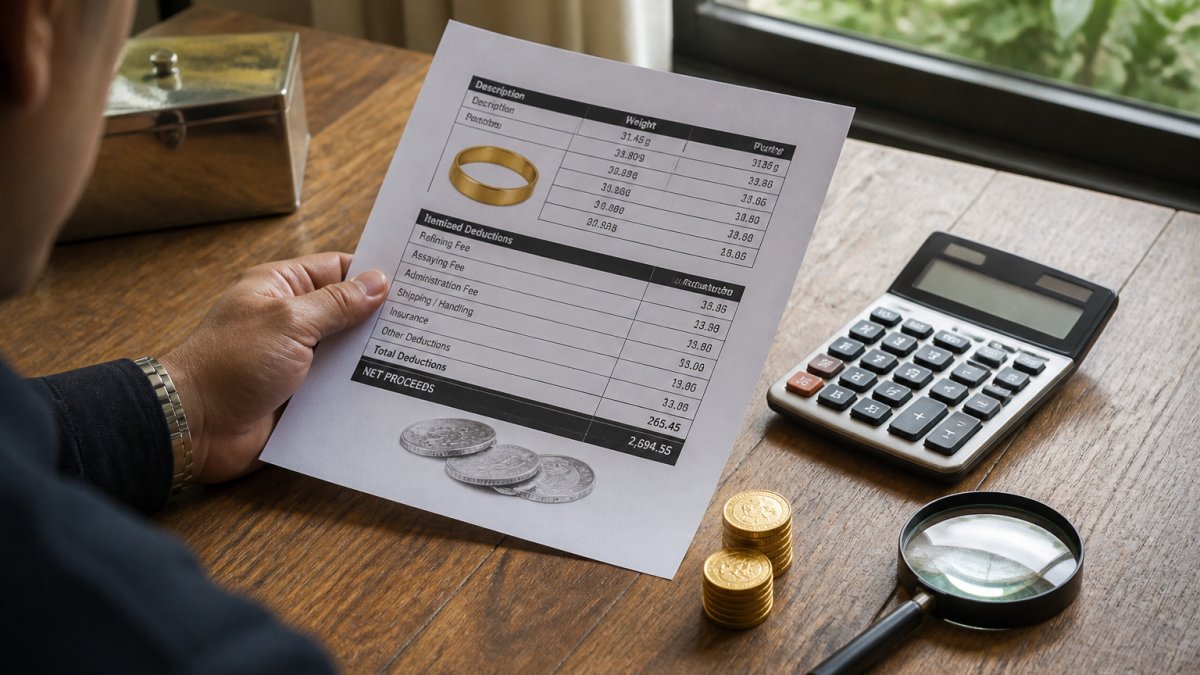
Net proceeds are what you actually keep after every cost is subtracted. This number matters more than the headline price, and most sellers never calculate it before agreeing to a deal.
The Net Proceeds Formula
Net proceeds = (quantity × payout price per unit) − selling costs − taxes owed
Every term in that equation is negotiable or avoidable except the market price. Work the formula before accepting any offer.
Transaction Costs, Dealer Premiums, and Fees
Every gold transaction carries costs. Add these up before you decide:
| Cost | What It Is | Why It Matters |
|---|---|---|
| Dealer premium | Markup over spot when buying | Raises your break-even price |
| Buy-sell spread | Gap between buy and sell prices | Cuts into your exit value |
| Refining or assay fee | Charged on some scrap or jewelry | Reduces payout on melt value |
| Shipping and insurance | Cost to send items to a buyer | Common with online buyers |
| Taxes | Applied to gains where owed | Lowers your final return |
A Worked Example
Suppose you sell one 1-ounce gold bullion coin. Spot is $2,400. A local dealer quotes 97% of spot, or $2,328. An online buyer quotes 99%, or $2,376, but charges $30 for insured shipping.
Now add tax. If you held the coin more than a year and it is classified as a collectible, the gain is taxed at your marginal rate up to a maximum of 28%, not the standard long-term capital gains rate.
Taxes and Recordkeeping
Gold selling taxes depend on what you sold, how long you held it, and how it is classified.
Good recordkeeping makes this manageable. Keep:
- Purchase receipts with dates and prices
- Dealer statements for every buy and sell
- Shipping and insurance costs
Your cost basis, what you originally paid, including premiums and fees, determines your taxable gain. The IRS guidance on capital gains and collectibles is the place to verify current treatment before you file.
Jewelry, Bullion, and Collectible Coins: Different Rules
Not all gold sells the same way, and the net-proceeds math changes with the asset type.
- Jewelry usually sells near melt value, minus refining costs. Design and brand rarely add much, so expect a wider effective spread.
- Bullion (bars and standard coins) trades close to spot, with a narrow spread, net proceeds come closest to the quoted price.
- Collectible coins can carry numismatic value far above melt, but only to the right buyer. An appraisal matters, and the buyer pool is smaller.
For collectibles, get an appraisal before selling. For bullion, spot and spread tell most of the story. For jewelry, weigh the metal and check the karat before accepting a melt offer.
Selling to the first dealer who quotes you is the most common way to lose money on a gold sale. Get multiple offers from local dealers and online buyers, then compare net proceeds, not just the advertised price.
Run the net-proceeds formula on every offer before you commit. The highest quoted price is not always the highest payout once shipping, refining, and taxes are subtracted.
Risk Management and Portfolio Allocation
Gold works best as one part of a diversified portfolio, not the whole thing.
This is where buy-and-hold beats timing. Rebalancing forces you to sell a little when gold has run up and buy when it has fallen, the opposite of instinct.
Risk to watch: gold can stay flat for years. It pays no dividend or interest. Own it for the role it plays, not a quick return.
Conclusion: Build a Plan, Not a Prediction
The question of when to buy and sell gold assets has no single right answer, but it has a right process: define your goal, run the five steps, calculate net proceeds, and let your allocation guide the decision.
If you want the full picture, from gold’s history and supply-demand dynamics to how it compares with Bitcoin and silver, My Gold Book’s GOLD: The Most Precious of Metals, by researcher Douglas Ginter, gives you the research to decide with confidence.
Frequently Asked Questions
Is it a good time to buy or sell gold right now?
There is no single right answer because the decision depends on your goals, not the calendar. If gold is more than 10% of your portfolio, trimming back toward your target allocation is reasonable. If you hold no gold and want a hedge against inflation, dollar-cost averaging over several months reduces the risk of buying at a short-term high. Check the current spot price, the buy-sell spread at two or three dealers, and your net proceeds before acting.
Does the IRS know if I sell gold?
Dealers must report certain transactions to the IRS on Form 1099-B. This generally applies to sales of specific bullion coins, bars, and 1-ounce or larger gold coins when the proceeds cross the reporting threshold. Jewelry and smaller items usually fall outside the reporting rules, but you are still required to report capital gains on your tax return. Keep your purchase receipts and sale records so your cost basis is documented if the IRS asks.
What factors should I consider before buying gold?
Start with your portfolio allocation: many advisors suggest keeping precious metals to 5% to 10% of investable assets. Then compare the buy-sell spread across dealers, since a wide spread eats into returns. Decide on the form you want, such as bullion bars for low premiums, coins for liquidity, or jewelry for personal use. Finally, plan storage and insurance, because these ongoing costs affect your real return on investment over time.
Should I sell gold when prices reach a new high?
A new high is a signal to review, not an automatic sell order. Ask three questions: Has gold drifted above your target allocation? Do you have a financial need that the sale would cover? Is the net proceeds figure, after dealer premiums and any capital gains tax, better than holding? If you answer yes to two of those, selling a portion makes sense. If not, a buy-and-hold approach with periodic rebalancing usually serves long-term investors better than timing the market.
Gold markets will keep moving, and headlines will keep predicting peaks and crashes. You don’t need to predict either one. You need a plan you can follow when prices swing and emotions run high. My Gold Book gives you the history, the economics, and the honest comparison to build that plan, with clear research on gold’s role in a portfolio and how it stacks up against modern alternatives. Get started with My Gold Book and make your next gold decision with evidence instead of guesswork.