
What Is Numismatic Value in Gold Coins? Explained
Table of Contents
- Numismatic Value vs. Intrinsic Metal Value
- Bullion vs. Numismatic Coins: Key Differences
- How to Grade Gold Coins: Condition, Finish, and Certification
- What Makes a Gold Coin Rare: Mintage, Mintmarks, and Scarcity
- Liquidity, Authentication, and Tax Rules for Numismatic Gold
- How to Get a Gold Coin Appraised for Its Numismatic Worth
- Frequently Asked Questions
Last Updated: September 15, 2026
Numismatic Value vs. Intrinsic Metal Value
Numismatic value is the premium a gold coin commands above its melt value because of rarity, condition, historical significance, and collector demand. A coin’s total price equals its intrinsic metal value plus that numismatic premium, and for many collectible coins the premium dwarfs the gold itself.
This guide from My Gold Book breaks down how that premium forms, how to measure it, and where collectors get burned. If you have ever wondered why two gold coins with identical metal content sell for wildly different prices, the answer lives in the gap between intrinsic metal value and numismatic premium.
The distinction matters because the two components behave nothing alike. Gold’s spot price moves with global markets and reacts to inflation and currency strength. The numismatic premium moves with collector demand, which can surge or vanish based on taste, fashion, and the health of the broader economy. One is a commodity; the other is a market of people.
How the Numismatic Premium Is Calculated
The premium is the coin’s fair market value minus its intrinsic metal value. If a coin contains a quarter-ounce of gold and spot price is a given figure per ounce, the melt value is one quarter of that. Everything above it is numismatic premium.
A common approach is to express the premium as a percentage. A coin trading at double its melt value carries a 100% numismatic premium. Serious collectors track this ratio because it tells them how much of the price is metal and how much is sentiment. When the ratio climbs, you are paying more for story and less for substance.
Bullion vs. Numismatic Coins: Key Differences
Bullion coins are valued primarily by their precious metals content and trade close to spot price. Numismatic coins carry collector demand on top of metal value, and that demand is what separates a coin worth its weight from one worth many multiples of it.
The practical difference shows up the moment you try to sell. Bullion moves quickly at a price tied to the spot market. Numismatic coins require a buyer who wants that specific coin, in that specific condition, at that specific moment. That is the trade-off: potential market appreciation against slower, less certain liquidity.
Side-by-Side Comparison: Bullion and Numismatic Gold
| Factor | Bullion Coins | Numismatic Coins |
|---|---|---|
| Primary value driver | Spot price of gold | Rarity, condition, collector demand |
| Premium over melt | Low, typically modest | Can be many multiples of melt |
| Liquidity | High, easy to sell | Variable, buyer-dependent |
| Grading impact | Minimal | Central to price |
| Best for | Metal exposure and hedging | Collectors and long-term appreciation |
Bullion is a metals play. Numismatic gold is a people play. Know which one you are actually buying before you wire funds.
How to Grade Gold Coins: Condition, Finish, and Certification
Coin grading is the standardized assessment of a coin’s condition, and it drives numismatic value more than almost any other factor. Graders examine surface preservation, strike quality, luster, and signs of wear or cleaning, then assign a score on a recognized scale.
That scale is the Sheldon 1-70 scale, and it is the common language of the market. A coin graded 70 is theoretically flawless; 60 marks the bottom of Mint State (uncirculated); anything below 60 falls into About Uncirculated, Extremely Fine, and downward (usmint.gov). The practical consequence is that the same coin can swing in value by multiples of its melt price across a handful of grade points, and the jump between 64 and 65 on a key date can be larger than the jump between 60 and 64.
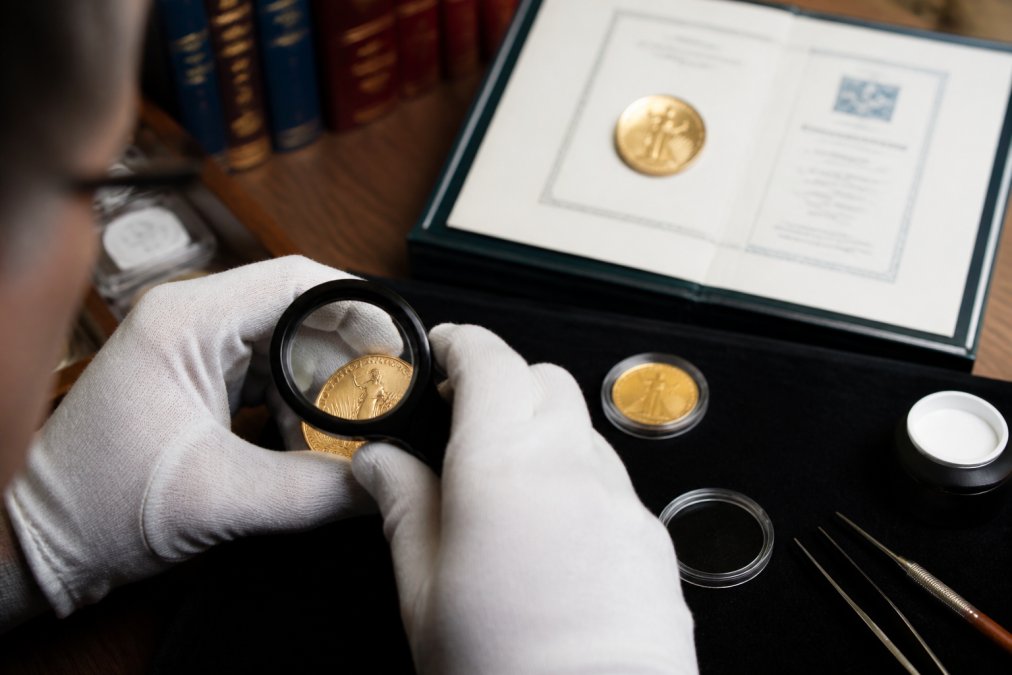
Third-party certification adds credibility. A coin sealed in a holder from a recognized grading service carries a grade that buyers trust, which widens the pool of potential purchasers and typically supports a higher price. The two names most collectors encounter are PCGS (Professional Coin Grading Service) and NGC (Numismatic Guaranty Company); both encapsulate coins in tamper-evident holders with a unique certification number you can verify in their online population reports. Those population reports matter because they tell you how many examples of a given coin and grade exist in that service’s census, a low population in a high grade is a strong signal of scarcity. Uncertified coins sell at a discount because every buyer must independently assess the risk.
Finish matters too. Proof coins, struck with polished dies and planchets, carry mirror-like fields that collectors prize. Uncirculated coins show no wear from circulation but may still lack the finish of a proof strike. Both command premiums over circulated examples. A related distinction is the difference between a coin that is genuinely uncirculated and one that has been cleaned, dipped, or otherwise altered, cleaning strips original luster and can knock a coin down several grade points or render it ‘details’ graded, meaning it is authenticated but not numerically graded.
A common mistake is assuming a high grade guarantees value. It does not. A flawless coin from a high-mintage year can still be common. Condition amplifies rarity; it does not create it.
Click Here To Order Your Copy →
Before you pay a premium for a certified coin, look up its certification number on the grading service’s website and check the population report. A high grade with a large population is not the same as a high grade with a small one.
What Makes a Gold Coin Rare: Mintage, Mintmarks, and Scarcity
Rarity comes from low mintage, specific mintmarks, survival rates, and collector demand converging on the same coin. A low mintage figure alone does not guarantee numismatic rarity, because many coins were melted or lost over time, and the surviving population is what actually matters.
Mintage is the number of coins struck in a given year. A mintmark identifies where a coin was produced, and certain mintmarks from certain years are far scarcer than others. When a low mintage year also carries an uncommon mintmark, scarcity compounds.
Historical significance adds another layer. Coins tied to a specific era, design change, or event attract collectors who value the story as much as the metal. That narrative demand can hold a premium even when the mintage is not especially low.
Supply and demand govern the rest. A scarce coin with no collector interest sits unsold. A common coin with intense demand can climb. Numismatic rarity is never just a number; it is a number meeting a market.
Liquidity, Authentication, and Tax Rules for Numismatic Gold
Liquidity is the risk most buyers underestimate. Numismatic coins can take weeks or months to sell at a fair price, and a rushed sale usually means accepting a discount. Bullion converts to cash quickly; collectible gold does not. The gap is structural: bullion has a deep, continuous two-way market tied to spot, while a numismatic coin needs a buyer who wants that specific date, mintmark, and grade. Auction houses and specialist dealers can move rare coins, but they charge seller’s commissions and may take weeks to settle. If you may need the money on short notice, that illiquidity is a real cost, not a footnote.
Authentication protects you from the counterfeit problem. Counterfeit gold coins exist, and some are convincing, tungsten cores plated with gold, cast copies of key dates, and altered mintmarks are all documented. Third-party certification and a verifiable holder reduce that risk substantially, because the grading service has already authenticated the coin and assigned it a certification number you can check. For raw coins, dealers and serious collectors use tools like specific gravity testing, X-ray fluorescence (XRF), and conductivity meters such as the Sigma Metalytics line to screen for fakes. Before any significant purchase, confirm the coin’s certification and, where possible, its provenance, the documented chain of ownership, which for high-value pieces may include auction records.
Tax treatment deserves its own conversation with a qualified professional, because it depends on your situation.
Buying an uncertified coin at a certified price is the fastest way to lose money in this market. If the seller cannot document the grade, price it as raw metal, and if the deal requires speed or pressure, walk away.
Numismatic gold is an illiquid, authentication-sensitive, tax-advantaged-or-not asset depending on how you hold it. Price the liquidity discount and the tax drag into your expected return before you buy.
How to Get a Gold Coin Appraised for Its Numismatic Worth
Frequently Asked Questions
What is the difference between numismatic value and bullion value?
Bullion value is the melt value of a coin’s gold content, calculated from the current spot price. Numismatic value is the additional premium collectors pay based on rarity, condition, mintage, and demand. A $20 Saint-Gaudens double eagle might carry a bullion value tied to roughly one ounce of gold, but a well-preserved example can sell for multiples of that because of its numismatic premium. The two values move independently: bullion tracks metals markets, while numismatic value tracks collector demand.
Are numismatic gold coins a good investment compared to bullion?
They serve different purposes. Bullion coins are liquid and track the spot price of gold closely, so they work well for portfolio diversification and inflation hedging. Numismatic coins can appreciate faster during strong collector markets, but they carry liquidity risk: selling takes longer and the buyer pool is smaller. Authentication costs, grading fees, and dealer spreads also cut into returns. Many investors hold both, treating bullion as the core position and numismatic coins as a smaller, research-intensive allocation.
How is the numismatic value of a gold coin determined?
Four factors drive it: rarity (mintage numbers and survival rates), condition (graded on the 1-70 scale by third-party services), historical significance (date of issue, mintmark, and context), and collector demand at the time of sale. Two identical coins from the same year can differ by thousands of dollars if one grades MS-65 and the other MS-63. Auction records for comparable specimens are the most reliable benchmark, which is why certification from a recognized grading service matters so much.
Do all gold coins have numismatic value?
No. Most modern bullion coins, such as recently minted American Gold Eagles, trade at a small premium over spot and have little numismatic value because millions were struck and survive in uncirculated condition. Numismatic value typically appears in older coins with low mintages, key dates, mintmark varieties, or exceptional preservation. A 1907 High Relief double eagle and a 2024 bullion Eagle contain similar gold, but only one carries a numismatic premium worth paying for.