
History of Gold as Currency: From Ancient Trade to Modern Investment
Table of Contents
- Why Humans Chose Gold as Currency
- The Lydian Influence and King Croesus
- Gold as a Store of Value Across Centuries
- Understanding the Gold Standard and Its Impact
- When Did the US Leave the Gold Standard
- Fiat Currency vs Gold Standard: The Modern Shift
- Why Gold Is a Hedge Against Inflation
- Gold vs. Crypto and Digital Assets Today
Last Updated: August 8, 2026
Why Humans Chose Gold as Currency
Gold became humanity’s preferred medium of exchange because it possesses unique physical properties no other naturally occurring metal can match. Before standardized currency, trade relied on barter, which collapsed at scale, a farmer with wheat couldn’t easily find someone who had exactly what they needed and wanted exactly what they offered. Gold solved this problem completely. Unlike grain, it doesn’t rot. Unlike land, it’s portable. Unlike shells or beads, it’s scarce enough to maintain value but abundant enough to facilitate commerce.
The history of gold as currency reveals something deeper than economics: humans instinctively trust gold. This trust emerged organically across continents, in cultures with no contact with each other. Egyptians, Lydians, Chinese, and Mesoamericans all independently concluded that gold held value. That convergence wasn’t coincidence.
Physical Properties That Made Gold Ideal
Gold possesses four properties uniquely suited as a medium of exchange. Scarcity ensures gold retains value, you cannot mine unlimited quantities, preventing the debasement that destroys other currencies. Durability means gold doesn’t degrade; a gold coin from ancient Rome maintains its integrity today, allowing it to function as a store of value across generations. Divisibility allows gold to serve as a unit of account; you can divide gold into smaller pieces without destroying its value, enabling commerce at all scales. Recognizability means people immediately identify gold and trust its value; even ancient traders could distinguish real gold from counterfeits with reasonable confidence.
These four properties exist nowhere else in nature in this combination. Silver comes closest, which explains why silver served as a secondary currency in many societies, but gold’s superior scarcity and durability made it the preferred choice.
Gold in Ancient Civilizations
The earliest evidence of gold’s use as currency appears in ancient Egypt around 3000 BCE. Egyptian tombs contain gold artifacts, and hieroglyphic records document gold’s role in trade and tribute. In Mesopotamia, Sumerian and Akkadian traders used gold as a medium of exchange by 2500 BCE, with archaeological evidence showing gold bars and ingots served as standards for valuing goods. China’s history of gold as currency extends back to at least 1000 BCE, with Chinese dynasties minting gold coins and establishing official standards for purity.
What unites all these civilizations is that they independently recognized gold’s superiority. No culture was forced to adopt gold as currency; each discovered through experience that gold solved real problems in commerce better than alternatives.
The Lydian Influence and King Croesus
The Lydian kingdom, located in what is now western Turkey, made a crucial contribution: they invented the minted coin. Before Lydia, gold and silver circulated as ingots and bars, requiring merchants to weigh and test every transaction. Around 600 BCE, King Croesus introduced stamped coins with an official mark guaranteeing weight and purity, eliminating the need to verify authenticity repeatedly.
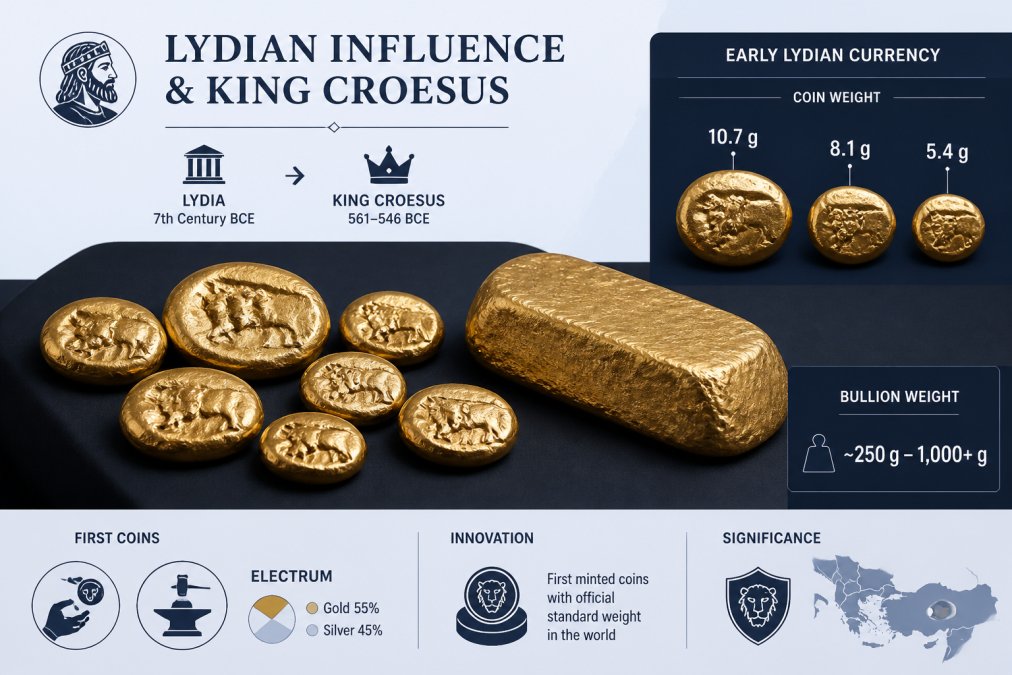
Croesus became legendary for his wealth, and his name entered Western vocabulary as a synonym for richness. His coins circulated throughout the Mediterranean, establishing Lydia as the center of a new monetary system. This innovation didn’t invent gold’s value; it unlocked gold’s potential as currency by reducing transaction costs dramatically. Minting led to standardization, which led to wider acceptance, which led to more commerce, a virtuous cycle that continues today.
Gold as a Store of Value Across Centuries
The defining characteristic separating gold from other commodities is its ability to preserve purchasing power across decades and centuries. A gold coin from 1500 CE still contains the same amount of gold today. This property becomes critical during economic instability. When governments debase currencies by mixing cheaper metals into coins or printing excess paper money, the currency’s value collapses. Gold maintains its value because its supply cannot be arbitrarily increased.
Historical evidence supports this relationship: empires that maintained sound gold-based currencies experienced longer periods of economic stability than those that debased their currencies. Rome’s economy remained stable when emperors maintained gold content in coins; it deteriorated when they reduced it. Families accumulated gold specifically because it served as a store of value across generations, with intergenerational trust in gold’s value unique among commodities.
Understanding the Gold Standard and Its Impact
The gold standard represents the most direct application of gold’s properties to a national monetary system. Under a gold standard, a nation’s currency is directly backed by gold held in reserves, with one unit of currency equaling a fixed amount of gold. Britain adopted an informal gold standard in the late 1600s and formalized it in the 1700s; by the 1800s, most major economies operated on some form of gold standard.
The gold standard created several important effects. First, it limited government spending, a government couldn’t print unlimited currency because it had to maintain gold reserves equal to the currency in circulation. Second, it facilitated international trade by linking currencies to gold at fixed rates, allowing merchants to know exactly what foreign currency was worth. Third, it created a self-correcting mechanism for trade imbalances: if one nation imported more than it exported, gold flowed out, reducing the money supply and making exports more competitive.
However, the gold standard also created constraints during economic crises. When unemployment rose or production fell, governments couldn’t increase the money supply to stimulate the economy. This rigidity contributed to the severity of economic downturns, most notably the Great Depression.
When Did the US Leave the Gold Standard
The United States maintained a gold standard from 1879 until 1933, then maintained a modified version until 1971. In 1933, President Franklin D. Roosevelt suspended citizens’ ability to exchange paper dollars for gold during the Great Depression, when banks faced runs and people rushed to convert currency into gold. However, the United States maintained a gold standard for international purposes, foreign governments could still exchange dollars for gold at a fixed rate of $35 per ounce under the Bretton Woods system formalized in 1944.
The critical break came in 1971 when President Richard Nixon suspended the Bretton Woods system. Foreign governments could no longer exchange dollars for gold, and the US dollar became a fiat currency backed by government decree rather than precious metal reserves. The United States had been losing gold reserves steadily throughout the 1960s as other nations redeemed dollars for gold; Nixon’s decision prevented complete depletion of American reserves and allowed greater monetary policy flexibility.
Fiat Currency vs Gold Standard: The Modern Shift
Fiat currency, money backed by government authority rather than precious metal, represents a radical departure from monetary systems that dominated human history. A gold standard imposes discipline on government spending, governments cannot spend more than they collect in taxes plus what they can borrow. Fiat currency removes this constraint, allowing governments to print as much money as they want, limited only by political will.
Click Here To Order Your Copy →
This flexibility allows governments to spend during economic downturns without waiting for tax revenue, enabling stimulus spending that can reduce unemployment. However, fiat currency vs gold standard reveals a critical tradeoff: flexibility comes at the cost of restraint. Without gold backing, nothing prevents a government from printing unlimited money. Throughout history, governments that abandoned metallic currencies eventually printed excessively, causing inflation that destroyed currency value.
The United States has managed fiat currency more responsibly than most nations. The Federal Reserve, while not bound by gold reserves, has generally exercised restraint in money printing, keeping inflation moderate and the dollar strong. The practical difference: a gold standard forces responsibility through physical constraint, while fiat currency depends on institutional discipline and political judgment.
Why Gold Is a Hedge Against Inflation
Inflation erodes the purchasing power of money. Gold maintains value during inflation because its supply cannot be arbitrarily increased. When a government prints excess currency, inflation results, but printing more currency doesn’t create more gold. The amount of gold in the world increases only through mining, limited by geology and economics. This fixed supply means gold’s value relative to other goods remains stable even as currency loses value.
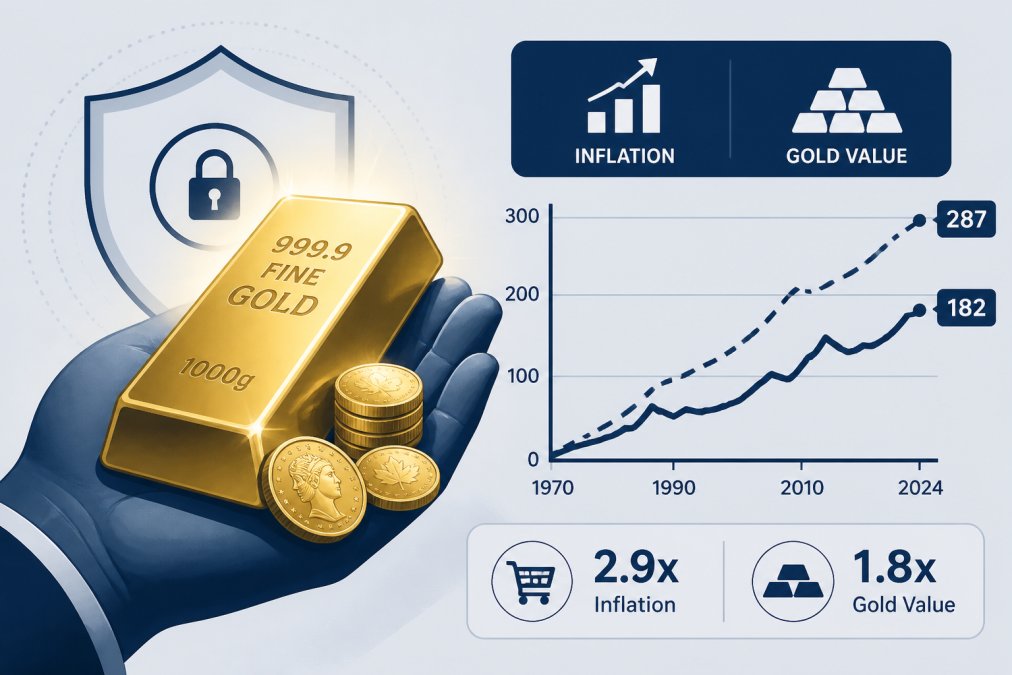
Historical data supports this relationship. During the 1970s, when US inflation reached double digits, gold prices surged from $35 per ounce to over $800 per ounce. Investors who held gold preserved their purchasing power; those who held only dollars saw their savings eroded. When currency becomes less valuable, people seek alternatives and buy gold, increasing demand and driving prices higher. This increased price reflects the declining value of the currency, not an increase in gold’s intrinsic value.
However, during periods of low inflation and stable currency, gold may not outperform other investments. This reality explains why sophisticated investors maintain a balanced portfolio rather than holding only gold.
Gold vs. Crypto and Digital Assets Today
The emergence of Bitcoin and other cryptocurrencies has prompted investors to reconsider gold’s role in a modern portfolio. Cryptocurrencies share some properties with gold: Bitcoin has a fixed supply cap of 21 million coins, mirroring gold’s physical scarcity. They are divisible, portable, and can serve as a medium of exchange, offering advantages over gold in instant global transfers and programmable properties.
However, gold vs. crypto reveals critical differences. Gold has 5,000 years of history demonstrating its value across civilizations, currencies, and centuries. Bitcoin has existed for 16 years. Gold’s value is based on physical properties and universal human recognition; Bitcoin’s value depends on network effects and collective belief. If people stop believing Bitcoin is valuable, it becomes worthless, while gold’s value cannot collapse the same way.
From a practical standpoint, gold works best as a long-term store of value and inflation hedge, while cryptocurrencies work better as a medium of exchange for digital transactions. An investor might hold both: gold for stability and long-term wealth preservation, Bitcoin for exposure to digital innovation. Gold’s 5,000-year track record creates confidence that no digital asset has yet earned.
The history of gold as currency reveals a consistent truth: humans recognize and trust gold’s value because of its unique physical properties, not because governments mandate its use. From ancient Egypt to modern portfolios, gold has served as a reliable store of value and medium of exchange.
If you’re exploring gold’s role in your investment strategy, understanding this history provides essential context. My Gold Book‘s comprehensive guide, "GOLD: The Most Precious of Metals" by Douglas Ginter, offers deeper insights into how gold functions as an inflation hedge, its comparison to modern digital assets, and practical guidance for collectors and investors. The book delivers balanced analysis of gold’s historical significance and contemporary relevance, helping you make informed decisions about whether gold belongs in your portfolio.
| Concept | Definition | Key Takeaway |
|---|---|---|
| Medium of Exchange | A commodity accepted universally in trade | Reduces transaction friction in commerce |
| Store of Value | An asset that maintains purchasing power | Protects wealth across time periods |
| Unit of Account | A standard for pricing goods | Enables consistent valuation across transactions |
| Fiat Currency | Money backed by government authority, not metal | Provides flexibility but requires institutional discipline |
| Gold Standard | Currency directly backed by gold reserves | Creates monetary discipline but limits economic flexibility |
| Inflation Hedge | An asset that maintains value during inflation | Gold’s fixed supply protects against currency debasement |
Frequently Asked Questions
When did humans first start using gold as currency?
Gold emerged as a medium of exchange in ancient civilizations around 3000 BCE, with the Lydians in modern-day Turkey credited with creating the first standardized gold coins around 600 BCE under King Croesus. These early coins established gold's role as a reliable store of value and unit of account, setting the foundation for its use as currency across trade routes and civilizations for millennia.
When did the US leave the gold standard, and why?
The United States officially abandoned the gold standard in 1971 under President Richard Nixon, ending the Bretton Woods system that had tied the dollar to gold since 1944. This shift occurred because the US gold reserves could no longer support the dollar's value amid inflation and trade deficits. The transition marked a move toward fiat currency, where money's value is backed by government authority rather than physical precious metals.
What's the difference between fiat currency and the gold standard?
Under the gold standard, currency had direct backing by physical gold reserves held by central banks, giving money intrinsic value tied to a commodity. Fiat currency, by contrast, has no commodity backing and derives its value from government decree and market confidence. Fiat allows greater monetary flexibility but removes the automatic restraint on inflation that gold backing provided, making gold attractive as a hedge against currency devaluation.
Why is gold considered a hedge against inflation?
Gold maintains purchasing power during inflationary periods because its scarcity and durability give it intrinsic value independent of monetary policy. As fiat currencies lose value through inflation, gold's limited supply means its price typically rises with inflation, preserving wealth. Investors use gold as a hedge because it historically moves inversely to currency debasement and monetary expansion, protecting savings from erosion of purchasing power.
Is gold still used as currency today?
Gold is no longer legal tender for everyday transactions in most countries, but it remains a form of money in economic terms. Central banks worldwide hold gold as reserve currency to back their monetary systems and maintain financial stability. Individual investors and collectors treat gold as a store of value and wealth preservation tool, making it functionally similar to currency even though it's classified as a commodity in modern financial markets.
How does gold compare to Bitcoin and other cryptocurrencies as an investment?
Gold offers centuries of proven value stability and universal acceptance, with physical scarcity and no counterparty risk. Bitcoin and crypto assets offer portability and modern transaction efficiency but lack the historical track record and tangible backing of gold. Gold's value is driven by supply-demand fundamentals and inflation expectations, while crypto prices depend heavily on sentiment and adoption rates, making gold a more conservative hedge for long-term wealth preservation.
This article was written using GrandRanker