
Gold vs. Bitcoin for Inflation: Which Hedge Works Best
Table of Contents
- Defining Inflation Hedges: Gold and Bitcoin Compared
- Historical Performance of Gold vs. Bitcoin as Inflation Protection
- Bitcoin Volatility vs. Gold Stability During Economic Uncertainty
- Store of Value and Safe-Haven Status: How They Differ
- Tax Implications and Custody Risks
- Portfolio Allocation Strategy: Combining Both Assets
- Which Inflation Hedge Is Right for You?
Last Updated: August 14, 2026
Defining Inflation Hedges: Gold and Bitcoin Compared
An inflation hedge is an asset purchased with the expectation that its value will rise faster than inflation, protecting purchasing power over time. Gold has served as a store of value for millennia with physical, verifiable scarcity. Bitcoin is a digital asset with a hard-coded supply cap of 21 million coins, enforced by cryptographic consensus. Both claim to protect against currency debasement, yet operate through fundamentally different mechanisms.
The inflation hedge debate hinges on a critical distinction: historical track record versus theoretical design. Gold’s inflation-protection properties have been tested across centuries and multiple economic cycles. Bitcoin’s inflation hedge credentials remain largely theoretical, tested only through a single decade of volatile price discovery.
At My Gold Book, we’ve analyzed how gold and bitcoin each respond to inflationary pressures. Our comprehensive guide, "GOLD: The Most Precious of Metals," by researcher Douglas Ginter, provides a balanced assessment of gold’s role as an inflation hedge compared to modern digital assets. The comparison reveals that neither asset is universally superior; the choice depends on your risk tolerance, time horizon, and portfolio construction.
Gold and bitcoin both claim to hedge inflation, but gold relies on physical scarcity and historical precedent, while bitcoin relies on mathematical scarcity and network consensus. The choice between them depends on whether you prioritize stability or potential upside.
Historical Performance of Gold vs. Bitcoin as Inflation Protection
Gold’s track record as an inflation hedge spans centuries. During the 1970s stagflation in the United States, when consumer prices rose significantly while economic growth stalled, gold prices increased substantially, demonstrating its ability to preserve purchasing power when traditional equities and bonds underperformed.
Bitcoin’s history is far shorter. From 2021 to 2023, when inflation rose sharply in the United States, bitcoin’s price declined significantly, falling from nearly $69,000 to around $16,500 by late 2022. This performance contradicted the inflation-hedge narrative many proponents had promoted. Bitcoin’s supporters argue that a single cycle is insufficient to judge an asset’s long-term hedging properties, and that the 2022 decline reflected broader monetary tightening rather than inflation specifically.
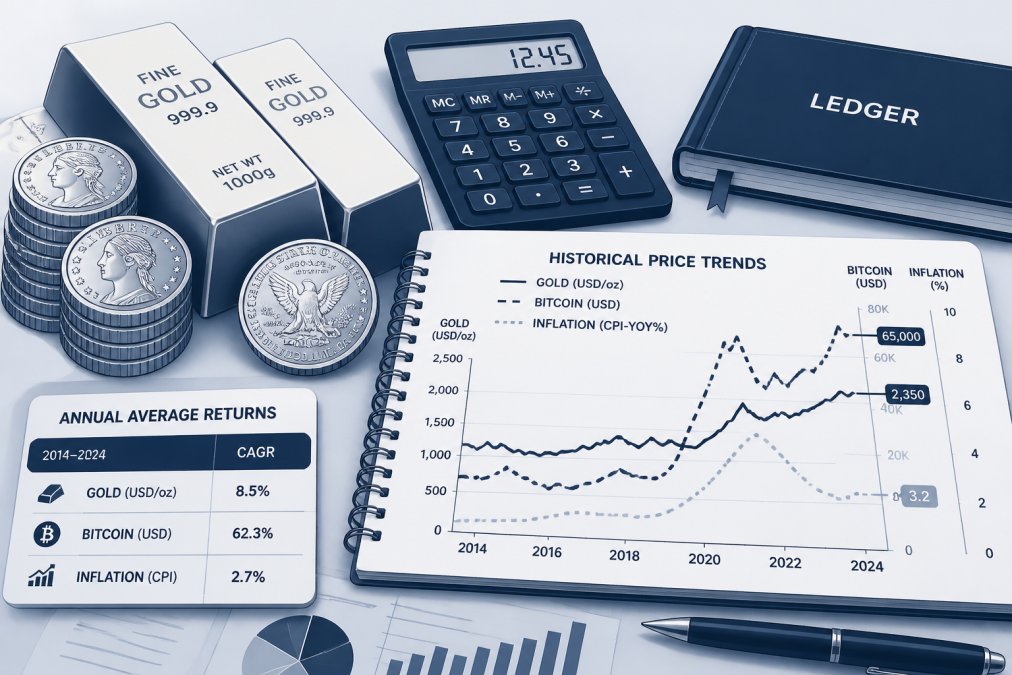
Gold’s inflation protection is demonstrated across multiple decades and various inflation regimes. Bitcoin’s inflation protection remains a hypothesis supported by its design but not yet validated across a full economic cycle where inflation rose while other risk assets remained stable. When inflation accelerated in 2021-2022, bitcoin fell alongside equities, suggesting it behaves more like a risk asset than a safe-haven inflation hedge.
If your goal is to hedge inflation with high confidence based on historical evidence, gold has the longer track record. If you’re willing to accept that bitcoin might eventually prove itself as an inflation hedge despite limited historical data, bitcoin offers potential upside that gold does not.
Bitcoin’s single test as an inflation hedge, the 2021-2023 period, showed it declining when inflation rose and the Federal Reserve tightened policy. Do not assume bitcoin’s theoretical design automatically translates to real-world inflation protection without more historical data.
Bitcoin Volatility vs. Gold Stability During Economic Uncertainty
Volatility is the statistical measure of how much an asset’s price fluctuates over time. This distinction is crucial when evaluating inflation hedges, because the purpose of a hedge is to reduce risk, not introduce it.
Gold’s volatility is moderate and predictable. During major economic shocks, financial crises, or geopolitical tensions, gold typically becomes more stable relative to equities and bonds. Investors fleeing risk often move into gold, creating demand that supports prices even as other assets collapse. This safe-haven characteristic is one reason central banks hold gold as a reserve asset.
Bitcoin’s volatility is extreme. Daily price swings of 5-10 percent are common. During the 2022 crypto market collapse, bitcoin fell over 65 percent from its peak. This volatility creates a paradox: if you buy bitcoin to hedge inflation, you might experience losses so severe that they overwhelm any inflation protection you gain.
The volatility difference reflects different market structures. Gold trades in mature, liquid markets with centuries of price history. Bitcoin trades in younger, less liquid markets dominated by speculative traders. For investors seeking stability during economic uncertainty, gold’s lower volatility is a decisive advantage.
If your inflation hedge causes you to panic-sell during a market crash, it’s not protecting you, it’s destabilizing your portfolio. Gold’s lower volatility makes it easier to hold through uncertainty, which is precisely when you need the hedge most.
Store of Value and Safe-Haven Status: How They Differ
A store of value is an asset that maintains purchasing power over time without degrading. A safe-haven asset is one that increases in value or holds steady when broader financial markets decline.
Gold functions as both. Physically, gold does not corrode or degrade. When financial markets crash or geopolitical tensions escalate, investors historically move capital into gold, creating demand that supports or increases prices. This safe-haven characteristic is why central banks hold gold reserves and why gold prices often rise during stock market declines.
Bitcoin’s store-of-value properties depend entirely on network consensus and adoption. Bitcoin has not yet demonstrated safe-haven characteristics during systemic financial crises. In 2008, gold rose while equities crashed. In 2020, bitcoin initially fell alongside equities before recovering. In 2022, bitcoin fell as the Federal Reserve tightened policy, alongside equities.
Gold’s safe-haven status is proven and consistent. Bitcoin’s safe-haven status remains theoretical and unproven. Bitcoin remains correlated with risk assets (equities, high-yield bonds) rather than safe-haven assets (treasuries, gold). Until bitcoin decouples from equity market movements during crises, it cannot claim safe-haven status.
Tax Implications and Custody Risks
Gold held as a physical commodity is taxed as a collectible under United States tax law. When you sell gold at a profit, the gain is taxed at a maximum federal rate of 28 percent for collectibles (versus 20 percent for most long-term capital gains). This higher rate reduces your after-tax returns compared to holding stocks or bonds.
Bitcoin held for more than one year qualifies for long-term capital gains treatment at standard rates (0, 15, or 20 percent depending on income), not the 28 percent collectibles rate. However, the IRS treats bitcoin as property, meaning each transaction is a taxable event. If you use bitcoin to purchase goods or services, you trigger a capital gains tax on the difference between your basis and the transaction price.
Physical gold requires secure storage, either in a home safe, safety deposit box, or professional vault. Professional vaults charge annual storage fees (typically 0.12-0.30 percent of assets annually). Bitcoin custody is digital but presents different risks. If you hold bitcoin in a self-custody wallet, you control the private key but if you lose it, your bitcoin is gone permanently. If you hold bitcoin in a custodial account, you depend on the custodian’s security practices and regulatory framework.
Click Here To Order Your Copy →
The custody comparison reveals that neither asset is risk-free. Gold’s risks are primarily operational (theft, storage fees, verification). Bitcoin’s risks are primarily technological and regulatory (hacking, key loss, regulatory uncertainty).
Portfolio Allocation Strategy: Combining Both Assets
Rather than choosing between gold and bitcoin, many investors combine both assets within a diversified portfolio. A typical allocation framework might weight gold as the primary inflation hedge (5-15 percent of portfolio) and bitcoin as a speculative allocation with inflation-hedge potential (1-5 percent of portfolio). This weighting reflects gold’s proven track record while acknowledging bitcoin’s potential without overexposing the portfolio to unproven assets.

The rationale for combining both assets is diversification within the inflation-hedge category itself. If inflation accelerates due to currency debasement, bitcoin might outperform gold. If inflation accelerates due to supply shocks or geopolitical disruption, gold might outperform bitcoin. By holding both, you hedge against the possibility that your primary hedge underperforms in a specific inflation scenario.
However, combining both assets introduces complexity in custody methods, tax treatments, and risk profiles. For many investors, a simpler approach, allocating 10 percent to gold and 0 percent to bitcoin, may be more practical than splitting the allocation between both.
Investors with moderate risk tolerance and 10+ year time horizons who want to hedge inflation without accepting extreme volatility. Allocate 10-15% to gold; consider 1-3% to bitcoin only if you can tolerate 50%+ drawdowns and understand the speculative nature of the allocation.
Which Inflation Hedge Is Right for You?
The answer depends on three factors: your time horizon, your risk tolerance, and your inflation scenario.
If your time horizon is less than 5 years: Gold is the better choice. Bitcoin’s volatility and unproven inflation-hedge track record make it unsuitable for near-term capital preservation.
If your risk tolerance is low: Gold is the better choice. Gold’s moderate volatility and safe-haven characteristics make it suitable for conservative investors.
If your risk tolerance is high and your time horizon is 10+ years: A combination of both assets may be appropriate, with gold as the primary hedge (10-15 percent allocation) and bitcoin as a speculative allocation (1-5 percent).
If you believe inflation will accelerate due to currency debasement: Bitcoin’s fixed supply cap makes it theoretically appealing. However, consider a small allocation (1-3 percent) while maintaining a larger gold allocation (10-15 percent) as your primary hedge.
If you believe inflation will accelerate due to supply constraints or geopolitical disruption: Gold is the clear choice. Gold’s historical performance during these scenarios is proven.
Most investors should prioritize gold as their inflation hedge. Gold’s centuries-long track record, moderate volatility, safe-haven characteristics, and proven inflation-protection properties make it the most reliable hedge available. Bitcoin may eventually prove itself as an inflation hedge, but that proof requires more historical data and more consistent performance during actual inflationary periods.
For those seeking deeper guidance on gold’s role in an inflation-hedging strategy, My Gold Book provides comprehensive research into gold’s historical performance, its economic properties, and how to think about allocation decisions. The guide balances gold’s proven track record against modern alternatives like bitcoin, helping you make an informed decision based on your specific circumstances.
Inflation hedging requires assets that protect purchasing power during currency debasement and economic uncertainty. Gold has proven this capability across centuries and multiple inflation cycles. Bitcoin’s theoretical design suggests it might eventually serve this purpose, but lacks the historical validation that gold provides. For most investors, gold remains the superior inflation hedge. If you’re considering whether to hold gold as part of an inflation-hedging strategy, start with My Gold Book’s research on gold’s economic properties and historical performance. The guide provides the context you need to decide how much allocation gold deserves in your portfolio and whether bitcoin adds meaningful diversification to your hedge strategy. Click Here To Order Your Copy
Frequently Asked Questions
Is gold or Bitcoin a better inflation hedge right now?
Neither asset is universally superior. Gold offers centuries of proven purchasing power preservation and acts as a safe-haven asset during systemic risk events. Bitcoin, with its fixed supply cap of 21 million coins, appeals to those seeking digital scarcity and protection from monetary policy debasement. Your choice depends on risk tolerance, time horizon, and portfolio diversification goals. A balanced approach often includes both, with gold providing stability and Bitcoin offering potential capital appreciation in high-inflation scenarios.
What are the primary risks of using Bitcoin as an inflation hedge?
Bitcoin faces significant volatility, regulatory uncertainty, and custody risks. Price swings of 20-30% in weeks are common, making it unsuitable as a stable inflation hedge for conservative investors. Regulatory changes by central banks or governments could impact adoption. Additionally, digital asset storage requires secure wallets or exchanges, introducing counterparty risk and potential loss through hacking or platform failure. Unlike gold, Bitcoin has no intrinsic industrial use, relying entirely on market sentiment and adoption.
How does gold's historical performance compare to Bitcoin over the last decade?
Gold appreciated roughly 100-150% over the past ten years, providing steady purchasing power protection with lower volatility. Bitcoin, despite extreme price swings, has significantly outpaced gold in total returns but with substantially higher risk. Gold's correlation with equity markets remains low, making it a true diversification tool. Bitcoin's market correlation varies by period and economic cycle. For inflation protection specifically, gold has a longer track record of success across multiple economic cycles and market crashes.
What storage and tax considerations should I know about?
Gold held longer than one year qualifies for long-term capital gains tax treatment (currently up to 20% federal rate for top earners). Physical gold requires secure storage, either home safes, bank safe deposit boxes, or professional vaults, each with associated costs and insurance considerations. Bitcoin stored in self-custody requires secure digital wallets; exchange-held Bitcoin carries counterparty risk. Self-directed IRAs can hold both assets with different custodians, offering tax-deferred growth. Consult a tax professional, as treatment varies based on your specific situation and holding structure.
This article was written using GrandRanker