
How a Gold Trading Position Sizing Calculator Works
Last Updated: November 8, 2026
Quick Summary
A gold trading position sizing calculator turns your account equity, risk percentage, stop-loss distance and contract size into the maximum number of ounces, lots or contracts you can safely hold. The formula is position size = (account equity × risk %) ÷ (stop distance × value per point), so wider stops automatically produce smaller positions.
- A $10,000 account risking 1% with a 50-point stop on XAU/USD allows 0.20 standard lots.
- A standard XAU/USD lot covers 100 ounces, where a $1 move is worth $100.
- Confirm whether your platform’s point means $0.01, $0.10 or $1.00 before sizing.
- Futures trade in whole contracts, so a 0.20-contract result rounds down to zero.
- Add the spread to your stop distance and always round position size down, never up.
Table of Contents
- What a Gold Position Sizing Calculator Does Before You Enter a Trade
- How to Calculate Position Size for XAU/USD Step by Step
- Gold Contract Specifications Across Brokers and Products
- How to Calculate Pips in Gold Without Getting the Decimal Wrong
- Gold Trading Use Explained in Position Sizing Terms
- Gold Trading Risk Management Strategies That Account for Spread and Gaps
- Common Input Errors That Skew Your Gold Position Sizing
- Practice Sizing Gold Trades With a Paper Account Before You Risk Capital
- Frequently Asked Questions
What a Gold Position Sizing Calculator Does Before You Enter a Trade
A gold trading position sizing calculator turns three numbers you already know into one number you don’t: how many ounces, lots, or contracts you can safely hold. It answers that question before you click buy, not after. New gold traders often skip this step and treat a $500 stop like a $50 one. The calculator exists to stop that mistake.
Gold moves fast, and one lot carries far more exposure than most beginners expect. A sizing tool does the math in seconds so your risk stays fixed while your position flexes with the market.
The Four Inputs Every Calculator Needs
Every gold trading position sizing calculator runs on the same four inputs. Get any one wrong and the output is worthless.
- Account balance or equity, your real, current number, not what you started with
- Risk percentage, the share of the account you’ll accept losing on one trade
- Stop-loss distance, how far price can move against you before you exit
- Contract size, how much gold one lot represents at your broker
Three of these come from you. The fourth comes from your broker’s spec sheet, and it’s the one people get wrong most often.
How to Calculate Position Size for XAU/USD Step by Step
The formula is short: Position size = (Account equity × Risk %) ÷ (Stop distance × Value per point). That’s it. Everything else is plugging in the right numbers.
Here’s a sequence to follow:
- Write down your account equity in USD
- Choose your risk per trade as a percentage
- Convert that to a dollar risk amount
- Measure your stop distance in dollars per ounce
- Find your contract’s value per point
- Divide dollar risk by stop risk per contract
- Round down to a whole number of lots or contracts
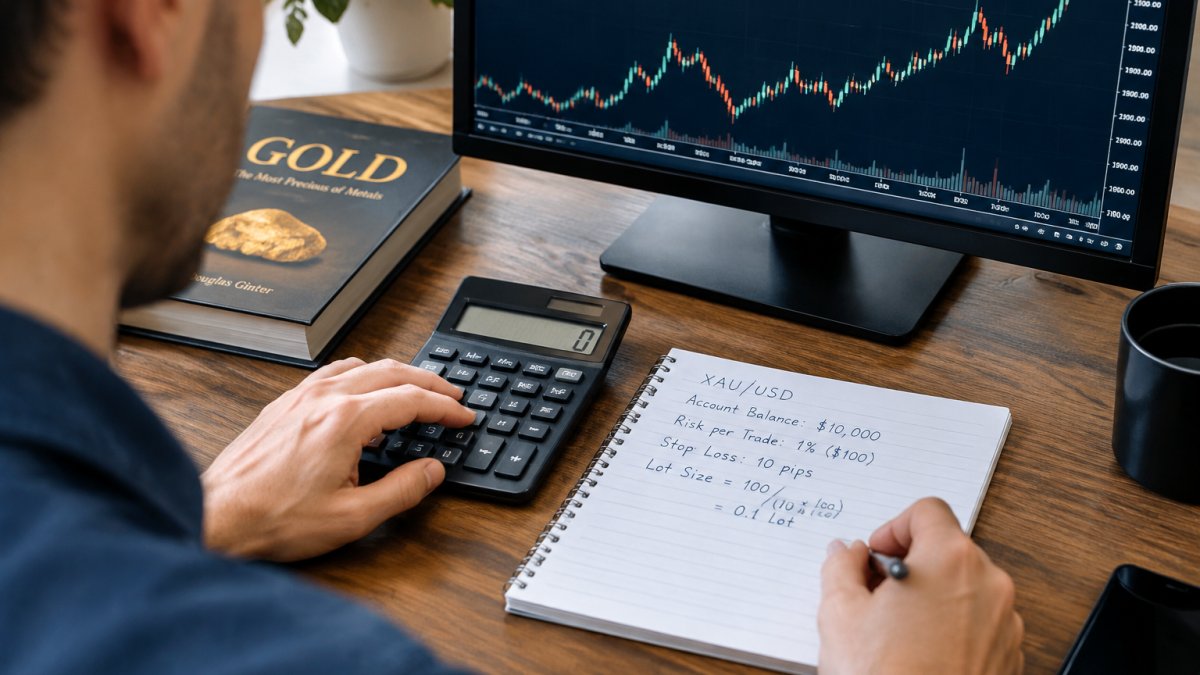
Worked Example: $10,000 Account, 1% Risk, 50-Point Stop
Start with a $10,000 account and a 1% risk limit. Your dollar risk is $100. Now suppose gold is quoted at $2,400 an ounce and your stop sits 50 points away, meaning $5.00 per ounce.
On a standard XAU/USD lot of 100 ounces, a $5.00 move equals $500 of exposure per lot. Divide your $100 risk by $500 and you get 0.20 lots. That’s your maximum size.
Change the stop to 100 points and the answer halves to 0.10 lots. Wider stop, smaller position. That trade-off is the whole point. If you want to know where the trade stops being profitable after costs, our guide on how to calculate gold’s break-even price walks through the math.
Gold Contract Specifications Across Brokers and Products
Gold contract specs can vary between brokers and products, and that variation changes your position size.
Common contract structures:
| Product | Typical Size | Value Per $1 Move | Minimum Increment |
|---|---|---|---|
| Standard XAU/USD lot | 100 ounces | $100 | 0.01 lot |
| Mini lot | 10 ounces | $10 | 0.01 lot |
| Micro lot | 1 ounce | $1 | 0.01 lot |
| Gold futures (GC) | 100 ounces | $100 | 1 contract |
| Micro futures (MGC) | 10 ounces | $10 | 1 contract |
Typical Size
Three details in that table matter more than the headline sizes.
Tick value versus point value. On spot XAU/USD, most brokers quote two decimals, so the smallest price increment is $0.01 per ounce. On a 100-ounce lot that tick is worth $1.00. On GC futures, the minimum tick is $0.10 per ounce, which is $10.00 per contract.
Minimum trade increments. Spot and CFD gold usually trade in 0.01-lot steps, so a 0.20-lot result is executable. Futures trade in whole contracts, so a calculated 0.20-contract result rounds down to zero and the trade is not available at that risk level.
Notional exposure. A single standard lot at $2,400 gold represents $240,000 of metal. That is the number your use limit is measured against, and it is why a $10,000 account with 20:1 use can technically hold about 0.83 standard lots.
Watch out: a sizing calculator built for forex pairs will quietly give you the wrong answer for gold futures because the tick values and contract conventions differ. Pull the contract specification from your own broker’s documentation and enter the value-per-point figure the calculator actually expects.
How to Calculate Pips in Gold Without Getting the Decimal Wrong
Gold doesn’t use pips the way currency pairs do, which is exactly why so many traders misplace a decimal. Most brokers quote XAU/USD to two decimals, so a move from $2,400.00 to $2,400.50 is 50 “points” or 0.50 in price. A move from $2,400.00 to $2,401.00 is 100 points, or $1.00.
Here’s the clean way to think about it. A pip in gold is usually the second decimal place, worth $0.01 per ounce. On a 100-ounce lot, one pip equals $1.00. On a 10-ounce mini lot, one pip equals $0.10. On a 1-ounce micro lot, one pip equals $0.01.
The trap is brokers who quote three decimals. There, the smallest increment is a tenth of a cent, and a “pip” may mean something different. A 50-point stop on a two-decimal feed and a 50-point stop on a three-decimal feed are not the same distance in dollars. Before you size anything, confirm three things: how many decimals your platform displays, what the platform calls the smallest increment, and what value-per-point figure the calculator expects.
A common pattern is to enter the stop distance in pips when the calculator wants price, or the reverse. If your stop is $5.00 per ounce and you type 5 into a field that expects pips, you have just told the calculator your stop is five cents wide. The output will be roughly one hundred times too large.
Watch out: rounding the stop distance to a whole number of points before dividing can shift the position size by several percent on a tight stop. Keep the stop in dollars per ounce and let the calculator do the division.
If you’re unsure which direction to trade, our breakdown of the best indicators for predicting gold market trends covers the tools traders use to time entries.
Gold Trading Use Explained in Position Sizing Terms
Use and position size are two views of the same decision. Use sets the maximum you can hold. Position sizing sets what you should hold. Confusing the two is how accounts get wiped out.
If your broker offers 20:1 use on gold, a $10,000 account can control $200,000 of metal. That’s roughly 0.83 standard lots. But your 1% risk rule might only permit 0.20 lots.
The use limit is a ceiling, not a target. Size to your risk, then confirm the result sits under the use cap. For context on how used gold exposure fits alongside physical holdings, see our piece on the role of gold in modern portfolios.
Gold Trading Risk Management Strategies That Account for Spread and Gaps
Your stop distance is not your real loss. Spread, slippage, commissions, and weekend gaps all add cost that a basic calculator ignores.
Three gold trading risk management strategies that close the gap:
- Add the spread to your stop distance before sizing, so the true risk is baked in
- Shrink position size on volatile days, when gaps are more likely
- Cap total open risk across all trades, not just per trade
Gold can gap over weekends and around major economic releases. A stop can fill well past your level. Sizing as if it won’t is a common error. For the mechanics of placing stops that survive these conditions, our guide on how to set stop loss orders for gold covers order types and placement.
Common Input Errors That Skew Your Gold Position Sizing
Small input mistakes produce large sizing errors. These are the ones that show up again and again.
- Using starting balance instead of current equity after a drawdown
- Entering stop distance in pips when the calculator wants price
- Mixing account currency with the instrument’s quote currency
- Forgetting commission when the broker charges per lot
- Rounding up to a whole lot instead of down
Watch out: rounding up “to make the trade worthwhile” is the single fastest way to break a risk plan. Always round down. A smaller position that respects your limit beats a bigger one that doesn’t.
Practice Sizing Gold Trades With a Paper Account Before You Risk Capital
Run the calculator on a demo account for at least twenty trades before you commit real money. You’ll learn how your broker’s specs behave, how spreads widen at news events, and how often your intended size actually fits your risk rule.
Log every trade: equity, risk percent, stop distance, calculated size, and actual fill. Patterns tend to emerge quickly, and many traders find their stops were too tight for gold’s normal daily range.
When you’re ready to move beyond practice and understand where gold fits in a long-term plan, our gold investment guide gives you the wider picture. And if you want the history, economics, and honest comparison behind the metal itself, GOLD: The Most Precious of Metals by Douglas Ginter covers it without hype.
Sizing gold trades correctly is the difference between a controlled risk and an account-ending surprise. If you want to understand the metal you’re trading before you trade it, My Gold Book gives you the full picture: the supply and demand history, how inflation actually affects gold, and a balanced look at gold versus Bitcoin and silver. Get started with My Gold Book and trade gold with real context behind every position.
Frequently Asked Questions
How do you calculate position size for XAU/USD?
Start with your risk amount: account equity multiplied by your risk percentage. Then divide that dollar figure by the dollar value of your stop distance. For XAU/USD, one standard lot is 100 troy ounces, so a $5 move against a full lot equals $500. If you risk $100 with a $5 stop, that is 0.20 lots, or 20 ounces. Always confirm the contract size your broker lists before placing the order, because mini and micro gold products differ.
What is the standard lot size for gold trading?
A standard XAU/USD lot is 100 troy ounces, so each $1 move in the gold price changes the position value by $100. Mini lots are typically 10 ounces ($10 per $1 move) and micro lots are 1 ounce ($1 per $1 move). Futures contracts are different: COMEX gold futures represent 100 ounces with a tick value of $10 per $0.10 move. Check your broker’s contract specification page, because some spot gold products use non-standard sizes.
How does leverage affect gold position sizing?
Leverage sets the margin your broker requires, not the risk you take. At 1:100 leverage, a 0.20 lot XAU/USD position worth roughly $50,000 at a $2,500 gold price needs about $500 in margin. That same position still loses $100 if gold moves $5 against you. Size from your risk amount and stop distance first, then check that the required margin fits your available equity so a normal stop-out does not trigger a margin call.
Can a position size calculator prevent margin calls?
A calculator reduces the chance of a margin call by keeping each trade’s risk small relative to equity, but it cannot prevent one. Gaps over weekends, widened spreads during news, and slippage on stop orders can all produce losses larger than planned. Keep total risk across open gold trades under a set ceiling, hold extra free margin, and avoid stacking correlated positions. The calculator handles the math; your risk limits handle the rest.
