
How to Allocate Assets Between Gold and Bitcoin
Table of Contents
- Why Gold and Bitcoin Belong in the Same Portfolio Conversation
- Gold vs. Bitcoin Inflation Hedge: How Each One Actually Protects Purchasing Power
- Risk, Volatility, and Correlation: What Each Asset Does to Your Portfolio
- How Much Bitcoin to Hold in a Portfolio Alongside Gold
- Gold and Bitcoin Allocation Examples Across Risk Profiles
- Rebalancing a Gold and Bitcoin Portfolio: Rules, Taxes, and Timing
- Custody, Access, and Costs: The Practical Side of Holding Both
- Frequently Asked Questions
Last Updated: October 17, 2026
Why Gold and Bitcoin Belong in the Same Portfolio Conversation
Gold and bitcoin are two of the most debated stores of value in modern investing, and many portfolios now hold both. This guide from My Gold Book explains how to allocate assets between gold and bitcoin. We’ll cover the trade-offs, worked examples, and the practical rules that keep a split allocation under control.
Here’s the core idea. Gold is the old anchor. Bitcoin is the young challenger. One has centuries of history behind it. The other has a short but explosive record.
Most allocation guides treat them as rivals. That’s the wrong frame. They play different roles in a portfolio, and that difference is exactly why some investors hold both.
A common mistake is picking one and ignoring the other. In practice, the split matters more than the pick.
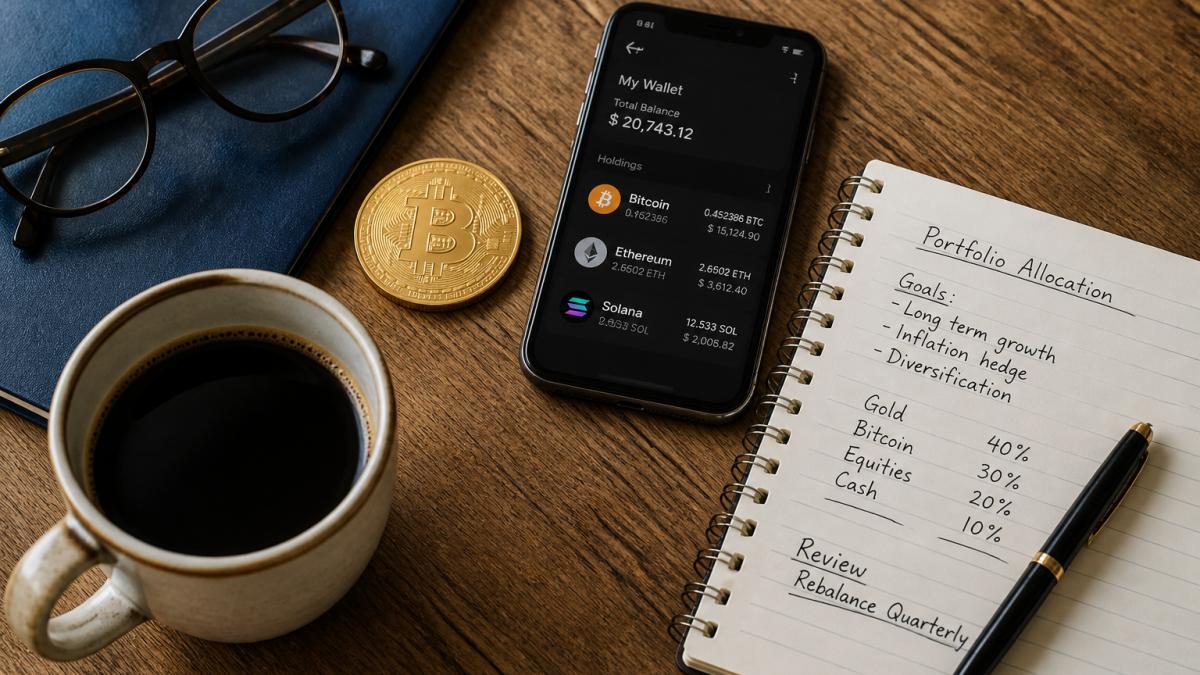
Gold vs. Bitcoin Inflation Hedge: How Each One Actually Protects Purchasing Power
Gold has a long record as an inflation hedge, while bitcoin is an unproven but increasingly discussed one. The two protect purchasing power in very different ways.
Gold’s case rests on scarcity and history. Supply grows slowly, and investors have treated it as a store of value for generations. Many savers hold it as capital preservation when monetary policy turns loose.
Bitcoin’s case rests on a fixed supply cap and decentralization. Supporters argue its scarcity makes it a hedge against currency debasement. The catch is that its price swings far more than gold’s.
- Gold: steady, slow-moving, widely accepted
- Bitcoin: volatile, fast-moving, still proving itself
- Gold: physical or fund-based access
- Bitcoin: digital custody only
The Federal Reserve’s guidance on inflation and purchasing power is a useful starting point for understanding what an inflation hedge is meant to do.
Treating bitcoin as a proven inflation hedge is a common error. Its short history includes long drawdowns, so size the position for volatility, not certainty.
Risk, Volatility, and Correlation: What Each Asset Does to Your Portfolio
Bitcoin carries far higher volatility and drawdown risk than gold, while gold’s correlation to equities is generally lower. That gap in risk is the single biggest factor in sizing each position.
Volatility is the price of upside potential. Bitcoin’s swings can be brutal. Gold’s moves are calmer, so it does more for downside risk and capital preservation.
Correlation matters too. When traditional assets like equities and bonds fall together, gold has often held up better. Bitcoin’s correlation has shifted over market cycles, sometimes tracking risk assets closely.
- Gold: lower volatility, steadier drawdowns
- Bitcoin: higher volatility, deeper drawdowns
- Gold: often a safe haven in stress
- Bitcoin: sometimes trades like a risk asset
The SEC’s investor education on digital assets explains the risks of cryptocurrency in plain terms.
How Much Bitcoin to Hold in a Portfolio Alongside Gold
Most visible guides stop at “keep bitcoin small.” That is not a method. The useful question is not what percentage to hold but how to arrive at your number. Below is a step-by-step process you can run once and revisit annually.
Step 1: Define the denominator. Decide whether your percentages apply to investable assets (brokerage, retirement accounts, cash, gold, crypto) or to total net worth including your home, pension, and emergency fund. Most practitioners size gold and bitcoin against investable assets, because a house cannot be sold in slices to rebalance. Write the denominator down. If you include home equity, a 5% bitcoin weight is a much larger dollar bet than if you exclude it.
Step 2: Net out existing exposure. Add up what you already own. A retirement fund may hold gold miners or a gold ETF. An employer plan may include a small crypto sleeve. A brokerage account may already hold bitcoin through a fund. Count all of it before adding a new position, or you will double-count exposure without realizing it.
Step 3: Set a drawdown budget. Decide the dollar loss you could tolerate in a severe bitcoin drawdown without selling. Bitcoin has fallen more than 70% from prior highs in past cycles. If a 70% decline in your bitcoin sleeve would equal more than you are willing to lose, cut the weight. This single test does more to size the position than any return forecast.
Step 4: Split the hard-asset sleeve. Decide how much of the portfolio belongs in hard assets overall, then divide that sleeve between gold and bitcoin. A common pattern is to make gold the larger share of the sleeve and bitcoin the smaller share, because gold’s lower volatility means it does more of the stabilizing work. The split within the sleeve matters as much as the sleeve’s total size.
Step 5: Stress-test the result. Model a 70% bitcoin decline and a 20% gold decline at the same time. If the combined hit would force you to sell other assets or abandon the plan, reduce the bitcoin weight. Repeat until the number survives the test.
- Conservative: bitcoin a small fraction of the hard-asset sleeve, gold the majority
- Moderate: bitcoin a modest slice, gold balanced against it
- Aggressive: bitcoin a larger slice, gold retained as a hedge
A common mistake is sizing bitcoin by upside potential alone. Size it by how much drawdown you can actually stomach, and let the gold weight do the ballast work.
Click Here To Order Your Copy →
Set your bitcoin weight so a steep drop would not force you to sell. If a big fall would panic you, the position is too large, and the fix is a smaller weight, not a better forecast.
The SEC’s investor education on digital assets is a plain-language starting point for understanding the risks that should feed into this sizing decision.
Gold and Bitcoin Allocation Examples Across Risk Profiles
Worked examples make the split concrete. The three illustrations below use portfolio weight as a share of investable assets, with stated assumptions so you can see how the gold-to-bitcoin split changes with risk profile. They are starting points, not recommendations.
Assumptions used in all three examples: investable assets only (home equity and pension excluded); no pre-existing gold or crypto exposure; a 10-year horizon; rebalancing reviewed annually; and a drawdown budget equal to roughly 10% of the portfolio.
| Risk profile | Hard-asset sleeve | Gold weight | Bitcoin weight | Focus |
|---|---|---|---|---|
| Conservative | 10% of portfolio | 8% | 2% | Capital preservation; bitcoin sized so a 70% drop costs about 1.4% of the portfolio |
| Moderate | 15% of portfolio | 10% | 5% | Risk-adjusted returns; bitcoin sized so a 70% drop costs about 3.5% of the portfolio |
| Aggressive | 20% of portfolio | 10% | 10% | Upside potential; bitcoin sized so a 70% drop costs about 7% of the portfolio |
Read the table by the drawdown column, not the return column. In the conservative case, a severe bitcoin drawdown costs less than the annual return on a typical bond allocation. In the aggressive case, the same drawdown is a meaningful portfolio event, which is the point of the larger weight, and the reason the gold share stays at 10% rather than shrinking.
A barbell strategy, a stable gold anchor paired with a small high-upside bitcoin bet, fits many investors, but the barbell only works if the anchor is genuinely stable. If the gold weight is too small to offset a bitcoin drawdown, the portfolio is not barbelled; it is just a crypto bet with a token hedge.
How the split changes across profiles. The gold weight rises more slowly than the bitcoin weight as risk tolerance increases. That is deliberate: gold’s job is to absorb shocks, and its stabilizing contribution per dollar is higher than bitcoin’s, so a moderate or aggressive investor can add bitcoin faster than gold without losing the hedge.
The denominator matters. Base percentages on total investable wealth, not just one account, so the split reflects your real exposure. If you hold a large cash position or a concentrated employer stock, treat those as part of the denominator before you size gold and bitcoin, otherwise a 5% bitcoin weight can be a much larger share of your actual risk budget than the headline number suggests.
Pick the example closest to your risk profile, then run the drawdown test from the previous section. If the modeled loss exceeds your budget, step down one profile. The table is a starting point; the stress test is the decision.
Rebalancing a Gold and Bitcoin Portfolio: Rules, Taxes, and Timing
Rebalancing keeps the split from drifting. A simple rule: review on a schedule, such as quarterly or annually, and trim whichever side has run past its target weight.
Monthly rebalancing can add cost and complexity. For most investors, a periodic check works better than constant trading. Rebalance when a position drifts meaningfully from its target.
Taxes deserve attention. Selling to rebalance can trigger capital gains, so check the rules before you trade. The IRS guidance on capital gains and losses covers how gains are taxed.
- Set target weights first
- Review on a fixed schedule
- Rebalance with new money when possible
- Check tax impact before selling
Rebalancing is risk management, not market timing. It keeps the gold and bitcoin split aligned with your risk tolerance as prices move.
Custody, Access, and Costs: The Practical Side of Holding Both
Custody is where gold and bitcoin diverge most. Gold can be held physically or through funds. Bitcoin lives in digital wallets, and access depends on securing private keys.
Security is the priority for both. Physical gold needs safe storage. Bitcoin needs careful key management and protection from loss or theft.
Costs add up quietly. Storage, insurance, fund fees, and trading spreads all eat into returns. Compare the total cost of each holding before you commit.
For readers who want the deeper history and economics behind gold, My Gold Book’s title GOLD: The Most Precious of Metals by Douglas Ginter offers a balanced look at how gold compares with modern assets like bitcoin.
Test your bitcoin custody setup with a small amount first. Confirm you can recover access before moving a large position.
Frequently Asked Questions
Which is a better investment, Bitcoin or gold?
Neither wins outright; they do different jobs. Gold has centuries of history as a store of value and tends to hold up during macroeconomic uncertainty, while Bitcoin offers larger upside potential with much deeper drawdowns. A common approach is to hold both: gold for capital preservation and Bitcoin for growth exposure. Your split should reflect your risk tolerance, investment horizon, and how much volatility you can stomach without selling at the wrong time.
How should I divide my portfolio between gold and Bitcoin?
Start with a combined allocation you can hold through a drawdown, often somewhere between 5% and 15% of total portfolio value for most investors. Within that sleeve, conservative investors might weight gold heavily, while investors with a long horizon and high risk tolerance may give Bitcoin the larger share. Write the percentages down before you buy, then rebalance on a fixed schedule so the allocation does not drift with market cycles.
Does holding gold and Bitcoin together reduce portfolio risk?
It can reduce single-asset risk, but not all risk. Gold and Bitcoin have different drivers: gold responds to monetary policy, real rates, and safe-haven demand, while Bitcoin trades more like a high-beta digital asset. Because their correlation is not consistently high, pairing them can smooth returns compared with holding either alone. That said, both can fall in a broad liquidity crunch, so treat the pair as a diversifier sleeve rather than a hedge against every downturn.
How often should I rebalance a gold and Bitcoin allocation?
Most investors do well with a calendar rule, such as quarterly or annually, plus a threshold rule that triggers a rebalance when either asset drifts more than 5 percentage points from its target weight. Monthly rebalancing tends to add turnover and tax drag without improving risk-adjusted returns much. If you hold Bitcoin in a taxable account, check short-term versus long-term capital gains treatment before selling, and prefer rebalancing with new contributions where possible.
Deciding how to split assets between gold and bitcoin comes down to matching the weights to your risk tolerance and keeping them there. At My Gold Book, our guide GOLD: The Most Precious of Metals gives you the history, the economics, and an honest comparison to help you decide with clarity. It covers gold’s role in inflation, its major uses, and how it stacks up against digital assets. Order your copy today and make your allocation call with better information.