
How to Start Collecting Gold: A Beginner’s Guide
Table of Contents
- Understand Gold Purity and Karats Before You Buy
- Gold Bullion vs Numismatic Coins: Which Should You Collect
- Best Gold Coins for Beginners to Start With
- Set Your Collecting Budget and Track Costs
- How to Store Physical Gold Safely at Home
- Verify Authenticity and Identify Counterfeits
- Common Mistakes New Gold Collectors Make
- Getting Started: Your First Gold Purchase
Last Updated: August 12, 2026
Understand Gold Purity and Karats Before You Buy
Gold purity is measured in karats, a system that confuses many beginners. Pure gold is 24 karats; everything else is a mixture. When you see 18K gold, that means 18 parts pure gold and 6 parts other metals. Those other metals are necessary because pure gold is too soft for coins and jewelry to hold their shape over time.
The karat measurement tells you the percentage of pure gold in an alloy. A 22K coin contains about 91.7% pure gold. An 18K piece contains 75% pure gold. A 14K item contains 58.3% pure gold. For bullion and investment-grade coins, higher karat is generally preferable because you’re getting more actual gold content per coin.
The term purity also appears on certification documents, expressed as a decimal: .999 fine gold means 99.9% pure gold. This is the gold standard for bullion rounds and bars. Most government-minted bullion coins fall into the .900 to .999 range.
When you start collecting gold, you’ll encounter coins stamped with both karat marks and assay certifications. The assay is a third-party verification of purity, and it’s one of the most important trust signals you can look for. Reputable dealers always provide assay certificates with their bullion offerings.
Check the mint mark on any coin you’re considering. The mint mark indicates where the coin was produced and can significantly affect both rarity and value. For American coins, mint marks appear on the reverse or obverse and are tiny but crucial for determining collectibility.
Gold Bullion vs Numismatic Coins: Which Should You Collect
Before you spend money, you need to decide whether you’re building an investment portfolio or a collector’s portfolio. These two approaches have different economics.
Bullion refers to gold in its purest form: bars, rounds, or coins valued primarily by weight and purity. Bullion is priced at spot price plus a dealer markup. The spot price is the global market rate for gold per troy ounce, and it fluctuates daily based on supply and demand.
Numismatic coins are collectible coins valued for rarity, historical significance, condition, and mint mark. An 1895-S Morgan Dollar in mint condition can sell for thousands of dollars, while its gold content alone might be worth a fraction of that.
The key difference: bullion moves with the gold market. Numismatic coins move with collector demand and rarity. If gold prices drop 20%, your bullion loses 20% of its value. A rare numismatic coin might hold its value or even appreciate because collectors are willing to pay for scarcity regardless of spot price.
For someone just beginning to start collecting gold, bullion is typically the smarter entry point. It’s easier to understand, easier to value, and easier to sell. Numismatic collecting requires knowledge of grading standards, mint history, and market trends.
Bullion is about the gold. Numismatic coins are about the history and scarcity. Pick one approach first, master it, then consider blending both if you want to.
Best Gold Coins for Beginners to Start With
When you’re ready to make your first purchase, choose coins that are widely recognized, easily valued, and simple to resell.
The American Gold Eagle is the most popular choice for beginners in the United States. It’s a government-minted coin with guaranteed purity (.9167 fine gold), comes in multiple weights (1 oz, 1/2 oz, 1/4 oz, 1/10 oz), and is recognized worldwide. The dealer markup on Gold Eagles is typically lower than on obscure coins because the market is liquid.
The Canadian Gold Maple Leaf is nearly identical in appeal. It contains .9999 fine gold (higher purity than the Eagle), comes in fractional weights, and is equally liquid. Many collectors prefer the Maple Leaf for its superior purity, though the Eagle’s legal tender status in the United States gives it a slight advantage domestically.
The South African Krugerrand was designed specifically as an investment coin. It contains exactly one troy ounce of gold and is instantly recognizable.
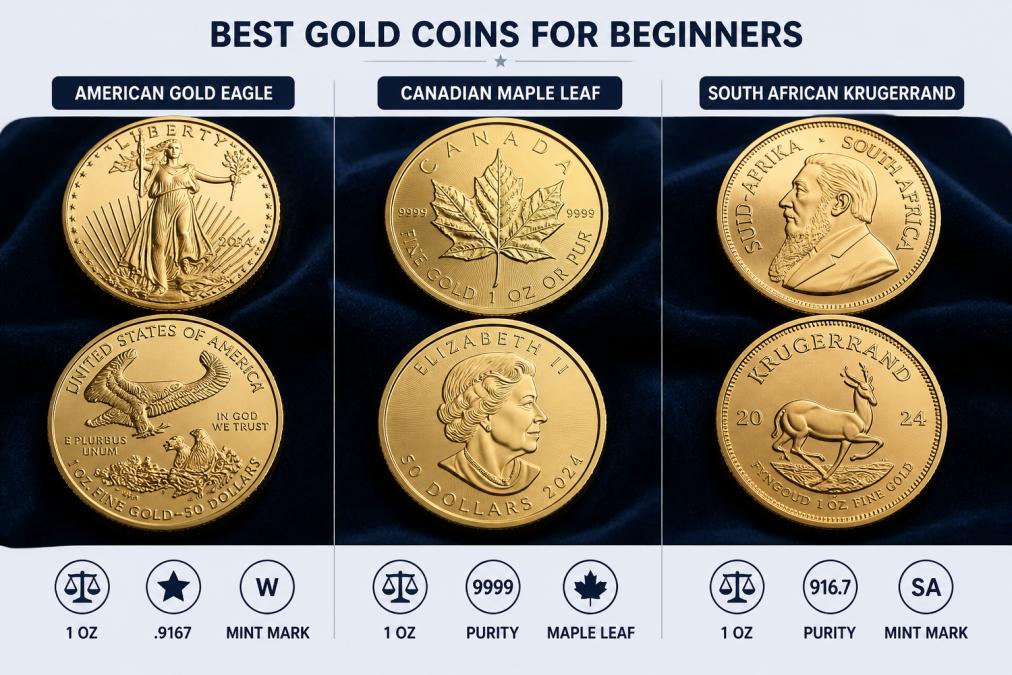
For fractional gold, the American Gold Eagle 1/10 oz is ideal if you want to own gold but don’t have capital for a full ounce.
A mistake many beginners make is buying rare or "special" coins for their first purchase. Stick with bullion coins that millions of other collectors also own. Liquidity is your safety net when you need to exit your position.
New collectors with $500-$5,000 to invest who want simple, liquid, easy-to-value coins.
Set Your Collecting Budget and Track Costs
Before you buy a single coin, decide how much you’re willing to spend and how you’ll track your collection.
Start by defining your total budget. Factor in dealer markups, potential insurance, secure storage, and the possibility of selling at a loss if you need liquidity quickly. The dealer markup is the difference between spot price and the price you pay. For bullion, markups typically range from 2% to 8% depending on the coin type and dealer reputation. American Gold Eagles usually command a 3-5% markup.
When you start collecting gold, track every purchase in a spreadsheet or dedicated app. Record the date, coin type, weight, purity, purchase price, and dealer name. This record becomes critical if you ever need to sell, file insurance claims, or calculate capital gains for tax purposes.
Many collectors also photograph each coin with identifying marks visible. This serves as both an insurance record and a reference guide for your collection.
A common approach is to dollar-cost-average into gold, buying a small amount regularly regardless of price fluctuations. This removes emotion from timing decisions and smooths out price volatility. You buy more coins when prices are low and fewer when prices are high, naturally balancing your average cost per coin over time.
How to Store Physical Gold Safely at Home
Once you own gold, you face a critical decision: where to keep it. This choice affects security, insurance costs, and your ability to access your collection.
Home storage requires a secure safe rated for jewelry and precious metals. A basic safe costs between several hundred and a few thousand dollars depending on size and security rating. The safe should be bolted to the floor or wall to prevent theft.
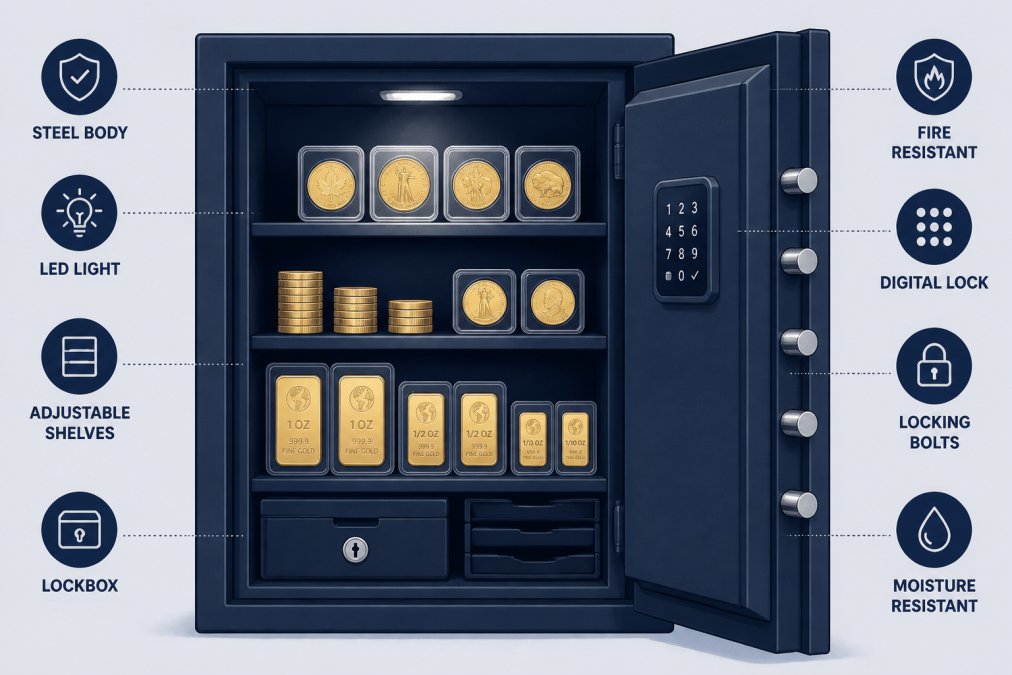
The challenge with home storage is that it’s not insured under standard homeowners insurance. Most policies exclude precious metals or cap coverage at a few thousand dollars. You need a separate rider or specialized precious metals insurance policy.
A middle ground is bank safe deposit boxes. They offer professional security, climate control, and insurance protection. The drawback is that you can’t access your gold during bank holidays or emergencies, and rental fees add up over time.
Many collectors use a combination: keep a small amount at home for liquidity and store the bulk of their collection in a safe deposit box or with a professional vault service.
When you store physical gold safely, consider environmental factors. Use acid-free holders and keep the environment dry. Humidity can damage labels and certificates.
Document your storage location and access procedures. If something happens to you, your family needs to know where the gold is kept and how to retrieve it.
Verify Authenticity and Identify Counterfeits
Counterfeit gold exists, and it’s more common than most people realize. Learning to spot fakes is essential before you start collecting gold at any serious level.
Click Here To Order Your Copy →
The first line of defense is buying from reputable dealers. Established coin dealers, certified precious metals retailers, and government mints are your safest sources. If a dealer won’t provide assay certificates or refuses returns, that’s a red flag.
Weight and dimensions are the quickest authenticity checks. A genuine American Gold Eagle weighs exactly 33.931 grams. If your coin weighs 33.5 grams or 34.3 grams, it’s fake. Get a precision scale accurate to at least 0.1 grams.
Dimension checks are equally important. An American Gold Eagle is 32.7 mm in diameter and 2.87 mm thick. Counterfeits often deviate slightly because the dies are imperfect copies.
Sound is another indicator. Drop a genuine gold coin on a hard surface from a few inches high. It produces a specific ring that experienced collectors recognize instantly. Counterfeit coins often sound dull or flat.
Visual inspection reveals obvious fakes. Look at the mint mark, the date, and the design details. Use a magnifying glass and compare to reference images of genuine coins.
For expensive purchases or if you have any doubt, send coins to a professional grading service like PCGS or NGC. They verify authenticity and provide a graded certification.
Never buy gold from strangers at below-market prices. If a deal seems too good to be true, it almost certainly involves counterfeit or stolen gold.
Common Mistakes New Gold Collectors Make
Most beginners make predictable errors that cost them money or frustration.
The first mistake is buying rare or proof coins before understanding grading standards. Proof coins are specially minted with mirror-like finishes and cost significantly more than bullion. Stick with bullion until you understand why certain coins command premiums.
The second mistake is not diversifying coin types. A balanced collection includes multiple types: Eagles, Maple Leafs, Krugerrands, and perhaps some fractional coins.
The third mistake is overpaying at local coin shops. Local dealers charge higher markups than online retailers because they have higher overhead. Comparing prices before buying saves 5-10% on every purchase.
The fourth mistake is storing gold in unsafe locations. A home safe that’s not bolted down can be carried away. Taking security seriously from the beginning prevents catastrophic loss.
The fifth mistake is failing to track purchases. Without documentation, you can’t prove cost basis for tax purposes or file insurance claims.
The sixth mistake is panic selling during price drops. Gold prices fluctuate, sometimes sharply. Have a long-term perspective from the start.
Getting Started: Your First Gold Purchase
Your first purchase should be simple, straightforward, and stress-free.
Step 1: Choose a reputable dealer. Research online retailers, check the Better Business Bureau, read customer reviews, and verify they’re members of professional organizations.
Step 2: Decide on coin type. For your first purchase, choose either American Gold Eagles or Canadian Maple Leafs. Decide on the weight: 1 oz is standard, but fractional coins are acceptable if budget is tight.
Step 3: Check current spot price. Look up the current gold spot price per troy ounce. Reputable sources include Kitco, APMEX, and major financial news outlets.
Step 4: Request a quote. Tell the dealer exactly what you want and ask for the total price including all fees. Confirm the dealer offers a return policy if the coin arrives damaged or doesn’t match the description.
Step 5: Verify the assay certificate. Request that the dealer include an assay certificate or grading certificate with your order.
Step 6: Arrange secure delivery. Use insured shipping if ordering online. Track the package and require a signature on delivery.
Step 7: Inspect upon arrival. When the coin arrives, inspect it immediately. Check weight, dimensions, and visual details. If anything seems wrong, contact the dealer within their return window.
Step 8: Document and store. Photograph the coin, record purchase details, and place it in your secure storage.
Starting to collect gold is simpler than most people assume, but the details matter. You now understand karat measurements, the difference between bullion and numismatic coins, which coins to buy first, and how to store and verify your collection. The real challenge is consistency: continuing to add to your collection over time and resisting the urge to sell during price downturns.
For deeper insights into gold’s history, its role in modern portfolios, and how it compares to alternative investments like Bitcoin, My Gold Book‘s "GOLD: The Most Precious of Metals" by Douglas Ginter offers comprehensive research that helps collectors and investors make informed decisions. The book explores both the practical and philosophical aspects of gold ownership, answering the questions that busy minds often overlook. Click Here To Order Your Copy and deepen your understanding of why gold remains one of the most trusted stores of value across centuries and cultures.
Frequently Asked Questions
What is the easiest way to start collecting gold?
Begin by purchasing fractional gold coins or bullion rounds from reputable dealers. American Eagles or Canadian Maple Leafs are ideal entry points because they're widely recognized, liquid, and available in 1-ounce denominations. Start with a small budget, even a single ounce, to learn the process before scaling up. This approach minimizes risk while you develop knowledge about spot prices, dealer markups, and storage.
What's the difference between numismatic value and bullion value?
Bullion value equals the metal's melt value based on current spot price and troy ounce weight. Numismatic value comes from rarity, historical significance, mint mark, and collector demand, often far exceeding bullion value. A rare 1933 Double Eagle might be worth thousands more than its gold content alone. Beginners should focus on bullion-grade coins first; numismatic collecting requires deeper expertise in grading and provenance.
How do I verify the authenticity of gold coins?
Buy only from reputable dealers with third-party certification. Check weight, dimensions, and sound, authentic coins have specific acoustic properties. Use a magnet test (gold is non-magnetic). For high-value purchases, request assay certificates or third-party grading from services like PCGS or NGC. These provide professional authentication and grading that protects your investment and increases liquidity when you sell.
What are the tax implications of owning physical gold?
Gold held longer than one year qualifies for long-term capital gains tax treatment at rates up to 28%, higher than stocks. Short-term gains are taxed as ordinary income. Sales must be reported on Schedule D (Form 1040). Inherited gold receives a stepped-up basis. Consult a tax professional about your specific situation, as rules vary based on purchase price, sale price, and holding period. Keep detailed records of all transactions and storage costs for deductions.
This article was written using GrandRanker