
Is Gold a Good Inflation Hedge? What Investors Should Know
Table of Contents
- Is Gold a Good Inflation Hedge? The Core Question Explained
- Historical Performance of Gold as an Inflation Hedge
- Gold vs. Stocks for Inflation: Which Protects Your Portfolio Better?
- How Interest Rates, the Dollar Index, and Monetary Policy Move Gold Prices
- The Hidden Costs: Storage, Liquidity, and Tax Implications of Gold Investment
- Risks of Investing in Gold Every Buyer Should Weigh
- How to Buy Gold for Investment: Physical, ETFs, and Mining Stocks
- Is Gold a Good Inflation Hedge for Your Specific Situation?
Last Updated: August 4, 2026
So many investors ask whether gold is a good inflation hedge. The honest answer is: it depends on your time horizon and what you’re actually trying to protect. At My Gold Book, we’ve examined the historical record, the economic mechanics, and the real-world costs of owning gold so you can make a clear-eyed decision rather than a fear-driven one. Below, we’ll show you exactly how gold behaves across different economic environments, where it outperforms, where it disappoints, and how to size it correctly in a portfolio.
Is Gold a Good Inflation Hedge? The Core Question Explained
An inflation hedge is an asset whose value tends to rise alongside, or faster than, the general price level, preserving the investor’s real purchasing power when fiat currency loses value. Gold meets that definition over very long time horizons, though it can lag inflation badly over shorter windows of five to ten years.
The core tension is real: gold has no yield, pays no dividend, and generates no cash flow. Its price is driven entirely by market sentiment, macroeconomic factors, and supply-demand dynamics, making it speculative in the short run even while functioning as a store of value over decades.
What Makes an Asset a True Inflation Hedge
A true inflation hedge must maintain or grow its real value during rising prices and hold up when the currency it’s denominated in weakens. Gold scores well on the second test, the correlation between a falling dollar index and rising gold prices is well-documented. The first test is messier, as gold’s relationship with the Consumer Price Index is positive over multi-decade periods but unreliable over five-to-ten-year windows. Gold works best as a long-term store of value, not as a year-to-year hedge against grocery bills.
How Gold Retains Purchasing Power Over Time
Gold retains purchasing power because its global supply grows slowly, roughly one to two percent per year through mining, while demand is persistent across cultures and central banks. Unlike fiat currency, no government can print more of it. Over centuries, an ounce of gold has purchased roughly the same quantity of goods, from Roman togas to modern clothing, making it one of the oldest tangible assets in human history.
Gold’s inflation-hedging power is strongest over multi-decade periods. Investors expecting short-term protection from a single year of rising CPI are likely to be disappointed.
Historical Performance of Gold as an Inflation Hedge
Gold’s historical record is compelling in some eras and weak in others.
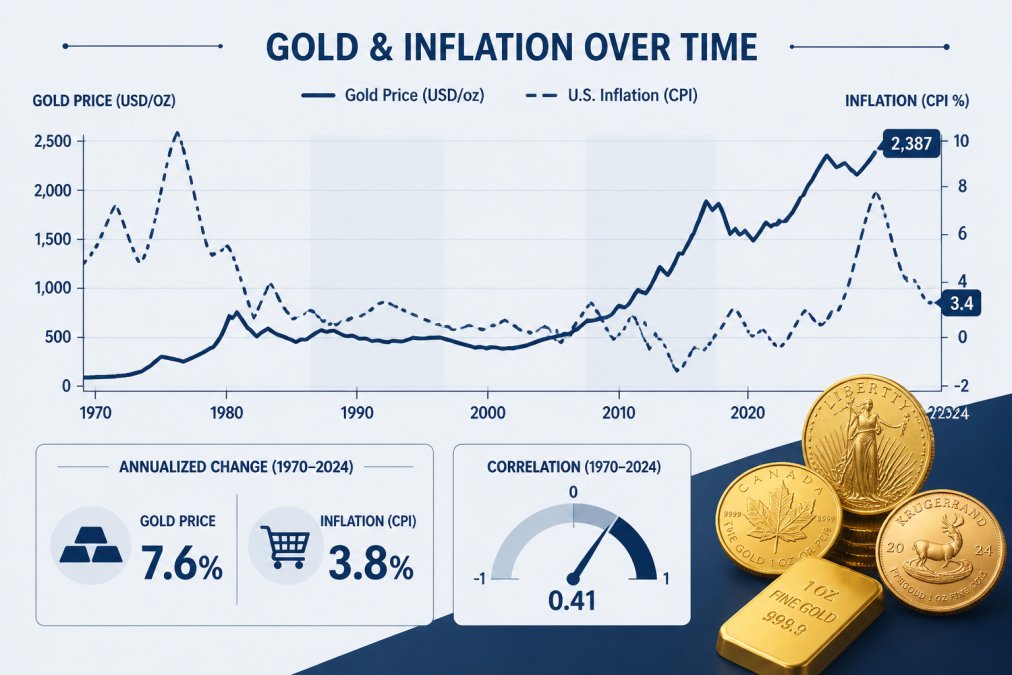
According to World Gold Council research on gold and inflation, gold has historically shown a positive long-run correlation with inflation, but the relationship is not tight enough to rely on over short periods. The 1970s remain the strongest case study: gold rose dramatically as stagflation gripped the U.S. economy, oil prices surged, and the dollar weakened after the end of the Bretton Woods system. Investors who held gold through that decade saw their real purchasing power preserved and then some.
The 1980s and 1990s told a different story. Inflation cooled, interest rates rose sharply under Federal Reserve Chair Paul Volcker, and gold entered a prolonged bear market that lasted nearly two decades.
Gold During High-Inflation Decades vs. Low-Inflation Periods
High-inflation environments tend to favor gold because rising prices signal monetary debasement, and investors rotate into tangible assets. The 2000s and early 2020s both saw gold perform strongly alongside elevated inflationary pressure and expansionary monetary policy.
Low-inflation, high-growth periods are gold’s worst environment. When real yields are positive and equities deliver strong risk-adjusted returns, the opportunity cost of holding a non-yielding commodity is high.
Gold in Stagflationary vs. Deflationary Environments
Stagflation, the combination of stagnant growth and rising prices, is gold’s strongest environment. The 1970s proved this conclusively. When the economy stagnates and inflation erodes bond yields, gold becomes one of the few asset classes that can preserve real value.
Deflation is different. During deflationary periods, cash and high-quality bonds tend to outperform because their real value rises as prices fall. Gold’s performance during deflation is mixed, it can hold up as a safe haven during financial panic, as it did briefly in 2008, but it doesn’t benefit from falling prices the way fixed-income assets do.
Gold vs. Stocks for Inflation: Which Protects Your Portfolio Better?
Equities are, over long periods, a better inflation hedge than gold. Companies can raise prices, grow earnings, and return capital to shareholders. Their intrinsic value compounds. Gold does not compound. A bar of gold in 1970 is still a bar of gold in 2026.
That said, stocks and gold behave very differently during acute inflationary crises. When inflation spikes suddenly and central banks are behind the curve, equities often sell off alongside bonds, while gold can serve as genuine portfolio diversification. The 2022 environment illustrated this: both stocks and bonds fell sharply, while gold held its value better than either.
Risk-Adjusted Returns: A Side-by-Side Comparison
| Factor | Gold | U.S. Equities | U.S. Bonds |
|---|---|---|---|
| Long-run real return | Low-to-moderate | High | Moderate |
| Inflation correlation | Positive (long run) | Positive (long run) | Negative |
| Volatility | Moderate-high | Moderate-high | Low-moderate |
| Yield / income | None | Dividends + buybacks | Coupon payments |
| Deflation performance | Mixed | Poor | Strong |
| Stagflation performance | Strong | Poor | Poor |
| Liquidity | High | Very high | High |
| Storage cost | Yes (physical) | None | None |
Gold earns its place in a portfolio not because it outperforms stocks but because it behaves differently at the moments that matter most, specifically during stagflation and geopolitical volatility.
Allocating more than 10-15% of a portfolio to gold based purely on inflation fears can drag down long-run returns significantly. Gold’s lack of yield means it consistently underperforms equities over 20-plus-year horizons.
How Interest Rates, the Dollar Index, and Monetary Policy Move Gold Prices
What actually matters is real interest rates, meaning nominal rates minus inflation. When real yields are deeply negative, gold thrives because the opportunity cost of holding a non-yielding asset falls to near zero. When real yields turn sharply positive, gold faces headwinds.
The dollar index is the other key variable. Gold is priced globally in U.S. dollars, so a weakening dollar makes gold cheaper for foreign buyers, driving up demand and price. A strengthening dollar has the opposite effect. Gold often rallies when the Federal Reserve signals looser monetary policy because looser policy typically weakens the dollar.
Geopolitical volatility adds a third dimension. Gold is the classic safe haven asset during periods of global uncertainty. Wars, banking crises, and sovereign debt stress all tend to drive capital into gold regardless of the inflation picture. As noted in Federal Reserve Bank of St. Louis research on gold and monetary policy, the relationship between gold and inflation is stronger when monetary policy is perceived as accommodative and real rates are low.
The Hidden Costs: Storage, Liquidity, and Tax Implications of Gold Investment
Most gold investment guides stop at the buy decision. The ongoing costs are where the real analysis lives.
IRS Rules and Capital Gains Tax on Physical Gold
The IRS classifies physical gold, including coins and bars, as a collectible. This matters because collectibles are subject to a maximum long-term capital gains tax rate of 28%, compared to the 20% maximum that applies to most other long-term capital gains. This tax treatment is a meaningful drag on after-tax returns that most comparisons ignore. Short-term gains on gold held less than one year are taxed as ordinary income. For current rates and reporting requirements, the IRS guidance on collectibles and capital gains is the authoritative source.
Gold ETFs structured as grantor trusts, such as the SPDR Gold Shares, are taxed as collectibles at the 28% rate. Gold futures ETFs and mining stocks are taxed differently. Know your structure before you buy.
Storage Fees, Insurance, and Liquidity Considerations
Physical gold requires secure storage. Professional vault storage typically runs a fraction of a percent of asset value per year, but those fees compound. Add insurance, and the carrying cost of physical gold becomes a real drag on returns, particularly for smaller positions.
Liquidity is generally strong for gold in its most common forms: coins, bars, and ETFs. Gold ETFs offer the best liquidity, trading on exchanges throughout the day with tight bid-ask spreads. Physical gold’s total cost of ownership is meaningfully higher than its spot price implies when you factor in storage, insurance, and the 28% collectibles tax.
Risks of Investing in Gold Every Buyer Should Weigh
Gold is not a risk-free asset. Common mistakes include treating it as a safe parking spot when it actually carries several distinct risks.
Price volatility: Gold can swing dramatically over short periods. Investors who need liquidity within two to three years face real sequence-of-returns risk.
Opportunity cost: Every dollar in gold is a dollar not compounding in equities. Over 20-plus-year periods, this gap tends to be substantial.
Confiscation and regulatory risk: Historically rare in the U.S., but worth noting. In 1933, Executive Order 6102 required citizens to surrender gold holdings to the Federal Reserve.
Counterparty risk in paper gold: Gold ETFs and futures contracts are not the same as holding physical metal. They carry counterparty and structural risks that physical gold does not.
Short-term fluctuations: Gold can underperform inflation for years at a time. Anyone who bought in early 1980 waited roughly 25 years to break even in nominal terms.
How to Buy Gold for Investment: Physical, ETFs, and Mining Stocks
There are three primary formats for gold exposure, and the right choice depends on your goals, tax situation, and time horizon.
Physical gold: Coins and bars offer direct ownership, no counterparty risk, and portability. American Gold Eagles and American Gold Buffalos are the most liquid U.S. coins.
Gold ETFs: Products like SPDR Gold Shares provide price exposure without storage hassle. They’re taxed as collectibles but are the most convenient entry point for most investors.
Mining stocks: Companies that mine gold offer leveraged exposure to gold prices, plus dividends in some cases. They carry company-specific and operational risks beyond the metal itself and are taxed as ordinary equities, not collectibles.

Pros and Cons of Each Gold Investment Format
| Format | Best For | Key Advantage | Key Disadvantage |
|---|---|---|---|
| Physical coins/bars | Long-term holders, tangible asset preference | No counterparty risk | Storage, insurance, 28% tax |
| Gold ETFs | Convenience-focused investors | Easy to buy/sell | 28% collectibles tax (most) |
| Mining stocks | Growth-oriented investors | Leveraged to gold price, potential dividends | Company and operational risk |
| Gold futures | Sophisticated traders | Price efficiency, use | Rollover costs, complexity |
The real difference between formats comes down to what you’re actually trying to accomplish. If you want a long-term store of value, physical gold or a straightforward ETF works. If you want leveraged upside during a gold bull market, mining stocks can outperform dramatically.
Is Gold a Good Inflation Hedge for Your Specific Situation?
The answer is conditional.
Gold makes sense if: You have a time horizon of 10-plus years, you want portfolio diversification against stagflation and geopolitical volatility, and you’re comfortable with the tax treatment and carrying costs. A 5-10% allocation is the range most often cited by practitioners as meaningful without being portfolio-dominating.
Gold makes less sense if: You need income from your investments, your time horizon is under five years, or you’re comparing it to equities on a pure return basis. Over most 20-year rolling periods, a diversified equity portfolio has outperformed gold on both nominal and real terms.
The stagflation scenario is gold’s strongest case. If you believe the U.S. faces prolonged slow growth combined with persistent inflationary pressure, gold’s historical performance in exactly that environment is compelling. If you’re simply worried about a year or two of elevated CPI, gold is a blunt instrument for that specific problem.
Understanding the full picture, history, costs, tax treatment, and economic context, is what separates a well-reasoned gold allocation from a fear-driven one. For investors who want to go deeper on the history, economics, and cultural significance of gold as a commodity and investment, the book GOLD: The Most Precious of Metals by researcher Douglas Ginter covers precisely that ground, including how gold compares to modern alternatives like Bitcoin and silver.
Understanding whether gold is a good inflation hedge requires moving past the simple yes-or-no debate and into the specifics of time horizon, economic environment, and total cost of ownership. My Gold Book offers GOLD: The Most Precious of Metals by Douglas Ginter, a balanced, research-driven guide that covers gold’s history, its role as a commodity, its comparison to Bitcoin and silver, and a clear-eyed assessment of whether owning gold makes sense for your situation. Click Here To Order Your Copy and get the full picture before you make your next investment decision.
Frequently Asked Questions
Does gold actually perform well during periods of high inflation?
Gold has historically held its value during prolonged inflationary periods, particularly when real interest rates turn negative and the dollar loses purchasing power. However, the relationship is not perfectly consistent. Over shorter timeframes, gold prices can lag behind CPI increases. Its strongest case as a gold inflation hedge comes during sustained inflationary pressure combined with economic uncertainty, rather than brief or moderate inflation spikes.
How does gold compare to stocks as an inflation hedge?
Gold vs. stocks for inflation protection involves real trade-offs. Stocks in sectors like energy, commodities, and real estate can outpace inflation through earnings growth, while gold produces no yield or dividends. Gold tends to outperform stocks during stagflation and geopolitical volatility, while stocks generally deliver stronger long-term risk-adjusted returns during stable growth periods. Most financial planners suggest holding both as part of a diversified portfolio rather than choosing one exclusively.
What are the main risks of investing in gold?
The risks of investing in gold include short-term price volatility driven by market sentiment rather than inflation data, zero yield compared to dividend-paying stocks or interest-bearing bonds, and the IRS classifying physical gold as a collectible taxed at up to 28% for long-term capital gains. Storage and insurance costs reduce net returns on physical gold. Gold also underperforms during deflationary periods and when real interest rates rise significantly.
How do I buy gold for investment in the United States?
U.S. investors can buy gold through several formats: physical gold coins or bars purchased from licensed dealers, gold ETFs traded on major exchanges, gold mining stocks, or gold futures contracts. Each format carries different cost structures, liquidity profiles, and tax treatments. Physical gold requires secure storage and insurance. ETFs offer easy liquidity but track spot prices indirectly. Before purchasing, review IRS reporting requirements and consult a tax advisor regarding collectibles capital gains rates.
Is gold taxed differently than stocks in the United States?
Yes. The IRS classifies physical gold, gold coins, and gold ETFs backed by physical metal as collectibles. Long-term capital gains on collectibles are taxed at a maximum rate of 28%, compared to the standard 0%, 15%, or 20% long-term capital gains rates that apply to most stocks. Short-term gains on gold held under one year are taxed as ordinary income. This tax treatment is a meaningful factor when calculating net returns on a gold inflation hedge strategy.
What is the best asset to hedge against inflation besides gold?
Common inflation hedges alongside gold include Treasury Inflation-Protected Securities (TIPS), which are U.S. government bonds that adjust principal with CPI changes, real estate investment trusts (REITs), commodities, and Series I savings bonds. Stocks in energy, materials, and consumer staples sectors have also historically kept pace with inflationary pressure over long periods. Portfolio diversification across several of these asset classes generally provides more consistent inflation protection than relying on any single one.
This article was written using GrandRanker