
Is Gold Investment Worth It in 2026?
Table of Contents
- Is Gold Investment Worth It? A Practical Framework
- Is Gold a Hedge Against Inflation
- Gold vs Silver Investment: Which Precious Metal Wins
- Gold IRA Pros and Cons for Retirement Planning
- The Real Cost of Gold Ownership
- Gold vs Other Asset Classes: Historical Performance
- When Gold Makes Sense (and When It Doesn’t)
Last Updated: August 10, 2026
Is Gold Investment Worth It? A Practical Framework
Whether gold investment worth considering depends entirely on your financial situation, risk tolerance, and time horizon. Gold has served as a store of value for thousands of years, but that historical role doesn’t automatically make it the right choice for your portfolio in 2026.
The core question isn’t whether gold is "good", it’s whether gold investment fits your specific needs. Some investors find it essential for portfolio balance. Others never touch it. Both approaches can be correct.
At My Gold Book, we’ve analyzed the practical realities of gold ownership: the costs, the returns, the risks, and the psychological factors that drive decisions. This guide cuts through the marketing noise to show you exactly when gold makes sense and when it doesn’t.
The honest truth: gold doesn’t generate income. It pays no dividends, no interest, no yield. You buy it, store it, and hope its price rises. That’s fundamentally different from stocks, bonds, or real estate, which produce cash flow. Understanding this distinction shapes everything that follows.
Gold investment worth your consideration only if you understand what you’re actually buying: a commodity that may preserve purchasing power during economic stress, not a wealth-building machine.
Is Gold a Hedge Against Inflation
Gold as a hedge against inflation is one of the most persistent claims in investing, and it’s partially true but incomplete.
When inflation rises, the purchasing power of your dollars falls. A dollar buys less. Gold, in theory, maintains its purchasing power because its value rises when currency weakens. During periods of rapid inflation, gold has historically outpaced the erosion of the dollar.
However, this protection is inconsistent. Gold performed well during the 1970s inflation surge. It also rose during the 2022-2023 inflationary period. But there have been extended periods when inflation climbed while gold prices stagnated or fell. The relationship exists, but it’s not automatic or reliable.
The real insight: gold works as an inflation hedge only if you hold it long enough and buy at the right time. If you purchase gold right before a deflationary period, you’ve locked in losses. Timing matters enormously, and most investors don’t time it correctly.
Consider this instead. A diversified portfolio that includes inflation-protected securities, real assets, and equities may provide more consistent inflation protection than gold alone. Gold can be one piece of that strategy, but treating it as your sole inflation defense is risky.
Assuming gold automatically protects you from inflation is a common mistake. Gold prices can diverge from inflation rates for years. You need other inflation hedges as well, don’t rely on a single asset class.
Gold vs Silver Investment: Which Precious Metal Wins
When comparing precious metals, gold and silver occupy different roles in a portfolio.
Gold is more stable. Its price moves in broader swings, but it’s less volatile than silver on a percentage basis. Silver is more volatile, its price can swing 20-30% in months. For conservative investors, gold’s steadier behavior appeals. For traders, silver’s volatility creates opportunity.
Silver has industrial uses. About half of annual silver demand comes from industrial applications: electronics, solar panels, medical devices, photography. Gold is primarily used for jewelry and investment. This means silver’s price is influenced by both investment demand and industrial demand. When manufacturing slows, silver falls harder than gold.
Silver is cheaper to own in absolute terms. You can buy silver coins or bars with smaller dollar amounts than gold, which appeals to beginners. However, storage costs and dealer premiums are proportionally higher for silver. A dealer might charge 5-8% above spot price for silver versus 2-4% for gold.
Historically, silver has underperformed gold as a long-term store of value. Over the past 20 years, gold has appreciated more consistently. But silver offers more volatility, which some investors view as opportunity.
For most investors, if you’re choosing between the two, gold is the more straightforward choice. It’s more stable, has lower proportional costs, and a clearer historical track record. Silver works better as a secondary precious metal position after you’ve established gold holdings.
Silver investment makes sense for traders comfortable with volatility and investors who want exposure to industrial metals. For conservative, long-term precious metals allocation, gold is typically the better choice.
Gold IRA Pros and Cons for Retirement Planning
A Gold IRA (Individual Retirement Account) allows you to hold physical precious metals within a tax-advantaged retirement account. This is different from a traditional IRA that holds stocks and bonds.
The appeal is straightforward: you get the tax benefits of an IRA (tax-deferred or tax-free growth, depending on the account type) while holding a tangible asset. For investors convinced that gold will outperform financial assets, this seems ideal.
The costs, however, are substantial. A Gold IRA requires a custodian, a specialized firm that holds and stores your metals. Custodian fees typically run $100-300 annually, sometimes more. You also pay storage fees, often $50-200+ per year depending on the amount held. Insurance costs add another layer. When you add these together, a small Gold IRA position costs disproportionately.
Setup fees are another hidden cost. Expect to pay $150-300 to establish the account and purchase initial metals. These fees make small positions uneconomical. You need at least $5,000-10,000 in gold positions for the costs to be reasonable relative to your holdings.
The rules are strict. You cannot take physical possession of the metals yourself, they must remain with the custodian. You cannot store them in your home safe. If you violate these rules, the IRA loses its tax protection and you face penalties.
Gold IRA pros and cons for retirement planning ultimately depend on your conviction level. If you believe gold will significantly outperform stocks over decades, the extra costs may be worth it. If you’re uncertain, the fees make it a poor choice. Most financial advisors recommend gold as a small portion of a broader portfolio, which makes the Gold IRA structure less attractive due to the fee structure being designed for larger holdings.
Consider a simpler approach: hold most retirement assets in a traditional brokerage IRA, and if you want gold exposure, buy gold exchange-traded funds (ETFs) within that account. You get gold exposure without the specialized custody and storage fees.
The Real Cost of Gold Ownership
This is where most gold investment discussions fall apart. People focus on the price of gold and ignore the actual costs of owning it.
When you buy physical gold, you immediately pay a dealer premium, typically 3-8% above the spot price (the current market price). You’re not buying gold at the quoted price. You’re paying a markup.
Storage costs come next. If you store gold at home in a safe, you’ve bought the safe. If you store it in a bank safe deposit box, you pay annual fees, typically $25-100 per year depending on the box size. If you use a private vault or depository, costs range from $50-200+ annually. These seem small until you calculate them over decades.
Insurance is mandatory if you store gold anywhere except your home. Insuring precious metals costs roughly 0.5-1% of the value annually. On $50,000 in gold, that’s $250-500 per year just for insurance.
Selling gold incurs another dealer markup. When you sell, the dealer buys at a price below spot. That spread is typically 3-8%. So you might buy at spot plus 5% and sell at spot minus 5%, creating a 10% round-trip cost before any price appreciation.
Add these together. If you buy $10,000 in gold:
Click Here To Order Your Copy →
- Dealer premium on purchase: $300-800
- Annual storage: $50-200
- Annual insurance: $50-100
- Dealer spread on eventual sale: $300-800
Over 10 years, these costs total $1,000-3,000 on a $10,000 position. Your gold price needs to appreciate 10-30% just to break even against these costs. That’s a significant hurdle.
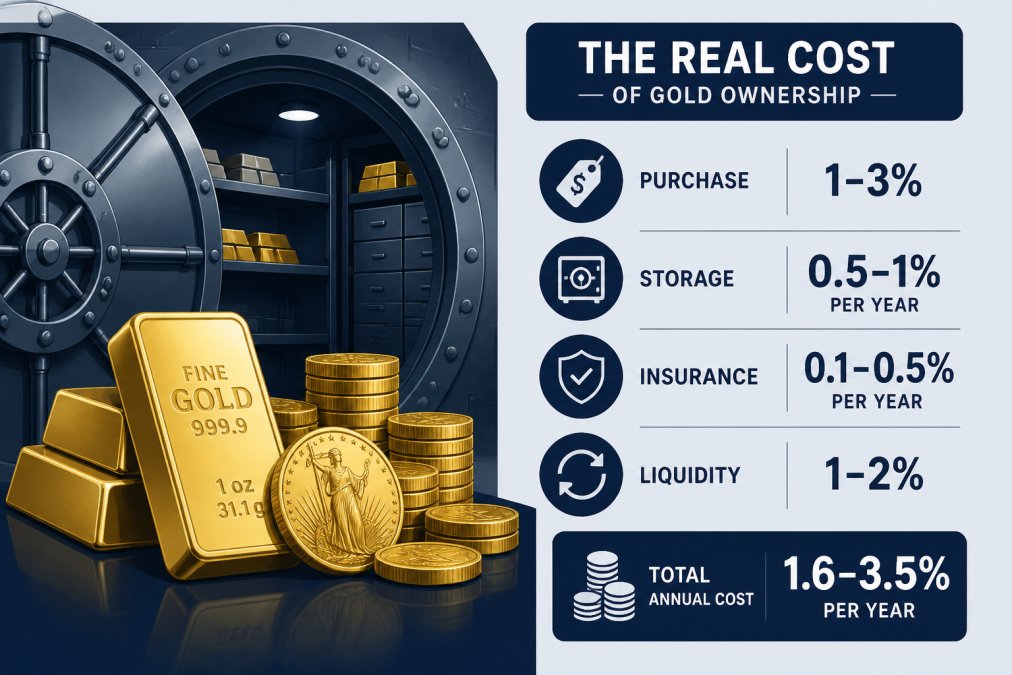
ETFs eliminate most of these costs. A gold ETF (like GLD or IAU) charges annual fees around 0.4%, has no dealer premiums, and you can sell instantly at market prices. You lose the psychological comfort of holding physical gold, but you gain efficiency.
If you want gold exposure but are concerned about costs, a gold ETF is almost always more cost-effective than physical gold. You pay roughly 0.4% annually versus 1-3% in combined costs for physical ownership.
Gold vs Other Asset Classes: Historical Performance
Gold’s performance looks different depending on your time horizon.
Over the past 50 years, gold has returned roughly 7-8% annually on average. That sounds reasonable until you compare it to stocks. The S&P 500 has returned approximately 10-11% annually over the same period, with dividends reinvested.
The difference compounds. A $10,000 investment in the S&P 500 in 1975 would be worth roughly $2 million by 2026. The same investment in gold would be worth roughly $1.3 million. That’s not a small difference.
However, gold and stocks don’t move together. When stocks crash, gold often rises. During the 2008 financial crisis, stocks fell 57% while gold rose 5%. This non-correlation is gold’s actual value, not as a wealth builder, but as a diversifier.
Bonds have underperformed both gold and stocks historically, returning roughly 5-6% annually. Real estate has performed similarly to stocks, around 9-10% annually when you include rental income.
The comparison changes when you look at specific periods. From 2000-2010, gold outperformed stocks significantly. From 2010-2020, stocks dominated. From 2020-2026, both have performed reasonably well, though stocks have pulled ahead.

The honest assessment: gold is a diversifier, not a wealth builder. Its primary value is that it moves differently than financial assets. When stocks and bonds decline together, gold often provides a cushion. But as your primary investment, gold underperforms a diversified stock portfolio over long periods.
For a 30-year retirement, a portfolio of 80% stocks, 15% bonds, and 5% gold has historically provided better returns than any other combination while managing volatility reasonably well. The gold portion didn’t drive returns, it reduced volatility and provided insurance.
When Gold Makes Sense (and When It Doesn’t)
Gold investment worth considering in specific situations. Outside those situations, it’s usually a waste of money.
Gold makes sense if:
You have significant assets and want insurance against systemic risk. If you have $500,000+ invested, allocating 5-10% to gold provides real diversification value. The costs become reasonable relative to your total holdings.
You’re concerned about currency devaluation. If you believe the dollar will significantly weaken, gold provides a hedge. This is a reasonable concern for some investors, though it’s unpredictable.
You have a very long time horizon (20+ years) and can tolerate volatility. Gold’s returns improve when you hold it through multiple economic cycles. Short-term holders usually lose money to costs and timing mistakes.
You want to diversify beyond financial assets. If your entire net worth is in stocks, bonds, and real estate, gold adds exposure to a different asset class that behaves differently in various economic environments.
Gold doesn’t make sense if:
You’re a beginner investor with limited capital. The costs eat your returns. Start with index funds and ETFs first.
You need income. Gold produces no cash flow. If you need retirement income, dividend stocks, bonds, or real estate are better choices.
You’re trying to time the market. Buying gold expecting it to crash soon, or selling it expecting a rally, usually fails. Most gold investors buy high and sell low because they react emotionally to price movements.
You can’t commit to a 10+ year holding period. The costs and volatility make shorter timeframes uneconomical.
You’re uncomfortable with volatility. Gold prices swing 15-20% annually. If that keeps you awake at night, gold isn’t for you.
Gold investment worth it when it serves a specific purpose in a diversified portfolio, not as a speculative bet or your primary investment vehicle. Define your reason for buying gold before you buy. If you can’t articulate a clear reason beyond “it might go up,” skip it.
Gold investment worth understanding thoroughly before you commit capital. My Gold Book provides a balanced assessment of gold’s role in wealth building, exploring its history, economic impact, and practical considerations for modern investors. Whether you’re comparing gold to silver, evaluating a Gold IRA, or simply trying to decide if gold belongs in your portfolio, understanding both the appeal and the real costs determines whether this precious metal makes sense for you. Start with education, then make a deliberate decision based on your specific financial situation rather than following conventional wisdom.
Frequently Asked Questions
What is the disadvantage of investing in gold?
Gold produces no income, carries storage and insurance costs, and historically underperforms stocks over long periods. During bull markets, gold often lags equities, and its value depends entirely on price appreciation. Liquidity can also be an issue with physical gold compared to stocks or ETFs, and dealer premiums add to your initial purchase cost.
How does gold perform during periods of high inflation?
Gold typically preserves purchasing power when inflation rises, though not perfectly. During the 1970s stagflation, gold surged as a safe haven asset. However, when inflation moderates, gold often declines. Gold's real value depends on whether inflation expectations change, it's the inflation surprise that matters most. As a hedge, gold works best as part of a diversified portfolio rather than a standalone strategy.
Is physical gold or a gold ETF a better investment?
Gold ETFs offer lower costs, better liquidity, and no storage worries, ideal for most investors. Physical gold gives you tangible ownership and works well for collectors or those concerned about systemic risk. ETFs typically have annual expense ratios under 0.5%, while physical gold involves dealer premiums (2-5%), storage fees, and insurance. For portfolio diversification, ETFs are usually more practical; for wealth preservation or collecting, physical gold has appeal.
What makes this book different from free online gold investing guides?
My Gold Book provides a comprehensive, researched framework covering gold's history, economic role, and honest comparison to modern assets like Bitcoin. Rather than sales-driven content, it delivers balanced analysis on when gold makes sense and when it doesn't, helping you avoid emotional decisions. The book's depth on cultural significance, supply dynamics, and inflation mechanics goes beyond typical online articles, saving you hours of scattered research.
This article was written using GrandRanker