
Why Warren Buffett Avoids Gold: A Practical Perspective
Table of Contents
- Why Warren Buffett Opposes Gold as an Investment
- Productive Assets vs Non-Productive Assets: The Core of Buffett’s Argument
- Gold as a Hedge Against Inflation: Does It Actually Work?
- The Performance Gap: Gold vs. Stocks and Bonds
- The Intrinsic Value Problem: Why Buffett Sees Gold Differently
- How to Start Investing in Gold for Beginners: A Balanced Approach
- Should You Follow Buffett’s Stance on Gold?
- Frequently Asked Questions
Last Updated: October 3, 2026
Why Warren Buffett Opposes Gold as an Investment
Warren Buffett gold skepticism rests on a fundamental distinction: gold doesn’t generate returns the way productive assets do. His argument is economic, not cultural, it’s about how wealth compounds.
The case against gold hinges on the distinction between productive assets (which generate cash flow) and non-productive assets (which don’t).
Productive Assets vs Non-Productive Assets: The Core of Buffett’s Argument
Productive assets generate cash flow or earnings. Stocks represent ownership in businesses that earn profits. Bonds pay interest. Real estate produces rental income. These assets create economic value independent of market sentiment.
Gold generates nothing, zero cash flow, dividends, or earnings. Profit comes only from selling it to someone willing to pay more. This makes it speculative rather than an investment in the traditional sense.
Buffett’s thought experiment: owning all gold ever mined yields zero income streams. A farm or apartment building, by contrast, generates real returns year after year.
Buying stock means buying a claim on future earnings. Buying gold means betting on price appreciation alone. One aligns with value creation; the other depends on finding a buyer willing to pay more.
Gold as a Hedge Against Inflation: Does It Actually Work?
Many investors hold gold for inflation protection. But does it actually work as a reliable hedge, and what are the hidden costs?
The Inflation Performance Reality
Gold performs well during some inflationary periods but underperforms during others. From 2000-2010, gold rose sharply. From 2011-2020, it stagnated. During 2021-2023 inflation, gold lagged equities.
The real issue is opportunity cost plus tax inefficiency: gold receives unfavorable tax treatment compared to equities, creating substantial long-term drag.
The Tax Efficiency Problem
Gold is taxed as a collectible at a maximum 28% long-term capital gains rate, versus 15-20% for stocks. This 8-13 percentage point difference compounds dramatically over decades.
Example: $10,000 in gold at 5% annually for 30 years becomes $43,200. After 28% tax on the $33,200 gain, you have $32,700. The same $10,000 in an S&P 500 index fund at 10% annually becomes $174,500, and after 20% tax, you have $161,900.
The tax code actively penalizes gold ownership relative to equities, compounding over a lifetime.
Equities offer tax-deferred dividend reinvestment in retirement accounts and preferential tax rates on qualified dividends. Gold generates no income stream to shelter.
Modern Alternatives: ETFs and Digital Gold
Most gold ETFs still receive collectibles tax treatment. Specialized structures exist but aren’t widely available to retail investors.
Digital gold platforms and cryptocurrency alternatives avoid the 28% collectibles tax but face regulatory and volatility challenges unsuitable for most investors seeking inflation hedges.
What Actually Works for Inflation Protection
Stocks and bonds have historically provided better inflation-adjusted returns. Stocks represent ownership in businesses that can raise prices during inflation, and equities receive superior tax treatment.
Treasury Inflation-Protected Securities (TIPS) adjust principal for inflation and provide a direct hedge without gold’s speculative element or tax penalty.
Gold has defensive value during market crashes and geopolitical crises, but more efficient portfolio structures exist for catastrophic insurance.
Gold’s inflation-hedging properties are real but inconsistent, and the 28% collectibles tax rate creates a substantial long-term drag compared to equities taxed at 15-20%. Productive assets with preferential tax treatment have historically provided better after-tax, inflation-adjusted returns over long time horizons.
The Performance Gap: Gold vs. Stocks and Bonds
Over 50 years, stocks have significantly outperformed gold, and bonds have provided steadier returns with lower volatility.
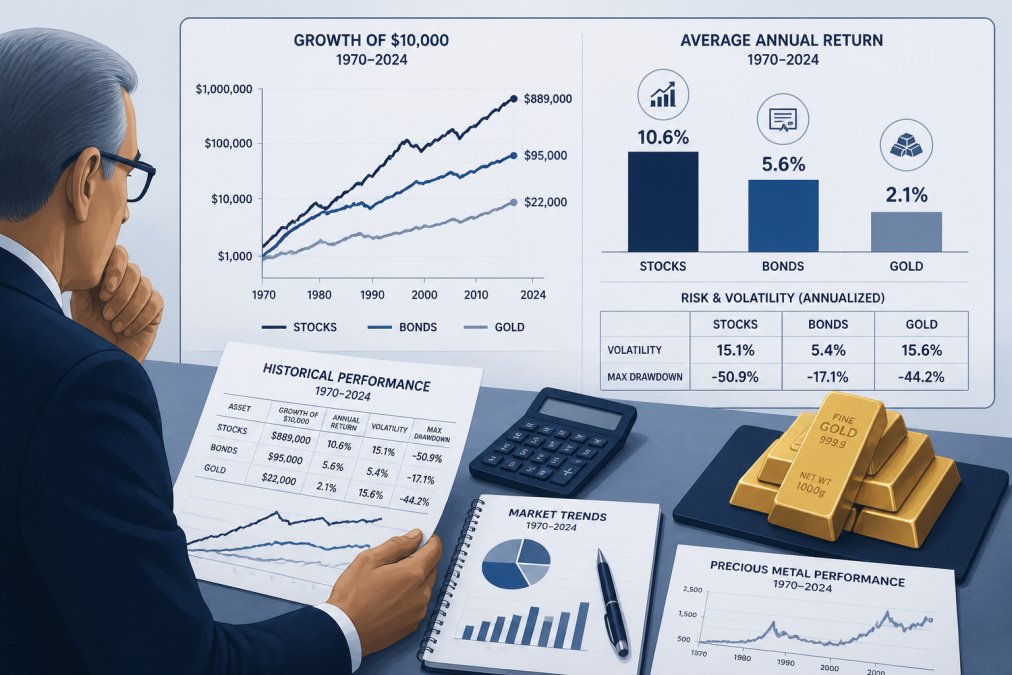
Stocks rise from company profits and reinvestment. Bonds rise from interest payments. Gold rises only from demand exceeding supply or currency debasement fears, sentiment and scarcity, not value creation.
Tools like LazyPortfolioETF allow investors to backtest different portfolio allocations, comparing gold-heavy strategies against traditional stock-and-bond portfolios. The historical data consistently shows that portfolios with minimal gold exposure outperformed those with significant gold positions over multi-decade periods.
Gold sometimes outperforms in specific years, but over 40-50 year investment lifetimes, productive assets deliver superior returns.
Comparing gold to stocks over short periods (1-5 years) can be misleading. Gold sometimes outperforms during market downturns. But over 20+ year periods, the performance gap heavily favors equities and diversified bond portfolios.
The Intrinsic Value Problem: Why Buffett Sees Gold Differently
Intrinsic value is what something is fundamentally worth based on its ability to generate returns. A business has intrinsic value because it earns profits. A bond has intrinsic value because it pays interest. A farm has intrinsic value because it produces crops.
Gold’s intrinsic value is hard to define. Most of its price reflects investor sentiment about scarcity, currency debasement, and geopolitical risk, not industrial demand or utility.
Buffett calculates intrinsic value and compares it to market price. This framework fails with gold because intrinsic value is subjective, you can’t calculate what gold “should” be worth based on earnings or cash flow.
Click Here To Order Your Copy →
This uncertainty bothers value investors. It introduces speculation into the equation. And speculation is the opposite of disciplined, long-term wealth building. According to Investopedia’s analysis of value investing, Buffett’s entire philosophy rests on purchasing assets at prices below their fundamental worth. Gold doesn’t fit that framework.
How to Start Investing in Gold for Beginners: A Balanced Approach
Despite Buffett’s skepticism, many investors hold gold. Here’s a practical framework for considering it as part of a diversified portfolio.
Understanding Your Ownership Options
Gold ownership comes in several forms, each with distinct cost, tax, and practical implications:
Physical Gold. Direct ownership with no counterparty risk, but requires secure storage, insurance (0.5-1% annually), and creates taxable events. The IRS taxes it at 28% on long-term gains. Selling requires finding a buyer, introducing liquidity friction and dealer markups of 2-5%.
Gold ETFs. Easier liquidity and lower costs (0.25-0.40% annually) with no storage hassles, but still taxed at 28% and introduce counterparty risk. Most are structured as grantor trusts, complicating tax filing.
Gold Mining Stocks. Taxed as equities (15-20%, not 28%), can pay dividends, and provide leverage to gold prices. Trade-off: volatile, dependent on company execution, and don’t provide pure gold exposure.
Digital Gold Platforms. Newer platforms allow fractional ownership of physical gold stored in vaults, combining some benefits of physical and ETF ownership. However, these platforms vary widely in regulatory oversight, insurance coverage, and fee structures.
Determining Your Allocation and Purpose
First, decide your allocation purpose. Are you holding gold for inflation protection, geopolitical insurance, portfolio diversification, or cultural/religious reasons? Your answer determines both how much gold makes sense and which ownership method fits best.
Most financial advisors suggest that if you hold gold at all, it should represent a small portion of your overall portfolio, typically 5-10% at most. This gives you some downside protection without sacrificing the long-term returns that productive assets provide.
For investors primarily concerned about inflation, a 2-3% allocation to gold combined with TIPS (Treasury Inflation-Protected Securities) may be more efficient than a larger gold position, since TIPS directly hedge inflation without the speculative element or tax penalty.
For investors seeking geopolitical insurance or portfolio stability during market crashes, a 5-7% allocation to gold ETFs (for liquidity) makes more sense than physical gold (which is harder to sell quickly during a crisis).
The Tax-Efficiency Hierarchy
If you decide to hold gold, the ownership method matters significantly for after-tax returns:
- Gold mining stocks (best tax treatment: 15-20% long-term capital gains, potential dividends)
- Gold ETFs held in tax-deferred accounts (IRAs, 401(k)s, no tax until withdrawal)
- Gold ETFs in taxable accounts (28% long-term capital gains, but easier to track and sell)
- Physical gold in taxable accounts (28% long-term capital gains, plus storage/insurance costs and liquidity friction)
This hierarchy explains why sophisticated investors often use gold ETFs in taxable accounts rather than physical gold, the tax treatment is identical, but the costs and liquidity are dramatically better.
A Practical Framework for Decision-Making
One often-overlooked approach: hold gold only in tax-deferred retirement accounts (IRAs, 401(k)s), where the 28% collectibles tax doesn’t apply until you withdraw. This eliminates the tax-efficiency penalty while preserving the portfolio insurance benefit.
If you hold gold, think of it as portfolio insurance rather than a wealth-building engine. Insurance is valuable even if you never use it. But you wouldn’t buy insurance and expect it to generate returns. The same logic applies to gold in a diversified portfolio. And if you do hold it, consider holding it in a tax-deferred account to eliminate the 28% collectibles tax penalty.
Should You Follow Buffett’s Stance on Gold?
The honest answer is: it depends on your situation and your temperament. Buffett’s argument against gold is logically sound and historically supported. Productive assets have outperformed gold over long periods. Stocks and bonds generate returns independent of market sentiment. Gold generates nothing.
But Buffett’s framework isn’t the only valid approach to investing. Some investors genuinely value the portfolio stability that gold provides during market turmoil. Others hold gold for cultural, historical, or religious reasons that go beyond pure financial calculation. Some worry about currency debasement or geopolitical instability in ways that make gold’s “insurance value” worth the opportunity cost.
The key is making a conscious choice rather than defaulting to gold out of habit or fear. If you decide to hold gold, understand exactly why. If you decide to follow Buffett’s approach and avoid it, that choice should rest on the same clarity.
According to Callan’s institutional research on asset class behavior, the strongest investment decisions come from understanding the reasoning behind them, not from blindly following any single authority, even one as successful as Buffett.
One practical approach is to examine your overall portfolio structure. If you already hold diversified stocks, bonds, and real estate, adding a small gold position might smooth volatility during specific market conditions. If you’re early in your wealth-building years with limited capital, concentrating on productive assets probably makes more sense. Your situation, time horizon, and risk tolerance matter more than any single investor’s philosophy.
The debate over Warren Buffett gold ultimately reflects a deeper question about how wealth compounds. Buffett’s skepticism rests on the belief that capital should flow toward businesses and assets that generate real economic value. That philosophy has served him extraordinarily well. But it’s a framework, not a law of nature.
For a comprehensive exploration of gold’s history, economic role, and place in modern investment strategy, My Gold Book’s “GOLD: The Most Precious of Metals” offers balanced research that goes beyond any single perspective. The book examines both the traditional value-investing critique and the legitimate reasons investors include precious metals in their portfolios, helping you develop your own informed stance on this enduring debate.
Frequently Asked Questions
Why does Warren Buffett prefer productive assets over gold?
Buffett favors productive assets like stocks and bonds because they generate cash flow, dividends, or interest, creating tangible returns over time. Gold, by contrast, produces no cash flow. It simply sits as a store of value, relying entirely on price appreciation driven by market sentiment rather than economic utility. This fundamental difference shapes his entire investment philosophy around capital appreciation and shareholder value.
Can gold serve as a hedge against inflation despite Buffett’s criticism?
Gold does offer some inflation protection, as its purchasing power tends to hold during periods of rising prices. However, historical performance shows that productive assets like stocks have outpaced inflation more consistently over long periods. The trade-off is that gold requires no management or ongoing investment, making it attractive for portfolio diversification. Whether it belongs in your portfolio depends on your risk tolerance and time horizon, not Buffett’s stance alone.
How can beginners start investing in gold for beginners without following Buffett’s approach?
Beginners can start with small allocations through exchange-traded funds (ETFs) tracking gold prices, which offer lower costs than physical gold. Alternatively, some investors purchase physical gold coins or bars from reputable dealers. Before investing, understand your goals: are you seeking wealth preservation, inflation protection, or speculation? Start with 5-10% of your portfolio and educate yourself on storage, insurance, and tax implications. Resources like financial education platforms can clarify the mechanics before committing capital.
What makes My Gold Book different from free online information about gold investing?
My Gold Book, authored by Douglas Ginter, provides a comprehensive, researched perspective that balances gold’s historical significance with modern investment analysis. Unlike scattered online articles, it explores gold’s role across history, religion, culture, and economics while offering honest comparisons to alternatives like Bitcoin and silver. For those seeking clarity on whether gold fits their strategy, a structured guide saves time and provides depth that quick searches cannot match.