
How to Spot Fake Gold Bars: A Step-by-Step Guide
Last Updated: November 11, 2026
Quick Summary
To spot fake gold bars, check the logo, stamping and fonts, then measure edges and dimensions with a caliper, compare the weight against the stated weight, and verify the serial number with the refiner. No single test is conclusive, so a passing bar still needs a professional non-destructive assay for high-value purchases.
- Fake bars are often a base metal core, such as tungsten, plated with a thin gold layer.
- Check stamping for blurry lettering, wrong fonts, spelling errors and shallow markings.
- Measure thickness at several points and compare with the refiner’s published specifications.
- A magnet test misses non-magnetic cores, so it cannot confirm a bar is genuine.
- For high-value purchases, use professional X-ray fluorescence or ultrasound testing.
Table of Contents
- Why Fake Gold Bars Are Hard to Catch
- Step 1: Inspect the Logo, Stamping and Fonts
- Step 2: Check Edges, Corners and Finish
- Step 3: Run Fake Gold Bar Visual and Weight Tests
- Step 4: Verify the Serial Number and Manufacturer Records
- Gold Bar Authenticity Testing Tools: What Works and What Doesn’t
- Next Step: Get a Professional Assay Before You Buy or Sell
- Frequently Asked Questions
Why Fake Gold Bars Are Hard to Catch
Fake gold bars fool buyers more often than most people expect. For a deeper look at judging gold purity correctly, see how to evaluate gold purity for investment.
A fake bar is usually a base metal core coated in a thin layer of gold. To see how bullion differs from jewelry and what that means for inspection, read gold bullion vs gold jewelry for investment.
How counterfeit bars are actually built
Most counterfeit bars fall into one of four construction patterns, and each one is designed to defeat a different test:
- Plated solid core. A bar of tungsten, lead, copper, or brass is machined to the stated dimensions and then plated with a thin layer of gold. Because tungsten has a density close to gold’s, a plated tungsten bar can pass a weight check and a magnet check at the same time.
- Dimension-matched shell. A hollow gold shell is fitted around a cheaper core so the outside dimensions and the total weight match the refiner’s published specifications. Calipers and a scale will agree with the label even though the interior is wrong.
- Gold-plated alloy. A lower-karat gold alloy, or a gold-colored alloy such as brass, is plated to reach the stated fineness on the surface only. An acid or electronic test that reads just the surface can return a passing result.
Why surface-only checks miss them
A magnet test only catches a magnetic core, and most counterfeit cores are chosen specifically to be non-magnetic. A caliper only measures the outside. A scale only measures total mass, which a dimension-matched fake can match. Acid and electronic testers read the surface layer, so a plated bar can pass. That is why a single inconclusive test proves nothing, and why the checks in this guide are ordered from quick and preliminary to slower and more conclusive.
Rank your tests by what they can actually prove
Treat the checks that follow as a decision tree, not a checklist:
- Preliminary (fast, low confidence): logo and font inspection, edge and finish inspection, magnet test. These catch sloppy fakes and rule out magnetic cores, but a skilled counterfeit can pass all three.
- Corroborating (moderate confidence): weight against stated weight, caliper dimensions against the refiner’s published specifications, serial number against manufacturer records. These catch dimension and record mismatches, but a dimension-matched fake with a copied serial can still pass.
- Confirming (high confidence): professional non-destructive testing such as X-ray fluorescence, ultrasound, or density measurement by a qualified lab. These are the only at-home-adjacent methods that can speak to the interior of the bar rather than its surface.
Stop and escalate the moment any preliminary or corroborating check fails. A passing magnet test or a matching weight does not outweigh a failed serial check.
Watch out: a bar that passes every preliminary and corroborating check is not proven genuine, it is only not yet proven fake. For a high-value purchase, the confirming tier is the one that matters.
Step 1: Inspect the Logo, Stamping and Fonts
Start with the markings. A genuine bar carries a clear refiner logo, a purity stamp (such as 999.9 or 24K), and a weight marking. Look closely at the letters and numbers.
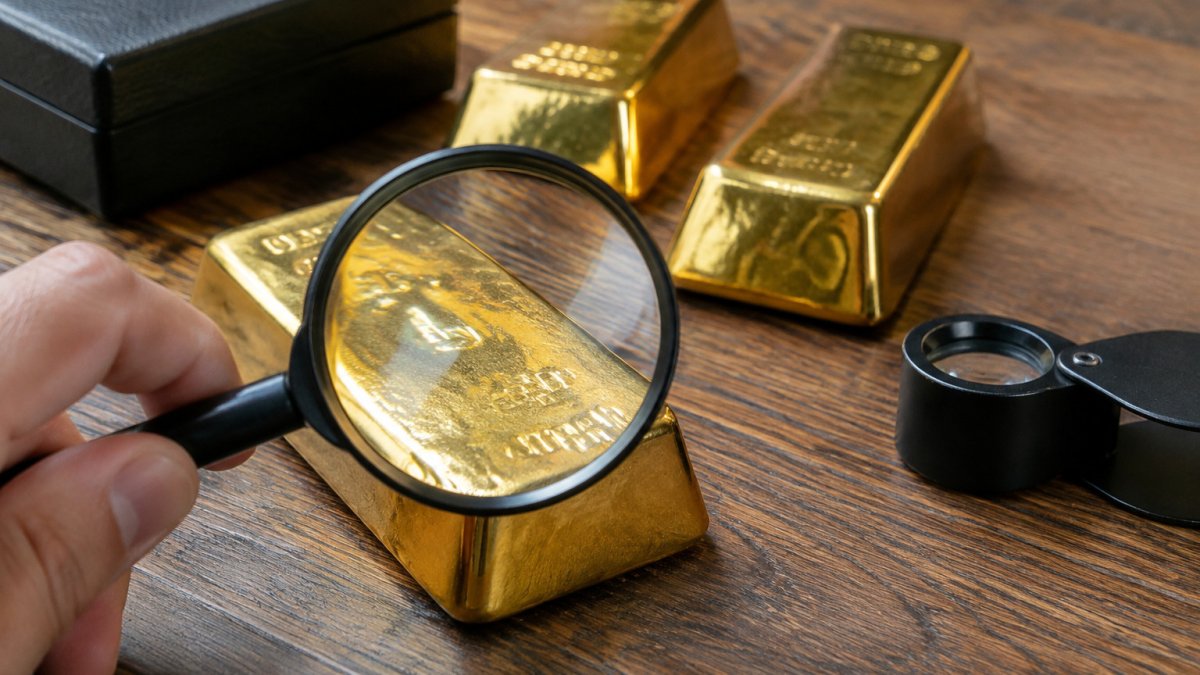
Check for these common warning signs:
- Blurry or uneven lettering: Real stamping is crisp and evenly spaced.
- Wrong fonts: Compare the typeface with a known genuine bar from the same refiner.
- Spelling or spacing errors: Counterfeiters often make small mistakes in the text.
Use a loupe or magnifying glass to see fine details. If you have a verified bar from the same refiner, place the two side by side. Small differences in shape and spacing often show up quickly.
Step 2: Check Edges, Corners and Finish
Next, look at the bar’s shape and surface. Real bars are cast or minted with clean, consistent edges. Fakes often show rough or irregular work.
Pay attention to:
- Sharp, even corners: Rounded or chipped corners can point to a poor casting.
- Surface finish: Look for scratches, bubbles, or pitting that seem out of place.
- Tool marks or seams: Some fakes show visible seams where two pieces were joined.
Be careful when you handle the bar. Hold it by the edges with clean hands, and avoid scratching the surface while you inspect it.
Step 3: Run Fake Gold Bar Visual and Weight Tests
This step combines simple measurements with a basic weight check. Together, they often expose a fake that passed the visual inspection.
Measuring Dimensions and Thickness
Use a digital caliper to measure the bar’s length, width, and thickness. Compare these numbers with the refiner’s published product specifications. Even small gaps can be a red flag.
Measure at several points, since a fake may match the overall size but differ in thickness across the bar.
Magnet and Density Checks
Gold is not magnetic, so a magnet should not attract a genuine bar. Hold a strong magnet near the bar and watch for any pull. Note that this test only catches some fakes.
Weight matters too. Weigh the bar on a precise digital scale and compare the result with its stated weight. Gold is dense, so a bar that is too light for its size is suspicious.
Step 4: Verify the Serial Number and Manufacturer Records
Many modern bars carry a unique serial number. Record it, then check it against the refiner’s records or certificate of authenticity.
If the bar came with an assay card or certificate, confirm that the details match the bar itself. Be cautious with paperwork alone, because counterfeiters can copy certificates too. Contact the refiner directly using contact details from its official website, not from the seller.
Gold Bar Authenticity Testing Tools: What Works and What Doesn’t
Many people try to spot fakes with online tools or home kits. Here is a practical view of what each option can and cannot do:
| Tool or Test | What It Can Show | Limitation |
|---|---|---|
| Visual inspection | Obvious stamping and finish errors | Skilled fakes can pass |
| Digital caliper | Size and thickness mismatches | Does not reveal the core |
| Precision scale | Weight that is off for the stated size | Needs a known, accurate reference |
| Magnet test | Magnetic cores in some fakes | Misses non-magnetic fake cores |
| Serial number check | Mismatched or duplicate serials | Only works if the refiner records are available |
| Professional assay | Actual metal composition | Usually involves a fee and sometimes a sample |
No single test proves a bar is real. The most reliable results come from combining several checks. For high-value purchases, a professional assay is the strongest option.
Next Step: Get a Professional Assay Before You Buy or Sell
If a bar passes your checks but the stakes are high, a professional assay from a qualified lab or dealer is the strongest confirmation available. Professionals can test the metal inside the bar without damaging it, which is the one thing at-home checks cannot do.
Non-destructive professional methods and what each can prove
- X-ray fluorescence (XRF). A spectrometer reads the elemental composition of the surface and the near-surface layer. It is fast and non-destructive, but a thick gold plating can mask a base-metal core, so XRF alone does not prove the interior. Ask the tester to take readings at multiple points, including the edge and any stamped recess.
- Ultrasound. High-frequency sound waves travel through the bar and reflect off changes in density.
- Density measurement. Weighing the bar in air and then in water gives a density figure that can be compared with the expected density for the stated purity. This is non-destructive and catches plated tungsten only when the measurement is precise enough to separate the two densities, which requires careful setup.
No single method is conclusive on its own. A common pattern among reputable testers is to combine XRF with ultrasound or density measurement so that surface and interior are both addressed.
Test without destroying value
Scratching, acid testing, cutting, or drilling a bar can confirm authenticity, but each one damages the bar and can reduce what a dealer will pay for it. A sealed bar in its original assay packaging is worth more than the same bar out of the package, so avoid opening the packaging or marking the surface unless you have already decided the bar is suspect.
Verify the serial number and packaging, but do not trust them alone
Record the serial number and check it against the refiner’s records or certificate of authenticity. Contact the refiner using contact details from its official website, not from the seller. A serial number that does not match, or one that appears on more than one bar, is a strong sign of a fake. Be cautious with paperwork and packaging by themselves, because counterfeiters copy certificates, serials, and shrink wrap convincingly.
What to do after you suspect a fake
If a check fails, act in this order:
- Stop the transaction. Do not send additional payment, and do not ship the bar back to the seller before documenting it.
- Document everything. Photograph the bar, the packaging, the serial number, the assay card, the listing, and all messages with the seller. Keep the original packaging intact.
- Contact the seller in writing. State the failed check and request a refund or return. Keep the correspondence.
- Contact your payment provider. Credit card issuers and payment platforms have dispute processes, and timing matters, so open a dispute promptly if the seller does not resolve it.
- Report the suspected fraud. File a report with the appropriate consumer protection and fraud-reporting channels, and notify the refiner whose markings were copied so it can flag the serial number.
- Get a written professional opinion. A lab report is the evidence a payment dispute or law enforcement report will need.
Professional assay providers typically charge a fee, and it is reasonable to ask for a written report. Choose a testing provider with a clear track record and no conflict of interest. Once you know your bar is genuine, store it carefully. If you need guidance on keeping it secure, see our guide on How to Store Physical Gold Securely.
Frequently Asked Questions
How do I tell if my gold bar is real?
Start with the markings: a genuine bar from a recognized refiner carries a clear logo, crisp lettering, a stated purity such as 999.9 fine, and usually a serial number. Next, check that the weight matches the stated weight on a scale accurate to 0.01 grams, and that the dimensions match the manufacturer’s specifications. Visual and weight checks can flag obvious fakes, but they cannot prove purity on their own. For a conclusive answer, use a professional assay or a verified bullion dealer, and be wary of any seller who discourages testing.
Can you tell if a gold bar is fake just by looking at it?
Sometimes, but not reliably. Crude fakes often show blurry or misspelled logos, uneven edges, tool marks, or fonts that do not match a known genuine example. Skilled counterfeiters, however, copy stamping and finish closely, and tungsten-core bars can look identical on the surface. Treat a visual check as a first filter. If the bar passes, it still needs a weight test and, for larger purchases, professional verification.
How can I check a gold bar’s serial number?
Record the serial number, refiner name and weight, then compare them against the refiner’s published verification tools or certificate database where one exists. Serial numbers that do not appear in the manufacturer’s records, or that are duplicated across multiple bars, are a red flag. Keep in mind that a serial number alone does not prove authenticity, because counterfeiters can copy stamps and numbers. Pair the record check with weight, dimension and professional testing.
Can I test a gold bar at home without damaging it?
Yes, several checks are non-destructive: visual inspection, weighing on a calibrated digital scale, measuring dimensions with digital calipers, a magnet test, and a density check using water displacement. Avoid acid tests, scratch tests on valuable bars, and drilling, since these can permanently mark or devalue the bar and do not reliably confirm purity. For a definitive, non-destructive result, professional methods such as X-ray fluorescence or ultrasound testing are available through assay offices and reputable dealers.
