
How to Evaluate Gold Purity for Investment: 2026 Guide
Table of Contents
- What You’ll Need Before You Evaluate Gold Purity
- How the Karat System Works and What It Means for Buyers
- Gold Fineness Explained: Reading the Numbers on Coins and Bars
- How to Test Gold Authenticity at Home and at a Dealer
- 24K vs 22K Gold Investment: Which Purity Belongs in Your Portfolio
- How Purity Affects Melt Value, Premiums, and Liquidity
- How to Evaluate Gold Purity for Investment: Step-by-Step
- Conclusion
- Frequently Asked Questions
Last Updated: September 25, 2026
What You’ll Need Before You Evaluate Gold Purity
You don’t need a lab to judge gold. You need a few cheap tools and a clear plan. This guide from My Gold Book walks through how to evaluate gold purity for investment, step by step.
Gather these before you start:
- A jeweler’s loupe (10x magnification)
- A digital scale that reads in grams
- A magnet (strong neodymium works best)
- A ceramic testing plate
- A small bottle of nitric acid, if you plan to test scrap
- A calculator for melt value math
How the Karat System Works and What It Means for Buyers
The karat system measures gold content in 24 parts. Pure gold is 24K. Everything else is a fraction of that.
- 24K = 99.9%+ gold
- 22K = 91.7% gold
- 18K = 75% gold
- 14K = 58.3% gold
- 10K = 41.7% gold
Gold Fineness Explained: Reading the Numbers on Coins and Bars
Gold fineness is the purity of gold stated in parts per thousand. It’s the number investors trust most.
| Marking | Fineness | Karat | Common Use |
|---|---|---|---|
| 999.9 | 99.99% | 24K | Bullion bars |
| 999 | 99.9% | 24K | Gold coins |
| 916.7 | 91.67% | 22K | Sovereign coins |
| 750 | 75.0% | 18K | Fine jewelry |
| 585 | 58.5% | 14K | Everyday jewelry |
How to Test Gold Authenticity at Home and at a Dealer
Start with the cheapest, non-destructive tests, then escalate. Each test rules out a different class of fake, and no single test catches everything.
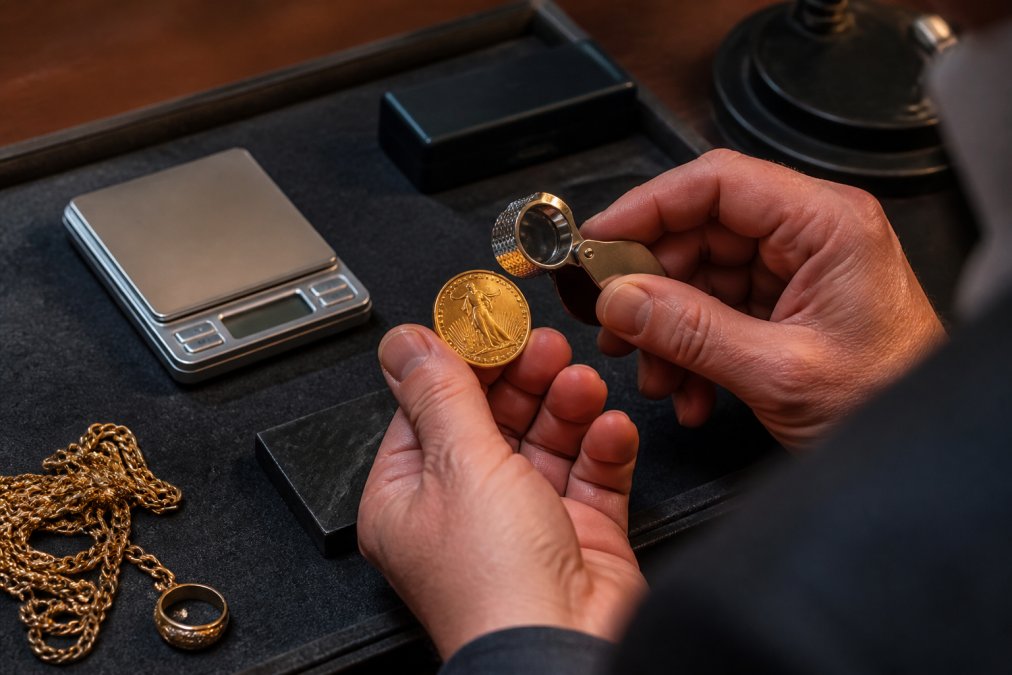
- Visual inspection with a 10x loupe. Look for the hallmark, the fineness stamp, and any seam, plating line, or porosity. Real bullion has crisp, uniform edges. Cast fakes often show pitting or a faint ridge where a plating layer meets the core.
- Weigh against spec. A genuine 1 troy ounce coin weighs 31.1035 grams. Fakes frequently run light by 0.2-0.5 grams, which is enough to flag them on a $20 digital scale.
- Magnet test. Gold is paramagnetic at most, it does not stick. A strong neodymium magnet should slide off with no pull. If the piece sticks, it contains iron or nickel. If it slides too freely with zero resistance, that is also a red flag, because tungsten and lead cores behave that way.
- Ceramic streak test. Rub the edge on unglazed ceramic. Real gold leaves a gold streak. A greenish or grayish streak indicates a base-metal core.
- Density test. Divide weight in grams by volume in milliliters (measure displacement in a graduated cylinder). Fine gold sits near 19.3 g/mL; 22K near 17.3 g/mL; 18K near 15.5 g/mL. Tungsten sits at 19.25 g/mL, which is why it defeats magnets and scales, density alone will not catch a tungsten core.
- Acid test. Scratch a small mark on a hidden edge, apply the correct nitric acid strength for the claimed karat, and watch the reaction. This is destructive and best reserved for scrap, not collectible coins.
- Electronic gold tester. A dealer’s conductivity tester reads surface purity in seconds and is the fastest way to catch plated tungsten. Ask for the reading before you buy.
Most counterfeits fail the density test, not the magnet test. Tungsten has a density close to gold, so it fools magnets and scales. A dealer’s electronic gold tester catches it.
Counterfeit Detection Protocol for Investors
Counterfeits have moved past crude plating. The two patterns that trip up buyers most often are tungsten-core bars (correct weight, correct dimensions, wrong metal inside) and plated coins with a thin gold shell over brass. A practical protocol:
- Buy only from a dealer who will test in front of you. Reputable dealers run an electronic tester or X-ray fluorescence (XRF) gun on request. If a seller refuses, walk.
- Insist on a written receipt that states weight, fineness, and serial number for bars. This is your paper trail if a piece turns out to be fake.
- Avoid deals priced far below spot. A price more than a few percent under melt value on a common bullion item is a warning sign, not a bargain.
- Check serial numbers against the mint’s database for branded bars. Major refiners publish verification portals.
- For high-value purchases, use an escrow or third-party assay. An assay costs a small fraction of the purchase and confirms purity independently.
- Never test with acid on a coin you intend to keep as an investment. The scratch permanently reduces its resale value.
A magnet test alone proves nothing. Tungsten, lead, and plated brass can all pass it. Treat any single test as one data point, not a verdict.
When to Walk Away
Walk away if the seller pressures you to skip testing, if the hallmark is blurry or misaligned, if the weight is off by more than 0.1 gram on a bullion coin, or if the price is too good. The cost of a missed fake is the full purchase price, there is no partial recovery on a counterfeit bar.
24K vs 22K Gold Investment: Which Purity Belongs in Your Portfolio
For pure investment, 24K wins. It holds the highest intrinsic value per gram and trades closest to spot price.
Here’s the trade-off:
- 24K: Highest purity, softest metal, best for bars and storage.
- 22K: Slightly less pure, tougher, easier to resell in coin form.
How Purity Affects Melt Value, Premiums, and Liquidity
Purity drives three numbers: melt value, premium, and liquidity. But for investors, the more important question is how purity is verified, and that answer changes depending on whether you hold metal, allocated metal, or a digital claim.
Click Here To Order Your Copy →
| Purity | Melt Value | Typical Premium | Liquidity |
|---|---|---|---|
| 24K bullion | Highest | Lowest | Highest |
| 22K coins | High | Low | High |
| 18K jewelry | Moderate | High | Moderate |
| 14K jewelry | Lower | High | Lower |
Low-purity jewelry is not a good investment vehicle. You pay retail markup, then sell at scrap value. That spread can wipe out any gain from a price move.
How Purity Is Verified for Allocated and Digital Gold
Most guides stop at physical testing. That leaves a blind spot: a growing share of retail gold exposure is bought as allocated or digital product, where you never touch the metal. Purity verification works differently here, and investors need to know what to demand.
- Allocated accounts. You own a specific, serialized bar held by a custodian. Purity is documented by the refiner’s assay certificate and the bar’s serial number. Ask for the bar list, the refiner name, and the assay. If the custodian will not disclose the specific bars, you have a pooled claim, not allocated metal.
- Pooled accounts. You own a fractional claim on a pool of metal. Purity is a weighted average across the pool, disclosed in the account terms. Pooled metal is cheaper to hold but carries custodian risk and less transparency.
- Digital gold products. These are typically tokenized claims backed by physical bars in a vault. Purity is verified by the vault’s independent auditor, not by you. Look for published audit reports, the identity of the auditor, the refiner, and the vault jurisdiction. A product that will not name its auditor is a red flag.
- Gold-backed ETFs. Purity is set by the trust’s prospectus, most hold London Good Delivery bars, which are 995 fineness or better. The prospectus and the trust’s bar list are public filings.
For any non-physical gold product, the purity question becomes a documentation question. Ask three things: who refined the metal, who audited it, and who holds it. If any answer is vague, treat the purity claim as unverified.
Why This Matters for Liquidity
Physical bullion with a recognized hallmark and assay sells in minutes at a dealer. Allocated metal with clean documentation sells back to the custodian or on a secondary market, usually at a small spread. Pooled and digital products depend entirely on the issuer’s redemption terms, read them before you buy, because a product that is easy to buy can be slow or expensive to sell.
Purity is only as good as its verification. For physical metal, that means a hallmark plus a test. For allocated and digital gold, that means an assay, an auditor, and a named custodian. Match the verification standard to the product before you commit capital.
How to Evaluate Gold Purity for Investment: Step-by-Step
Here is the full process, start to finish.
Step 1: Identify the mark. Look for a karat stamp or fineness number. Note it.
Purity, weight, and liquidity matter more than the brand on the bar. A well-known 24K bar with a low premium beats a rare 22K coin with a high markup for most investors.
Conclusion
Evaluating gold purity takes an hour of practice and a few cheap tools. The payoff is real: you stop overpaying for low-purity pieces and start buying metal that holds value.
Frequently Asked Questions
Is 999.9 gold equal to 24K?
Yes. 999.9 fine gold is 99.99% pure, which rounds to 24K on the karat scale. The difference between 999 and 999.9 is measured in hundredths of a percent, so both qualify as 24K for investment purposes. When you evaluate gold purity for investment, look for the fineness stamp (999, 999.9) rather than the karat label alone, since fineness gives you the exact purity percentage.
What is the difference between karat and fineness?
Karats divide gold into 24 parts, so 18K means 18 parts gold and 6 parts alloy. Fineness expresses the same purity in parts per thousand, so 18K equals 750 fineness. Investment-grade bullion is usually stamped in fineness (999, 999.9) because it is more precise. American Gold Eagles, for example, are 22K (916.7 fineness) but contain a full troy ounce of pure gold.
How can I verify gold authenticity at home?
Start with a visual check for hallmarks, then weigh the item on a digital scale and compare it to the expected troy weight for its size. A strong magnet should not attract gold, and a density test (weight divided by water displacement) can flag tungsten-filled fakes. These methods catch obvious counterfeits but cannot confirm purity. For investment-grade purchases, ask a dealer to run an electronic gold tester or assay.
How much does it cost to test gold purity?
Costs vary by method and provider. Acid test kits for home use are inexpensive, while an electronic gold tester costs more upfront but pays off if you buy often. A professional assay at a refiner or dealer typically carries a fee that depends on the item and turnaround time. For any single high-value purchase, a professional test is worth the cost before you commit funds.