
How to Secure Your Digital Assets vs Gold in 2026
Table of Contents
- Digital Assets vs Gold: Quick Security Comparison
- Best Practices for Cold Storage of Digital Assets
- Physical Gold Storage Options for Maximum Security
- Digital Asset Cybersecurity Risks Every Investor Should Know
- Insurance and Liability: Gold vs Digital Assets
- Inheritance and Estate Planning for Both Asset Types
- How to Secure Digital Assets vs Gold: A Step-by-Step Framework
- Frequently Asked Questions
Last Updated: September 24, 2026
Digital Assets vs Gold: Quick Security Comparison
Learning how to secure your digital assets vs gold starts with one fact: gold has no password to lose and no server to hack. That difference shapes every storage, insurance, and inheritance decision that follows. This guide from My Gold Book breaks down both paths, from hardware wallets to home safes. Most guides stop at “buy a hardware wallet” or “rent a vault.” The real work is in the details: seed phrase backups, custodial trade-offs, and estate planning.
Here is the security picture at a glance:
| Factor | Digital Assets | Physical Gold |
|---|---|---|
| Ownership proof | Private keys or custodial account | Physical possession or vault receipt |
| Primary threat | Phishing, malware, exchange failure | Theft, fire, loss |
| Recovery if lost | Seed phrase backup | Insurance claim or police report |
| Access needs | Internet or device | None |
| Inheritance | Requires key transfer plan | Requires physical handover |
Best Practices for Cold Storage of Digital Assets
Cold storage keeps private keys offline so no internet connection can expose them. For holdings you don’t trade weekly, it is the single most effective step you can take.
Hardware Wallets and Seed Phrase Management
A hardware wallet stores your private keys on a dedicated device that never touches the internet. Ledger, for example, keeps keys inside a secure element chip and requires a physical button press to approve each transaction (Ledger hardware wallet documentation). Devices in this category typically start around $79.
- Write the phrase on paper or metal, never in a photo or cloud note
- Store it somewhere separate from the device itself
- Never type it into a website or share it with “support”
- Test your backup once with a small amount before trusting it
A common mistake is storing the seed phrase next to the hardware wallet. A single burglary then defeats both layers at once. Keep them in separate locations.
Custodial vs Self-Custody Trade-offs
Self-custody means you hold the keys and accept full responsibility. Custodial services like Coinbase hold assets on your behalf, with most customer funds kept in cold storage and hot-wallet balances covered by insurance (Coinbase security and insurance overview). The trade-off is counterparty risk: if the platform fails or freezes withdrawals, your access goes with it. Beginners often start custodial and move larger balances to self-custody over time.
Physical Gold Storage Options for Maximum Security
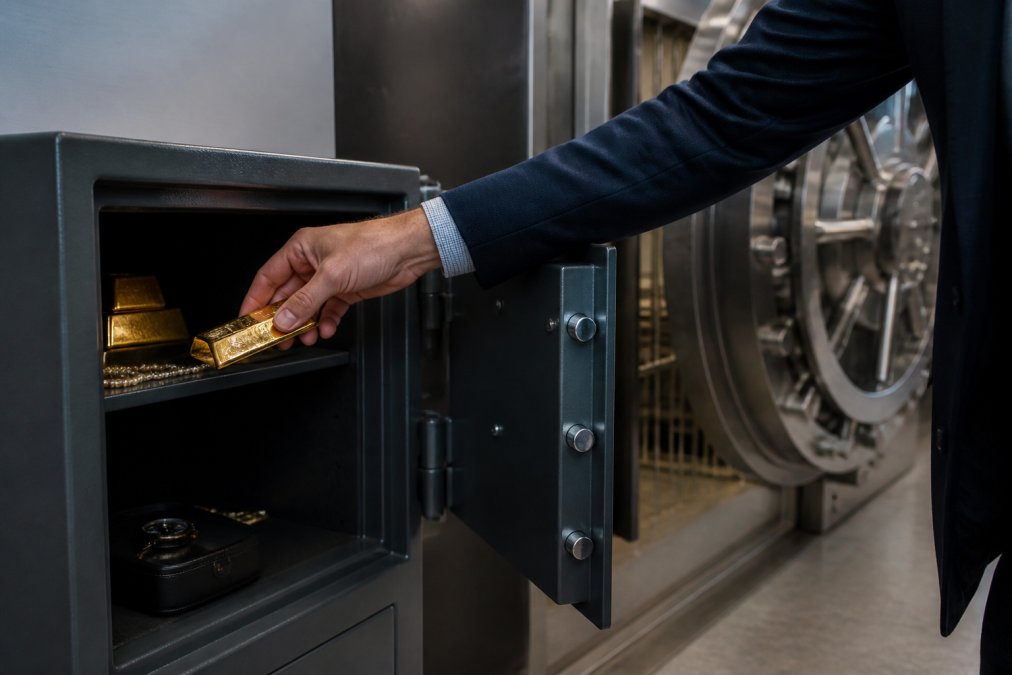
Physical gold storage options range from a home safe to a bank safe deposit box to a professional vault. The right choice depends on how much you hold, how often you need access, and what you’ll pay for peace of mind.
Home Safes vs Bank Safe Deposit Boxes vs Professional Vaults
Each option trades cost, control, and convenience against the others.
- Home safe: Full access, no monthly fee, but a burglar who finds it has found your gold. A bolted safe with a UL-rated lock can be a significant investment depending on size and fire rating. Insure it separately and bolt it to a concrete floor or wall stud, a safe that can be carried out will be.
- Bank safe deposit box: Inexpensive and off-site, often a modest annual fee. Access is limited to branch hours, and contents are not federally insured, the bank’s liability is capped at a multiple of the annual rent, far below serious holdings. You also lose privacy: a court order can open it.
- Professional vault: A dealer or depository stores and insures your bullion, often via a third-party vaulting service. You get segregated storage, audited inventory, and all-risk insurance, but give up physical possession and pay ongoing fees that scale with value. For larger positions, the insurance and audit trail usually justify the cost.
Choosing Based on Your Situation
- Small holdings (a few coins or a small bar): A bolted home safe plus a scheduled rider on your homeowner’s policy is workable. Keep the safe discreet.
- Mid-size holdings: Split between a home safe and a bank box, or move to a professional vault if the annual fee is a small fraction of the value.
- Large holdings: A professional vault with segregated, insured storage is usually right. Vaulting cost is a rounding error next to the risk of a home loss.
Access and Liquidity Trade-offs
Home storage wins on immediate access, you can sell a coin the same day. Bank boxes add a branch visit and limited hours. Professional vaults may require advance notice and identity verification, slowing a quick sale. If you trade frequently, keep a small working amount at home and vault the rest.
Whatever you choose, photograph your holdings and store the images separately from the gold. If you ever need to file an insurance claim or a police report, that record is the difference between a smooth payout and a denied one.
Digital Asset Cybersecurity Risks Every Investor Should Know
Digital asset cybersecurity risks fall into two buckets: attacks on your accounts and attacks on the platforms themselves. Most losses trace to the first bucket, and most of those start with a careless click.
Phishing, Malware, and Exchange Breaches
Phishing is the top threat. Fake emails, cloned login pages, and impostor “support” accounts all aim to capture your credentials or seed phrase. Exchange breaches make headlines but affect a minority of holders compared with individual phishing losses. Your login hygiene matters more than which exchange you pick.
Click Here To Order Your Copy →
Cybersecurity Hygiene for Non-Technical Investors
You do not need a technical background to protect yourself. A short checklist covers most of the risk:
- Turn on multi-factor authentication everywhere, using an app rather than SMS
- Use a unique password for every exchange and email account
- Bookmark exchange URLs instead of clicking links in emails
- Never share your seed phrase with anyone, including “support”
- Keep your device updated and avoid public Wi-Fi for account access
Set up a separate email address used only for exchange accounts. If that inbox stays clean, a phishing email landing in your main inbox is an obvious red flag.
Insurance and Liability: Gold vs Digital Assets
Insurance is where the two asset classes diverge most, and it’s the angle most comparisons skip. Understanding the actual mechanisms separates a real security plan from a wish list.
How Physical Gold Is Insured
Gold held at home is typically covered under a homeowner’s or renter’s policy, but only up to a sub-limit for valuables, often a fraction of what a serious collection is worth. Standard policies may exclude bullion entirely unless scheduled. Above the sub-limit, you need one of two things:
- A scheduled personal property endorsement (rider): You list each item or the aggregate holding, the insurer agrees on a value, and coverage applies without a deductible in most cases. The insurer usually requires proof of storage, a bolted safe, vault receipt, or bank box, before binding coverage.
- A standalone precious metals policy: Written by specialty carriers, these cover bullion in transit, at home, or in a depository. Premiums scale with declared value and storage quality; a professional vault typically earns a lower rate than a home safe.
How Digital Assets Are Insured
Digital assets are harder to insure directly, and the coverage that exists is often misunderstood.
- Custodial platforms: Major exchanges carry insurance on hot-wallet crypto, and some add cold storage coverage. That protects the platform’s balance sheet and may reimburse customers in a covered event, but it is not a personal policy and does not guarantee your claim is paid in full. Read the fine print on payout triggers.
- Self-custody: Coins you hold in a hardware wallet are effectively uninsurable through standard homeowners or renters policies. Some specialty insurers now offer limited coverage for self-custodied assets, but underwriting is strict and premiums are high relative to the coverage amount.
- Stablecoins and tokenized gold: These sit in a gray zone. If the issuer fails or the backing asset is mismanaged, insurance may not respond at all.
The Practical Takeaway
With gold, you can buy protection through a rider or standalone policy, and insurers understand the coverage. With digital assets, you mostly build protection through custody choices, cold storage, multi-signature setups, and platform diversification, because the insurance market is still thin. If you hold both, treat gold insurance as a purchasable layer and digital asset security as an operational discipline.
Do not assume your homeowner’s policy covers gold in a safe or crypto in a wallet. Most standard policies exclude or severely limit both. Confirm coverage in writing before you rely on it.
Inheritance and Estate Planning for Both Asset Types
Estate planning is the quiet failure point for both asset classes. Gold in an unknown home safe can sit undiscovered for years. Digital assets are worse: without the keys, the holdings are gone permanently, with no court or exchange able to recover them.
The asset you can’t hand over is the asset your heirs lose. A one-page access letter, updated yearly, protects both gold and crypto better than any single storage upgrade.
How to Secure Digital Assets vs Gold: A Step-by-Step Framework
Use this sequence to secure both sides of your portfolio without overcomplicating it.
- Inventory everything. List each holding, its location, and its access method.
- Move long-term crypto to cold storage. A hardware wallet plus a separated seed phrase backup.
- Decide custody per balance. Small amounts custodial, larger amounts self-custody.
- Store physical gold deliberately. Bolted safe for small holdings, professional vault for larger ones.
- Add insurance where it exists. A scheduled rider for gold; understand what platform coverage actually covers.
- Write the access letter. One page, stored with your estate documents, updated yearly.
| Step | Applies To | Time Needed | Frequency |
|---|---|---|---|
| Inventory holdings | Both | 1 hour | Yearly |
| Cold storage setup | Digital | 1-2 hours | Once |
| Safe or vault decision | Gold | 1 week | Once |
| Insurance rider | Gold | 2-3 weeks | Yearly review |
| Access letter update | Both | 30 minutes | Yearly |
Frequently Asked Questions
What are the primary security risks associated with digital assets compared to physical gold?
Digital assets face cybersecurity threats like phishing, malware, and exchange breaches that can wipe out holdings in seconds. Physical gold is vulnerable to theft, loss, and storage costs, but it cannot be hacked remotely. The key difference is that digital asset security depends on your operational habits and platform trust, while gold security depends on physical safeguards and insurance.
How do cold storage solutions for digital assets compare to physical gold vaults?
Cold storage, such as hardware wallets, keeps private keys offline, similar to how a vault keeps gold out of reach. Both require careful access management. However, cold storage demands seed phrase backups and device maintenance, while gold vaults need insurance and audit verification. Each method trades convenience for security in different ways.
What regulatory protections exist for gold investors versus digital asset holders?
Physical gold ownership is governed by general property and contract law, with no dedicated federal regulator. Digital assets fall under a patchwork of state and federal rules, including SEC and CFTC oversight for securities and derivatives, and NYDFS for certain custodians. This means gold investors rely more on private contracts and insurance, while digital asset holders may have some regulatory recourse in cases of fraud.
Is gold considered a safer long-term store of value than digital assets?
Gold has a multi-century track record as a store of value and tends to hold up during inflation and market volatility. Digital assets like Bitcoin offer high growth potential but are far more volatile and depend on continued network security and adoption. For long-term wealth preservation, many investors use gold as a hedge and allocate only a small portion to digital assets.