
Gold Bullion vs Gold Jewelry for Investment
Table of Contents
- Gold Bullion vs Gold Jewelry: A Side-by-Side Comparison
- Understanding Gold Bullion Premiums
- Gold Jewelry Resale Value and Liquidity
- Is Gold a Good Inflation Hedge?
- Tax Implications and Storage Considerations
- Which Option Fits Your Investment Goals?
- Frequently Asked Questions
Last Updated: September 28, 2026
Gold Bullion vs Gold Jewelry: A Side-by-Side Comparison
When you’re considering gold as an investment, the first decision isn’t whether to buy gold at all, it’s which form makes sense for your financial goals, and understanding gold bullion vs gold jewelry for investment is essential to that choice. Gold bullion and gold jewelry represent fundamentally different approaches to owning the same underlying asset. One prioritizes pure investment efficiency. The other blends utility, aesthetics, and wealth preservation into a single purchase.
The difference matters because it directly affects how much you’ll pay, how easily you can sell, and whether you’re actually building wealth or simply buying something beautiful that happens to hold value.
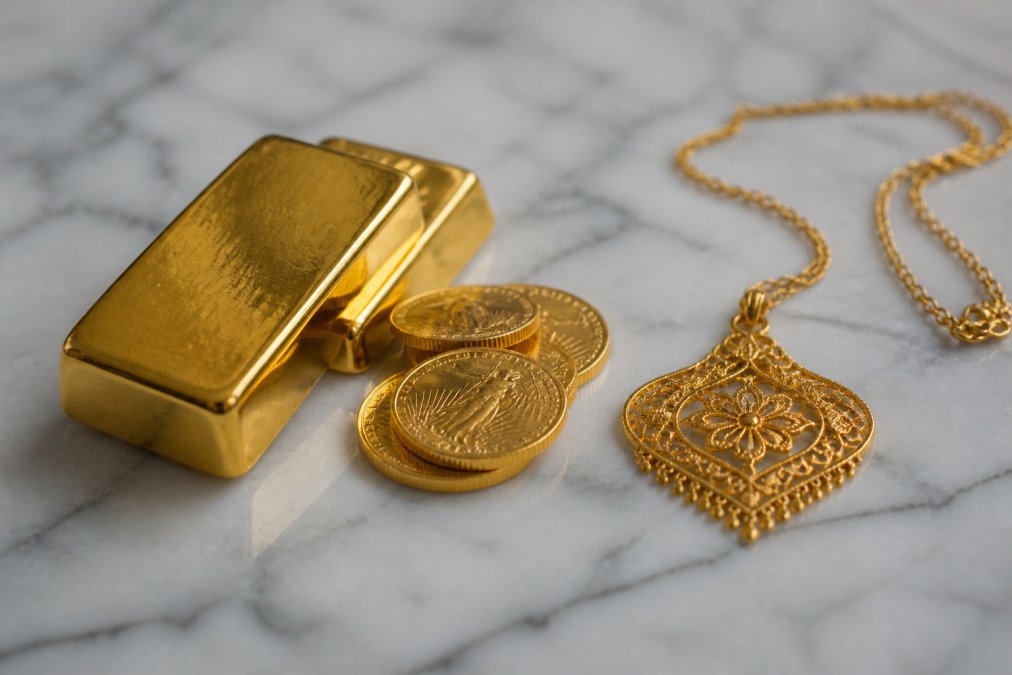
Investment Efficiency and Total Cost
Gold bullion wins on pure investment efficiency. A bullion bar or coin contains standardized weight and purity, typically .999 or .9999 fine gold, with minimal markup over the spot price. When you buy from dealers, you’re paying for the gold itself plus a small premium that reflects the dealer’s cost and profit margin.
Gold jewelry, by contrast, carries significant additional costs. A 14-karat gold ring isn’t just gold, it’s labor, design, branding, and retail markup. Even at 24-karat purity, some jewelry charges a design fee on top of the spot price. That fee can range considerably depending on the piece’s complexity and the jeweler’s positioning.
Here’s the practical difference: if gold spot price is $2,000 per troy ounce, a bullion dealer might sell you an ounce for $2,050 to $2,100. A jeweler selling a comparable weight in a finished piece could ask $2,500 or more. That premium, the gap between what you pay and what you can resell for, is where investment efficiency diverges.
Purity and Weight Standards
Bullion products follow strict purity standards that make verification straightforward. The U.S. recognizes investment-grade gold as .995 fine or higher, though most bullion traded internationally meets .999 or .9999 standards. Weight is measured in troy ounces, a system designed specifically for precious metals. You always know exactly what you own.
Jewelry purity varies widely. The standard karatage system, where 24 karat equals pure gold and 14 karat equals roughly 58% gold, tells you the percentage but not the total weight in a wearable piece. A 14-karat bracelet might contain only a fraction of an ounce of actual gold mixed with other metals for durability and color. That makes comparing the gold content between a bracelet and a bullion bar more complicated than it should be.
Some jewelry retailers address this gap by pricing jewelry based on daily spot price plus a transparent design fee, and by tracking weight standardization for every piece. It’s a bridge between jewelry and bullion. But standard jewelry retailers don’t offer this level of clarity, you’re often guessing at the actual gold content relative to total weight.
Understanding Gold Bullion Premiums
The premium is the extra amount you pay above the spot price when buying bullion. It’s not a hidden fee, it’s the dealer’s legitimate cost for sourcing, assaying, storing, insuring, and selling the product to you.
Premiums vary based on product type and market conditions. Sovereign mint coins (like American Gold Eagles or Canadian Maple Leafs) typically carry higher premiums than generic bars because they’re government-backed and easier to verify. Private mint bars often cost less. During periods of high demand or supply constraints, premiums widen. During calm markets, they compress.
A reasonable premium on bullion ranges from 2% to 8% above spot, depending on what you’re buying and when. Compare that to jewelry, where the markup, the difference between what you pay and the gold’s intrinsic value, often exceeds 50% or more. That’s the real cost of design, craftsmanship, and retail positioning.
Dealers focused on low-premium products emphasize this point heavily in their marketing. Their value proposition is straightforward: minimize the markup, maximize the gold you own for your dollar.
Gold Jewelry Resale Value and Liquidity
This is where jewelry’s limitations become unavoidable. When you sell gold jewelry, the buyer is interested in one thing: the gold content. The design, brand, and craftsmanship that added 50% to the original price disappear the moment you try to liquidate.
A jeweler buying your used 14-karat ring will pay based on the weight of pure gold it contains, usually at a discount to the current spot price. That discount, sometimes called the resale deduction, can be 10% to 25% below spot, depending on the buyer and current market conditions. The beautiful design you paid a premium for has zero resale value.
Bullion, by contrast, sells at or near spot price. A dealer buying back a bar or coin you own will pay close to the current market rate, minus a small spread. The spread is typically 2% to 5% below spot, far tighter than jewelry’s resale deduction. Liquidity is higher because buyers know exactly what they’re getting: standardized gold at a predictable purity.
Some buy-back programs attempt to bridge this gap by offering to repurchase jewelry at transparent prices. But even with that advantage, a jewelry piece still loses more value on resale than an equivalent weight of bullion would.
Click Here To Order Your Copy →
Is Gold a Good Inflation Hedge?
This question drives much of the gold investment conversation, and the answer depends on your time horizon and what you’re protecting against.
Gold has historically held purchasing power during periods of rising inflation. When the dollar weakens or prices rise across the economy, gold tends to appreciate. That’s the hedge, your gold retains value while the currency in your bank account loses it.
But gold isn’t a perfect inflation hedge. Over short periods (months to a few years), gold prices fluctuate based on interest rates, dollar strength, and investor sentiment. It doesn’t move in lockstep with inflation. Over decades, gold has roughly matched inflation, meaning you preserve wealth but don’t necessarily grow it.
The practical implication: if your goal is inflation protection, both bullion and jewelry technically work.
Tax Implications and Storage Considerations
Gold held as a physical asset triggers specific tax treatment. When you sell gold bullion or jewelry at a profit, the gain is taxed as a collectible under Internal Revenue Code Section 408(m), which means a maximum federal tax rate of 28% on long-term capital gains. That’s higher than the long-term capital gains rate for stocks (15% to 20%), which matters when you’re building a portfolio.
Tax-Advantaged Accounts: The IRA Advantage
Some investors use self-directed IRAs to sidestep this tax drag entirely. A precious metals IRA (also called a self-directed IRA) allows you to hold physical bullion in a retirement account, deferring or eliminating taxes on gains. However, not all gold qualifies. The IRS permits only investment-grade bullion that meets specific purity standards: gold bars and coins must be .995 fine or higher.
Storage, Insurance, and Appraisal Costs
Home Storage: Bullion stored at home requires a safe (typically $500-$3,000 for a quality model) or a safe deposit box at a bank ($25-$100 annually). You’ll also need homeowner’s or renter’s insurance that explicitly covers precious metals. Standard policies often exclude or cap coverage for bullion; you may need a rider or separate policy, adding $100-$300 annually depending on the value insured. For jewelry, home storage in a safe is the norm, and insurance is often bundled into standard homeowner’s coverage, though you should verify the limit (many policies cap jewelry at $1,500-$5,000 without a rider).
Verification and Counterfeit Detection
Before storing or insuring any gold, you need to verify authenticity and purity. This is where bullion and jewelry diverge significantly in practical terms.
The Total Cost of Ownership
When calculating whether gold is a sound investment, factor in all carrying costs:
- Bullion in home safe: $500-$3,000 initial safe cost, $100-$300 annual insurance rider, $0 storage fees. Total first-year cost: $600-$3,300. Ongoing annual cost: $100-$300.
- Bullion in professional vault: $0 initial cost, $500-$1,000 annual storage, $100-$300 insurance. Total annual cost: $600-$1,300.
- Jewelry in home safe: $500-$3,000 initial safe cost, $50-$150 annual insurance (often included in homeowner’s policy), $25-$100 appraisal (every 3-5 years). Total first-year cost: $575-$3,250. Ongoing annual cost: $50-$150 plus periodic appraisals.
- Jewelry in vault: $0 initial cost, $500-$1,000 annual storage, $50-$150 annual insurance, $25-$100 appraisal (every 3-5 years). Total annual cost: $550-$1,250 plus periodic appraisals.
Which Option Fits Your Investment Goals?
When deciding between gold bullion vs gold jewelry for investment, choose gold bullion if you’re building a dedicated precious metals allocation. You want to maximize the gold you own for each dollar spent, minimize resale friction, and potentially use a tax-advantaged account. Bullion is the pure play on gold as an asset.
Frequently Asked Questions
What is the main difference between gold bullion premiums and jewelry markups?
Gold bullion premiums are the fees dealers add above the spot price, typically 3-8% for investment-grade bars and coins. Jewelry markups are much higher, often 50-100% or more, because they cover design, labor, and retail overhead. A gold bullion bar tracks closely to its intrinsic value, while jewelry prices include significant fabrication costs that don’t return when you resell.
Why is gold jewelry resale value so much lower than its purchase price?
Jewelry resale value depends on weight and purity, not the original retail price. When you sell jewelry back, dealers pay based on the spot price minus their margin and assay costs. The design premium, labor, and retail markup you paid upfront disappear. A ring bought for $2,000 might contain only $1,200 worth of gold by weight, and a dealer may offer $900-$1,100 for it.
Is gold a good inflation hedge compared to other assets?
Gold historically preserves purchasing power during inflation and currency devaluation, making it a legitimate hedge. Over decades, gold prices tend to rise when inflation accelerates. However, gold generates no income like stocks or bonds do, and its price can be volatile short-term. For inflation protection, gold works best as part of a diversified portfolio, not as your only hedge.
Can I store gold bullion in a tax-advantaged IRA account?
Yes, certain gold bullion products qualify for Individual Retirement Accounts (IRAs). Gold must meet purity standards (.995 fine or higher for bars, specific coin types) and be held by an IRS-approved custodian, not at home. This offers tax-deferred growth, but jewelry generally does not qualify for IRA storage due to purity and design restrictions.
When you’re deciding between gold bullion and gold jewelry for investment, the choice comes down to efficiency versus aesthetics. Bullion wins on pure investment merit: lower premiums, tighter resale spreads, and clearer liquidity. Jewelry offers beauty and utility alongside wealth preservation, but at a meaningful cost. My Gold Book provides the comprehensive framework to evaluate both options against your specific financial goals and investment timeline.