
Is Gold Research Still Relevant in 2026? A Practical Guide
Table of Contents
- Why Gold Research 2026 Still Matters for Investors
- Key Macroeconomic and Geopolitical Drivers Shaping Gold in 2026
- Gold Price Outlook: Structural Momentum vs. Tactical Risks
- How to Analyze Gold Price Movements Step by Step
- Best Gold Investment Research Tools for 2026
- Gold vs Cryptocurrency 2026 Comparison: Inflation Hedge or Speculation?
- Tax Implications and Practical Steps for Retail Gold Investors in 2026
- Why Gold Research 2026 Demands More Than a Google Search
Last Updated: August 6, 2026
Why Gold Research 2026 Still Matters for Investors
Gold research 2026 is the foundation of every sound decision a retail investor makes about precious metals today. Investors who skip the research phase are caught off-guard when prices move sharply. Gold is a safe-haven asset that tends to hold or increase value during economic stress, currency devaluation, and geopolitical instability, but understanding the forces behind price moves requires more than a quick search.
Below, we’ll walk through the macroeconomic drivers, price outlook scenarios, practical analysis methods, and tax considerations that define the current landscape. Central bank reserve strategies have shifted, real interest rates have oscillated, and geopolitical instability has introduced new demand patterns. Investors relying on outdated frameworks are navigating with the wrong map.
Key Macroeconomic and Geopolitical Drivers Shaping Gold in 2026
Understanding which economic indicators move bullion prices separates tactical allocation from guesswork.
Central Bank Buying and Reserve Diversification
Central bank buying has become one of the most consequential structural drivers of gold demand. Many central banks, particularly in emerging economies, have been actively diversifying away from dollar-denominated reserves, reflecting concerns about fiat currency concentration risk.
According to World Gold Council’s central bank survey, central banks have been net buyers of gold for well over a decade, with recent years seeing particularly elevated purchase volumes. This institutional portfolio diversification at the sovereign level creates a durable floor under gold prices. When the largest institutional buyers in the world are structurally increasing their gold reserves, that signals long-term confidence in the asset class, regardless of short-term price consolidation.
Interest Rates, Real Rates, and the Yield Environment
Gold moves with real rates, nominal rates minus inflation expectations, not simply with interest rates. When real rates are negative or deeply suppressed, the opportunity cost of holding a non-yielding asset like bullion drops to near zero, making gold comparatively attractive.
The yield environment in 2026 reflects ongoing tension between central bank policy and persistent inflation pressures. When real rates remain low, gold’s role as a capital preservation tool is reinforced. When real rates rise sharply, gold can face downside risk as yield-bearing assets become more competitive.
Tracking the 10-year Treasury Inflation-Protected Securities yield, available through U.S. Treasury real yield data, gives investors a direct read on this relationship.
Gold Price Outlook: Structural Momentum vs. Tactical Risks
The gold price outlook for 2026 reflects tension between structural momentum and tactical risks. Structural forces, including central bank demand, currency devaluation concerns, and persistent inflation, support a bullish longer-term case. Tactical risks, including shifts in investor sentiment, a strengthening dollar, or rapid real rate increases, can produce sharp corrections within that broader trend.
Investment Demand vs. Jewelry Consumption
Gold demand splits into two fundamentally different categories. Investment demand, which includes exchange-traded funds, bullion coins, and bars, is highly sensitive to macroeconomic conditions and investor sentiment. Jewelry consumption is driven by income growth, cultural factors, and price sensitivity in key markets like India and China.
In a high-price environment, jewelry demand tends to contract as consumers defer purchases. Investment demand can accelerate in the same environment if investors view the price rally as confirmation of a macro thesis. Understanding which category is driving price tells you whether the move is sustainable.
Supply-Side Constraints and Production Trends
Gold mining is capital-intensive, geographically concentrated, and subject to long lead times between exploration and production. New mine supply cannot respond quickly to price signals. High-grade ore deposits are becoming harder to find and more expensive to develop, creating a structural supply ceiling that, combined with growing demand from central banks and retail investors, supports a long-term price floor.
How to Analyze Gold Price Movements Step by Step
Analyzing gold price movements effectively requires combining macroeconomic awareness, sentiment data, and technical signals.
| Step | What to Track | Key Source | Frequency |
|---|---|---|---|
| Step 1: Macro Indicators | Real rates, CPI, USD index | U.S. Treasury, BLS | Weekly |
| Step 2: Sentiment & Positioning | COT reports, ETF flows | CFTC, ETF providers | Weekly |
| Step 3: Technical Analysis | Support/resistance, moving averages | Charting platforms | Daily |
Step 1: Track Macroeconomic Indicators
Start with the macro picture. The U.S. dollar index, real interest rates, and inflation data from the Bureau of Labor Statistics explain the majority of gold’s medium-term price behavior. A weakening dollar and rising inflation expectations are historically the most consistent tailwinds for gold as an inflation hedge.
Do not ignore geopolitical instability. Escalating conflicts, sanctions regimes, or sudden shifts in trade policy all tend to increase safe-haven demand, with immediate impact on gold prices.
Step 2: Read Investor Sentiment and Positioning Data
The Commodity Futures Trading Commission publishes Commitments of Traders reports weekly, showing how large speculators and commercial hedgers are positioned in gold futures. Extreme positioning often precedes a reversal. This data is one of the most actionable sentiment tools available to retail investors and is completely free.
ETF flow data is equally valuable. Large inflows into gold-backed ETFs signal rising investment demand; outflows suggest institutional investors are reducing tactical allocation.
The CFTC’s COT report is published every Friday for the prior Tuesday’s positions. Bookmark the gold futures section and check it weekly. Extreme net-long positioning by large speculators is often a contrarian warning sign that a short-term correction is near.
Step 3: Apply Technical Analysis Alongside Fundamentals
Technical analysis is a timing tool, not a substitute for fundamental research. Once you have a macro thesis, technical levels help you identify better entry and exit points.
Click Here To Order Your Copy →
Key levels include the 200-day moving average, which many institutional traders use as a trend filter, and historical support and resistance zones around major price consolidation areas. A gold price that holds above its 200-day moving average during macro uncertainty is structurally different from one that has broken below it.
Best Gold Investment Research Tools for 2026
The best gold investment research tools provide primary data, not secondary commentary:
- U.S. Treasury real yield data: The single most important macro input for gold analysis, available free at treasury.gov
- CFTC Commitments of Traders reports: Weekly positioning data for gold futures, free at cftc.gov
- World Gold Council demand data: Quarterly breakdowns of investment demand, jewelry consumption, central bank buying, and supply trends
- Bureau of Labor Statistics CPI releases: Monthly inflation data that directly influences real rate calculations
- Charting platforms: Any platform providing daily gold spot prices, moving averages, and volume data is sufficient for most retail investors
Avoid relying on social media commentary or YouTube channels as primary research sources. Sentiment-driven content often lags the data by days or weeks, and by the time a thesis becomes popular, the trade has already moved.
Free, official sources outperform paid services for most retail investors. The edge is not in accessing better data but in reading the same public data more carefully and consistently than the average participant.
Gold vs Cryptocurrency 2026 Comparison: Inflation Hedge or Speculation?
Gold and cryptocurrency occupy fundamentally different positions in a portfolio. Gold is a physical commodity with thousands of years of monetary history, institutional adoption at the sovereign level, and well-understood price dynamics. Cryptocurrency is a digital asset class with high liquidity, extreme volatility, and a track record measured in years rather than centuries.
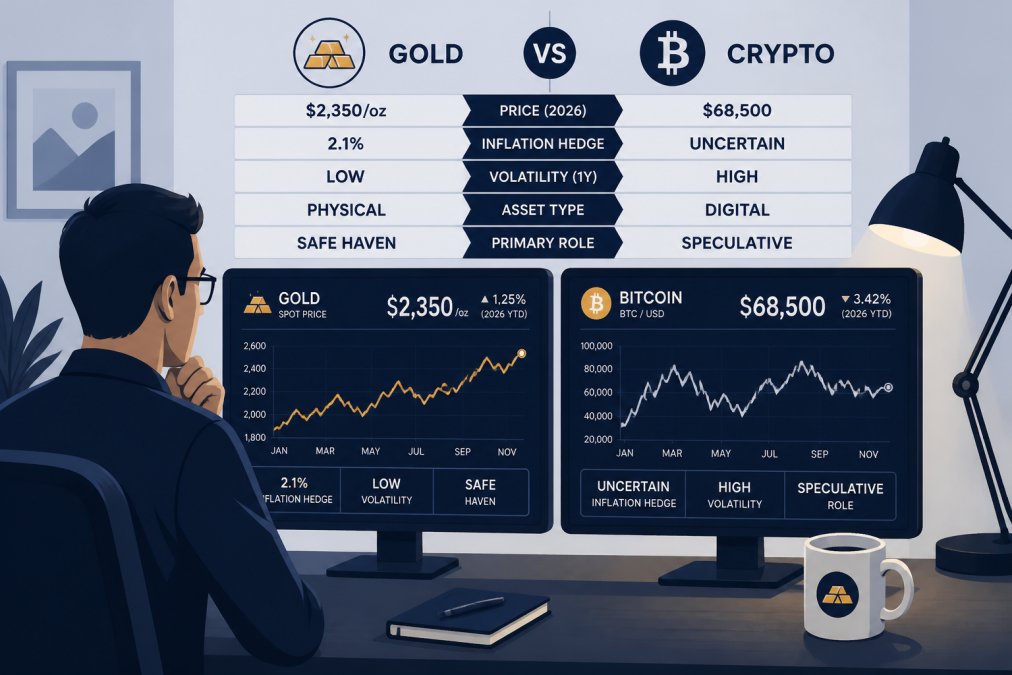
The inflation hedge argument for cryptocurrency rests on fixed supply mechanics. The inflation hedge argument for gold rests on millennia of empirical evidence and current central bank behavior. These are not equivalent claims.
| Factor | Gold | Cryptocurrency |
|---|---|---|
| Historical track record | Thousands of years | Under 20 years |
| Volatility | Moderate | High to extreme |
| Central bank adoption | Yes, actively buying | Minimal to none |
| Inflation hedge evidence | Strong historical basis | Limited, debated |
| Liquidity | High (global markets) | High (digital markets) |
| Regulatory clarity (U.S.) | Well-established | Evolving |
| Storage/custody risk | Physical or custodial | Digital key management |
These assets are not mutually exclusive. Many portfolio construction frameworks treat gold as a capital preservation anchor and allocate a smaller, speculative position to digital assets separately. According to CFA Institute’s portfolio diversification research, asset class correlation matters as much as individual asset performance. Gold’s low correlation to equities and bonds is one of its most durable portfolio diversification properties.
Tax Implications and Practical Steps for Retail Gold Investors in 2026
Tax implications are the most overlooked dimension of gold investing for retail participants. Gold is classified by the IRS as a collectible, not a standard capital asset.
Key tax facts for U.S. gold investors:
- Physical gold, including bullion coins and bars, is subject to a maximum long-term capital gains rate of 28% under the collectibles tax rate, higher than standard long-term capital gains rates. Confirm current rates with IRS guidance on collectibles.
- Short-term gains on gold held under one year are taxed at ordinary income rates.
- Gold ETFs holding physical gold are typically treated as collectibles for tax purposes.
- Gold mining stocks follow standard equity capital gains rules. Futures contracts may involve blended short- and long-term treatment under Section 1256.
The 28% collectibles rate on physical gold is a material consideration that changes the after-tax math on long-term holding strategies. Run the numbers before deciding between physical bullion, ETFs, and mining stocks.
Practical steps for retail investors:
- Keep detailed records of every purchase, including date, quantity, price per ounce, and total cost including premiums.
- Track your cost basis separately for each lot if you purchase at different prices over time.
- Consult a tax professional before selling large positions, particularly if you are near a tax bracket threshold.
- Understand the reporting requirements for foreign-held gold if you store bullion outside the United States.
The book GOLD: The Most Precious of Metals by Douglas Ginter, available through My Gold Book, addresses the practical dimensions of gold ownership, including how inflation dynamics affect the real value of a gold position over time.
Why Gold Research 2026 Demands More Than a Google Search
Search results surface recent news and price commentary but rarely provide the historical context, supply-demand framework, and comparative analysis needed to build a durable investment thesis. A search for "gold price today" tells you the spot price but not why central banks are buying or how gold compares to other assets as a long-term store of value.
Gold research 2026 is complicated by conflicting information online. Some sources are optimistic to the point of advocacy; others are dismissive without engaging the underlying data. Quality gold research examines supply-side constraints alongside demand growth, understands how geopolitical instability translates into safe-haven flows, and is honest about scenarios where gold underperforms.
The investor who approaches gold research 2026 with a structured methodology, tracking real rates, monitoring central bank activity, reading positioning data, and understanding tax implications, operates at a fundamentally different level than one who follows price headlines. That gap is exactly what separates capital preservation from capital loss.
Staying current on gold research in 2026 requires more than monitoring spot prices. The macroeconomic forces driving bullion demand a structured analytical framework that most casual investors do not have. My Gold Book’s GOLD: The Most Precious of Metals, authored by researcher Douglas Ginter, provides that framework in a balanced, accessible format, covering gold’s history, supply and demand dynamics, its comparison to Bitcoin and silver, and practical guidance on ownership. Click Here To Order Your Copy and build the research foundation your investment decisions deserve.
Frequently Asked Questions
Is gold still considered a safe-haven asset in 2026?
Gold continues to function as a safe-haven asset in 2026. Persistent geopolitical instability, currency devaluation concerns, and macroeconomic headwinds have reinforced investor demand for capital preservation. Central banks worldwide have maintained or increased their gold reserves, which signals institutional confidence in bullion as a store of value. For retail investors, gold remains a recognized tool for portfolio diversification, particularly during periods of elevated market volatility and uncertainty about fiat currency stability.
What are the best tools for researching gold prices in 2026?
Useful gold research tools in 2026 include commodity data platforms that track spot prices per ounce, CFTC Commitments of Traders reports for positioning data, the World Gold Council's demand and supply reports, and Federal Reserve economic data feeds for real rates and yield environment tracking. Combining these with technical charting tools gives investors both fundamental and price-momentum context. For a structured foundation, a well-researched guide like My Gold Book can help beginners understand what these data sources actually mean before using them.
How does gold compare to cryptocurrency as an inflation hedge in 2026?
Gold and cryptocurrency serve different roles in 2026. Gold has centuries of history as an inflation hedge with lower price sensitivity to short-term sentiment shifts and deep institutional liquidity. Cryptocurrency, especially Bitcoin, offers higher potential returns but carries far greater downside risk and volatility. Gold's structural momentum is driven by central bank reserves and physical demand; crypto's is driven by speculative flows. Many investors hold both as separate asset classes rather than treating them as direct substitutes.
Does technical analysis still work for gold in 2026?
Technical analysis remains a useful layer in gold price analysis in 2026, but it works best alongside fundamental research. Gold price movements are heavily influenced by macroeconomic indicators like real rates, dollar strength, and central bank policy signals. Pure technical signals can generate false breakouts when a major geopolitical or Fed policy event overrides chart patterns. Treating technical analysis as a timing tool within a fundamentally sound thesis gives it the most practical value for retail investors.
This article was written using GrandRanker