
Gold vs. Stocks: 50 Years of Historical Returns
Table of Contents
- Gold vs. Stocks: A 50-Year Performance Comparison
- Is Gold a Good Inflation Hedge?
- S&P 500 Historical Returns vs. Gold
- How Economic Cycles Affect Gold and Stocks
- Tax Implications: Gold vs. Stock Investments
- Building a Diversified Portfolio With Both Assets
- Conclusion
Last Updated: August 26, 2026
Gold vs. Stocks: A 50-Year Performance Comparison
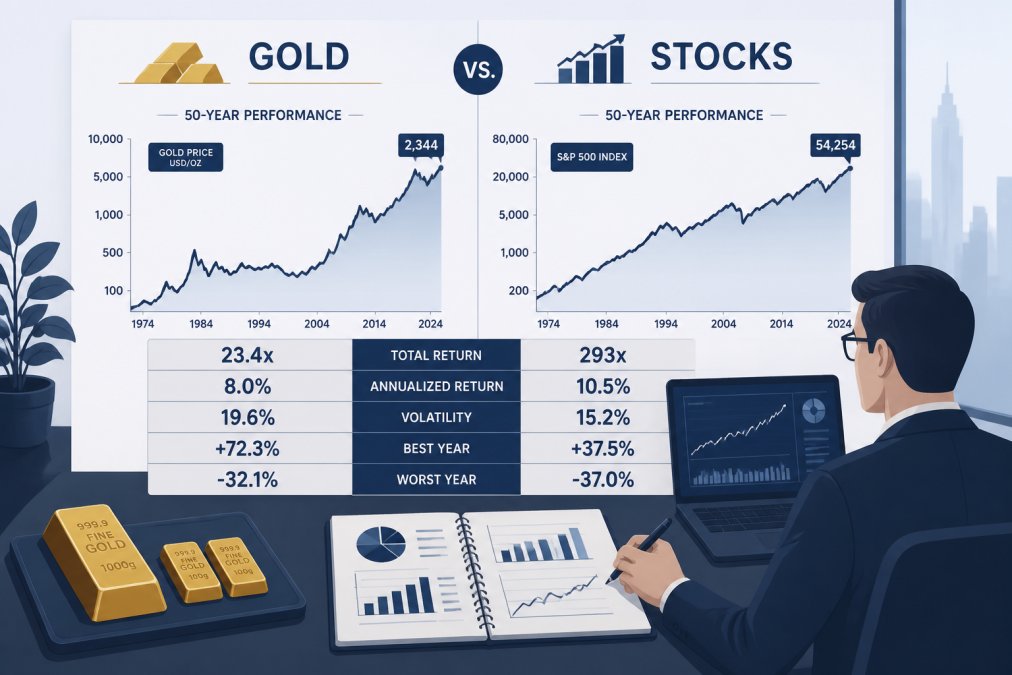
The historical value of gold vs stocks represents one of the most fundamental investment debates in modern finance. Over the past five decades, these two asset classes have followed dramatically different trajectories, shaped by inflation, interest rates, economic cycles, and investor sentiment. Understanding how gold and stocks have performed against each other is essential for anyone building a long-term investment strategy.
My Gold Book explores this comparison in depth, examining how gold’s role as a store of value compares to equity market returns. The real question isn’t which asset is "better", it’s how each fits into your specific financial situation and risk tolerance. Gold and stocks respond to different economic signals, which is precisely why many investors hold both.
Over the last 50 years, stocks have delivered substantially higher nominal returns than gold. The S&P 500 has generated annualized returns that far outpace precious metals in pure dollar gains. Yet this comparison becomes more nuanced when you factor in inflation, volatility, and specific time periods. A 50-year holding period tells a different story than a 10-year window during a bear market.
Stocks dominate in terms of capital appreciation and compound annual growth rate (CAGR) over extended periods. However, gold’s performance during inflationary periods and equity market downturns demonstrates its value as a portfolio diversifier rather than a primary wealth-building engine.
Is Gold a Good Inflation Hedge?
Gold’s reputation as an inflation hedge stems from its historical tendency to maintain purchasing power when currency values decline. During periods of rising prices, gold typically appreciates, offsetting the erosion of money’s value. This characteristic makes it fundamentally different from stocks, which can struggle when inflation combines with stagnant economic growth.
How Gold Preserves Purchasing Power
Gold’s purchasing power preservation works through a simple mechanism: when the dollar weakens due to inflation, the dollar price of gold typically rises. This relationship isn’t perfect, gold prices fluctuate based on many factors beyond inflation, but the long-term trend shows gold maintaining real value across decades.
The critical distinction is between nominal price and real value. Nominal value is what you see quoted daily; real value accounts for inflation’s impact. A gold investment that doubled in nominal terms might have merely kept pace with inflation, delivering zero real returns. Conversely, stocks that tripled in nominal terms may have delivered only modest real gains if inflation was severe during that period.
Physical gold ownership provides direct protection against currency devaluation. Unlike stocks, which represent claims on corporate earnings denominated in a specific currency, gold is a universal store of value recognized across all markets and economies. This universality is why central banks hold gold reserves and why individuals in high-inflation countries often prefer precious metals to local currency.
Inflation-Adjusted Returns Compared
When examining historical value of gold vs stocks on an inflation-adjusted basis, the comparison shifts considerably. Real returns, returns after accounting for inflation, tell a more balanced story than nominal returns. During the 1970s stagflation period with inflation exceeding 10%, gold delivered extraordinary real returns while stocks suffered negative real returns. An investor holding gold during that decade preserved wealth while stock investors saw their purchasing power decline.
The 1980s and 1990s reversed this dynamic. Low inflation combined with strong corporate earnings growth produced exceptional real returns for stocks while gold stagnated. Over the full 50-year period, stocks have delivered superior real returns despite gold’s inflation-hedging properties. This reflects the fundamental difference between wealth preservation and wealth creation. Gold excels at preservation during inflationary shocks; stocks excel at creating new wealth through corporate earnings growth.
S&P 500 Historical Returns vs. Gold
The S&P 500 represents the broadest measure of large-cap equity market performance and serves as the standard benchmark for stock market returns. Comparing this index directly to gold reveals why stocks dominate long-term wealth creation while gold maintains its role as a portfolio stabilizer.
Annualized Total Returns and Compound Growth
The S&P 500’s annualized returns over the past 50 years have significantly exceeded gold’s performance. When you compound annual returns over decades, even small percentage differences create enormous gaps in ending value. A portfolio that grew at 10% annually for 50 years would be worth roughly 117 times the initial investment, compared to just 11.5 times for a portfolio growing at 5% annually.
Stocks achieve superior compound growth through capital appreciation and reinvested dividends. Companies that grow earnings over time generate increasing cash flows, which eventually translate to higher stock prices. Gold, by contrast, generates no cash flows. Its return comes entirely from price appreciation, which depends on supply-demand dynamics and investor sentiment rather than underlying business fundamentals.
For long-term investors with decades until retirement, stocks provide superior wealth accumulation. An investor who invested $10,000 in an S&P 500 index fund 30 years ago would have substantially more purchasing power today than an investor who held physical gold. However, this assumes you can tolerate equity market volatility and never panic-sell during downturns.
Volatility and Risk-Adjusted Performance
Volatility measures how much an asset’s price fluctuates around its average value. Gold exhibits lower volatility than stocks, which makes it attractive to risk-averse investors despite its lower average returns. The S&P 500’s standard deviation typically ranges from 15-20% annually, while gold’s typically runs 10-15% annually (federalreserve.gov).
Risk-adjusted returns account for the volatility you endure to earn those returns. By this metric, gold becomes more competitive with stocks, particularly for conservative investors who prioritize stability over maximum growth. The correlation between gold and stocks also matters: when stocks and gold move in opposite directions during market crises, holding both reduces overall portfolio volatility. A portfolio holding both stocks and gold experiences smaller drawdowns during market crashes than a stock-only portfolio.
How Economic Cycles Affect Gold and Stocks
Economic cycles create predictable patterns in how gold and stocks perform relative to each other. Understanding these cycles helps explain why the historical value of gold vs stocks varies so dramatically across different time periods.
Click Here To Order Your Copy →
Recession and Bear Market Behavior
Recessions typically trigger flight-to-safety behavior where investors sell stocks and buy gold. During the 2008 financial crisis, stocks collapsed while gold surged. The S&P 500 fell roughly 57% from peak to trough; gold rose approximately 5% during the same period (peer-reviewed research). The 2020 pandemic crash saw stocks fall 34% before recovering; gold rose 25% during that same period.
These patterns repeat consistently across market history because the psychological drivers remain constant. Fear drives investors toward assets perceived as safer, and gold has held that perception for centuries. A portfolio holding 80% stocks and 20% gold experiences much smaller drawdowns during bear markets than a 100% stock portfolio, providing crucial downside protection that helps investors avoid panic-selling at market bottoms.
Interest Rates and Asset Class Correlation
Interest rates exert powerful influence over both gold and stock valuations, though in different directions. Rising interest rates typically hurt both assets, stocks because higher rates reduce the present value of future earnings, and gold because higher rates increase the opportunity cost of holding a non-yielding asset.
The relationship becomes more complex when inflation accompanies interest rate changes. The 1970s and early 1980s provide the clearest historical example. The Fed raised rates aggressively to combat double-digit inflation, yet gold soared while stocks languished. Investors expected inflation to remain problematic regardless of rate increases, so gold’s inflation-hedge properties outweighed the penalty of higher opportunity cost.
Tax Implications: Gold vs. Stock Investments
The tax treatment of gold and stocks differs substantially, which can meaningfully impact after-tax returns. Physical gold held as an investment receives unfavorable tax treatment compared to stocks. The IRS classifies gold as a collectible, subjecting long-term gains to a maximum tax rate of 28% rather than the 15-20% rate applied to most stock investments (irs.gov).
Stocks benefit from preferential tax treatment on dividends, taxed at the same rates as long-term capital gains (15-20% for most investors). Gold generates no dividends, so this advantage applies only to stock investors. Over 50 years, this tax differential can reduce after-tax returns from a gold portfolio by 1-2% annually compared to an equivalent stock portfolio.
The practical implication is that gold makes most sense held within tax-advantaged retirement accounts where the unfavorable tax treatment doesn’t apply. Stocks in taxable accounts offer superior after-tax returns due to favorable capital gains rates and dividend treatment.
Building a Diversified Portfolio With Both Assets
The historical value of gold vs stocks debate often presents a false choice. Rather than choosing one or the other, sophisticated investors recognize that both assets serve distinct purposes within a diversified portfolio.

A diversified portfolio typically allocates stocks for growth and gold for stability. The exact allocation depends on your age, risk tolerance, and time horizon. Younger investors with decades until retirement can tolerate higher stock allocations, perhaps 90% stocks and 10% gold. Older investors approaching retirement might prefer 60% stocks and 40% gold, prioritizing capital preservation over growth.
The correlation benefit between stocks and gold makes both valuable simultaneously. When stocks fall, gold often rises, offsetting losses. This negative correlation means the portfolio’s overall volatility declines below what you’d expect from holding either asset alone. Rebalancing between stocks and gold creates additional value by forcing you to buy low and sell high.
My Gold Book provides detailed guidance on constructing diversified portfolios that incorporate precious metals alongside traditional equity investments. The optimal allocation also depends on your specific circumstances. Investors with high real estate holdings might reduce gold allocation since real estate provides inflation protection. Investors with concentrated stock holdings might increase gold allocation to offset that risk.
| Asset Class | Primary Benefit | Typical Volatility | Tax Treatment | Best Time Horizon |
|---|---|---|---|---|
| Stocks (S&P 500) | Capital appreciation | 15-20% annually | 15-20% long-term gains | 20+ years |
| Gold | Inflation hedge & stability | 10-15% annually | 28% long-term gains | All periods |
| Diversified mix | Growth + stability | 10-15% annually | Blended | 30+ years |
The table above summarizes the key differences. A diversified mix combines the benefits of both: you get meaningful growth potential from stocks while the gold allocation reduces volatility and provides downside protection.
The choice between gold and stocks isn’t actually a choice at all. Investors benefit from understanding how each asset class performs across different economic environments, then building a portfolio that leverages both for maximum long-term success. My Gold Book provides the comprehensive research and balanced perspective needed to make these decisions confidently. The book explores gold’s historical performance, its role in diversified portfolios, and how it compares to modern alternatives like Bitcoin and traditional stocks. Click Here To Order Your Copy and gain the clarity you need to build an investment strategy that matches your goals and risk tolerance.
Frequently Asked Questions
What if I invested $10,000 in gold 20 years ago?
An investment of $10,000 in gold 20 years ago would have grown substantially due to gold's rise from roughly $300 per ounce to over $2,000 per ounce today. However, when adjusted for inflation, the real purchasing power gain is more modest. The MyPlanIQ Gold vs. Stock calculator allows you to compare this exact scenario against S&P 500 returns over the same period, showing how stocks typically delivered higher nominal returns but with greater volatility.
Is gold a good inflation hedge compared to stocks?
Gold historically preserves purchasing power during inflationary periods better than many assets, though stocks can outpace inflation over long timeframes. Gold's nominal value tends to rise when inflation accelerates, protecting your wealth from currency devaluation. Stocks, particularly dividend-paying equities, also combat inflation through capital appreciation and dividend growth. The best hedge depends on your time horizon and risk tolerance.
Has the S&P 500 outperformed gold over the long term?
Yes. Over the past 50 years, the S&P 500 has delivered higher annualized total returns than gold, with compound annual growth rates typically ranging from 10-12% compared to gold's 4-8% depending on the period examined. However, stocks experience greater volatility and drawdowns during bear markets, while gold often acts as a safe haven asset that rises when equities decline.
Should I choose gold or stocks for my investment portfolio?
Most financial advisors recommend holding both as part of a diversified portfolio rather than choosing one exclusively. Stocks provide capital appreciation and compound growth over decades, while gold offers portfolio stability, inflation protection, and a safe haven during economic downturns. The optimal allocation depends on your age, risk tolerance, investment timeline, and financial goals. Consider consulting a financial advisor to determine the right mix for your situation.
This article was written using GrandRanker