
Gold Investing for Busy People: A Quick Start Guide
Table of Contents
- Why Gold Matters to Busy Investors
- Gold ETF vs Physical Gold: Which Fits Your Schedule
- Best Ways to Buy Gold for Beginners
- Gold IRA Rules and Regulations for Tax Efficiency
- How Much Gold Should You Own?
- Gold as an Inflation Hedge: What You Need to Know
- The Time-Cost Reality of Gold Ownership
- Conclusion
Last Updated: August 27, 2026
Why Gold Matters to Busy Investors
Gold investing for busy people isn’t about becoming a precious metals expert. It’s about recognizing that your portfolio needs an asset that moves independently from stocks and bonds, and then choosing the simplest way to own it.
Most busy investors never get around to diversifying because the process seems complicated. They know gold belongs in a balanced portfolio, they’ve heard it from financial advisors, read it in investment guides, and seen it mentioned in market analyses. But between work, family, and managing existing investments, actually buying gold feels like another project on an already-full list.
Here’s the reality: gold as an inflation hedge and safe-haven asset doesn’t require active management. You don’t need to monitor it daily, trade it frequently, or become fluent in spot prices. What you need is a straightforward entry point that fits your schedule and investment horizon.
This guide from My Gold Book covers the fastest, most practical paths to gold ownership for people who want portfolio diversification without the time commitment. Whether you’re looking at gold ETFs for hands-off exposure, exploring a gold IRA for tax efficiency, or considering physical gold for tangible wealth preservation, we’ll break down what actually works for a busy schedule.
The best gold investment for a busy person is one that requires zero maintenance after purchase. That typically means gold ETFs or a gold IRA, not physical bullion stored in a safe deposit box.
Gold ETF vs Physical Gold: Which Fits Your Schedule
Gold ETFs are the time-efficient choice for busy investors. An ETF that tracks gold prices gives you commodity market exposure without any of the friction: no storage fees, no insurance concerns, no logistics. You buy it like any stock through a brokerage account, and it sits in your portfolio doing its job.
Physical gold, coins, bars, and bullion, requires decisions that busy people don’t have time for. Where do you store it? A home safe is a security risk. A safe deposit box at a bank costs money annually and may not be accessible during banking hours. A third-party custodian adds another layer of fees and complexity. You also need to verify authenticity, insure the metals, and eventually deal with the transaction costs when you sell.
The trade-off is tangibility. Physical gold is an actual asset you can hold. Some investors find psychological comfort in that. Others view it as unnecessary friction.
For most busy professionals, the math is straightforward:
- Gold ETFs: Buy once, hold, rebalance annually. Minimal fees. Instant liquidity. No storage logistics.
- Physical gold: Higher transaction costs upfront, annual storage and insurance fees, authentication concerns, slower to liquidate, requires secure storage decisions.
The time cost of managing physical gold usually outweighs the psychological benefit unless you’re buying significant quantities. A busy investor with $10,000 to allocate to gold is far better served by an ETF than by managing physical coins or bars.
If you do choose physical gold, buy it in larger denominations (one-ounce coins or bars rather than fractional pieces). Fewer items to store and track means less ongoing management.
Best Ways to Buy Gold for Beginners
The simplest path depends on where your money already lives. If you have a brokerage account for stocks, buying a gold ETF takes five minutes. If you want tax-advantaged growth, a gold IRA opens different possibilities. If you’re starting from scratch, the choice matters more.
Gold ETFs through a brokerage account are the fastest entry point. Open an account with any major broker, search for a gold ETF (common tickers track spot price directly), and buy shares like you would any stock. Popular options include funds that hold physical gold bullion in vaults and pass the price movement to shareholders. Your investment horizon doesn’t change, you’re just adding an asset class that behaves differently than equities.
A gold IRA makes sense if you’re looking at long-term wealth preservation with tax efficiency. Unlike a standard brokerage account, a gold IRA can hold physical precious metals directly (subject to IRS regulations on purity and form). You’ll need to work with a custodian who specializes in precious metal IRAs, which adds a step but enables tax-deferred growth. This approach works best if you’re already thinking in 10-20 year terms and want to minimize tax drag on your asset allocation.
Precious metal dealers sell physical gold directly, but this route requires more vetting. You need to verify the dealer’s reputation, confirm pricing against spot price, understand buyback terms, and arrange secure storage. For a busy person, the administrative burden often exceeds the benefit.
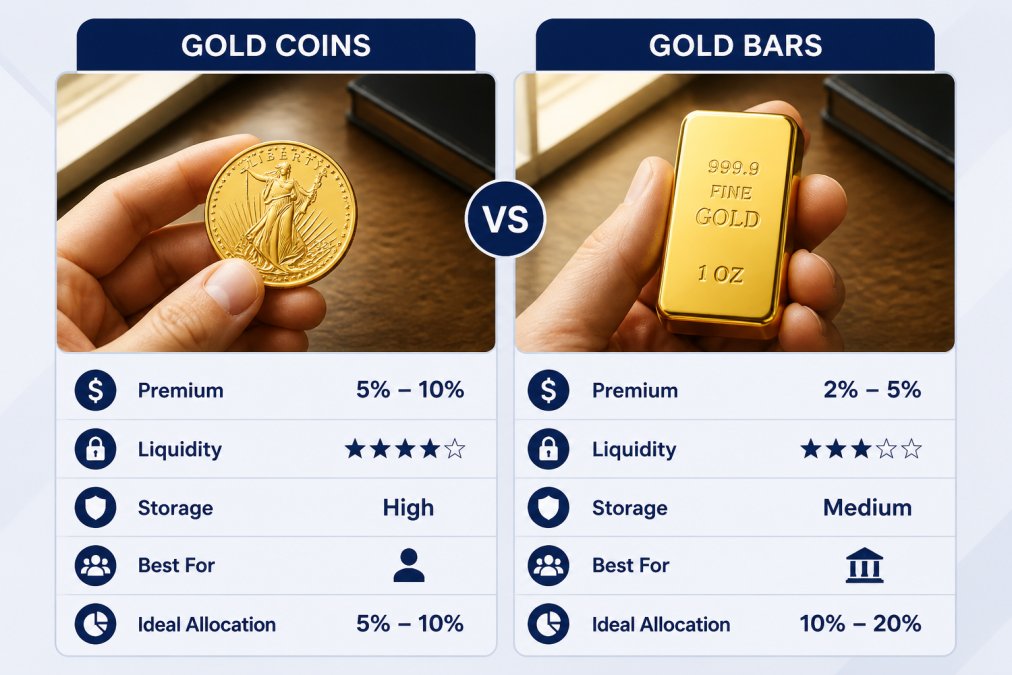
The entry point that requires the least ongoing attention is a gold ETF in a standard brokerage account. You own the exposure, you don’t own the logistics.
Gold IRA Rules and Regulations for Tax Efficiency
A gold IRA is a self-directed IRA that holds precious metals instead of (or alongside) traditional securities. The IRS allows certain forms of gold in IRAs, specifically, coins and bars that meet minimum purity standards (generally 99.5% for gold bullion) (irs.gov).
The tax efficiency comes from the same mechanism as any IRA: money grows tax-deferred until withdrawal. If you’re in a higher tax bracket now and expect to be in a lower bracket in retirement, the advantage is real. If your tax situation stays constant, the benefit is smaller.
Here’s what matters for a busy investor:
You need a custodian. You cannot hold the physical gold yourself, that violates IRA rules. A custodian holds the metals in an approved depository and handles the paperwork. This adds a fee, but it’s the price of tax-deferred status.
Contribution limits apply. As of 2026, you can contribute up to $7,000 per year to an IRA (or $8,000 if you’re 50 or older) (irs.gov). That’s the same limit whether your IRA holds stocks, bonds, or gold.
Withdrawal rules are strict. You cannot withdraw physical gold from a gold IRA before age 59½ without triggering a 10% penalty plus income taxes on the withdrawal (irs.gov). There are narrow exceptions (hardship, disability, death), but they’re genuinely narrow. A gold IRA is a buy-and-hold vehicle, not a flexible savings account.
The administrative burden is higher than a gold ETF in a taxable account, but the tax deferral can be worth it over decades. For a busy person, the key is finding a custodian with straightforward processes and then letting it run.
Click Here To Order Your Copy →
Do not attempt to store gold IRA metals yourself or hold them in a personal safe. The IRS will disqualify the IRA and treat the entire balance as a taxable distribution. The penalty is severe and often unexpected.
How Much Gold Should You Own?
There’s no universal answer, but the range most financial advisors suggest is 5-10% of a diversified portfolio. Some suggest as little as 3%, others go to 15%. The variation reflects different views on gold’s role in portfolio construction.
The core logic is this: gold doesn’t correlate strongly with stocks. When equities fall during market stress, gold often holds value or rises. That negative correlation is why it belongs in a portfolio at all. But gold also doesn’t generate income like bonds or dividends. It’s purely a price-appreciation play (or a preservation play during downturns). That’s why it shouldn’t dominate your allocation.
For a busy investor with a 20-30 year investment horizon, 5-7% in gold is a reasonable starting point. It’s enough to provide genuine diversification benefit without requiring constant rebalancing or attention. If your portfolio is $100,000, that’s $5,000-7,000 in gold exposure. If you’re adding $500 per month to investments, allocating $25-35 of that monthly contribution to gold keeps it proportional without complexity.

The percentage matters less than consistency. A busy person who buys $5,000 in gold and then forgets about it for 15 years has done better than someone who obsesses over daily prices and trades constantly. Set a percentage, buy accordingly, and rebalance once annually when you review your overall portfolio.
The right amount of [gold for](/best-gold-investment-guide-2026/) a busy investor is the amount you can buy once and then ignore. That’s usually 5-7% of a diversified portfolio, held in an ETF or IRA for minimal maintenance.
Gold as an Inflation Hedge: What You Need to Know
Gold’s primary appeal to busy investors is its behavior during inflation. When the purchasing power of cash declines, hard assets like precious metals tend to hold or gain value. This isn’t guaranteed, gold prices fluctuate like any commodity, but the long-term pattern is clear: gold preserves wealth when currencies weaken.
The mechanism is straightforward. If inflation runs at 4% annually and your savings account earns 0.5%, you’re losing 3.5% in real purchasing power each year. Gold, by contrast, tends to track inflation over long periods. Not perfectly, and not every year, but over decades, it keeps pace. A busy investor who buys gold as part of a diversified portfolio isn’t trying to beat the market, they’re trying to protect against wealth erosion.
This matters more in high-inflation environments. During periods of stable, low inflation (like the 2010s), gold’s value proposition weakens. During periods of rising inflation or currency uncertainty, gold’s role becomes more obvious.
For a busy person, the takeaway is simple: gold belongs in your portfolio not because it will make you rich, but because it will help your wealth survive scenarios where other assets struggle. That’s a defensive position, not an aggressive one. It’s exactly the kind of boring, set-it-and-forget-it investment that fits a busy schedule.
The Time-Cost Reality of Gold Ownership
Here’s what most gold investment guides skip over: the actual time required depends entirely on what you buy.
A gold ETF requires approximately five minutes to research and purchase. After that, zero time. You check it once or twice a year during portfolio rebalancing. Total annual time commitment: 10-15 minutes.
A gold IRA requires 2-3 hours upfront (finding a custodian, completing paperwork, arranging the first deposit), then 30 minutes annually to file required forms or verify holdings. The administrative burden is real but manageable.
Physical gold is the time sink. Authentication takes time. Storage decisions take time. Insurance verification takes time. Selling requires finding a buyer, confirming pricing, and arranging secure transfer. If you’re buying significant quantities or trading frequently, the time cost compounds. Even a passive holder of physical gold spends 5-10 hours annually managing the logistics.
For a busy professional, this is the decisive factor. A gold ETF in a brokerage account is the only option that doesn’t steal time from your actual work and life. The cost is slightly higher fees, but the time savings are enormous.
My Gold Book’s guide to precious metals explores these trade-offs in depth, helping readers understand not just whether to own gold, but how to own it in a way that fits their actual schedule and priorities.
Gold investing for busy people comes down to one principle: choose the vehicle that requires the least ongoing attention. For most professionals, that means a gold ETF held in a standard brokerage account. It gives you the diversification benefit of precious metals without the logistics of physical ownership or the administrative overhead of an IRA.
The goal isn’t to become a gold expert or to time the market. It’s to own an asset that behaves differently from stocks, that preserves wealth during inflation, and that requires almost no maintenance after the initial purchase. When you approach gold that way, as a simple, boring, long-term holding rather than an active trading position, it becomes exactly what a busy investor needs.
For deeper insights into gold’s role in wealth preservation, its historical significance, and how it compares to modern investments like Bitcoin, consider exploring My Gold Book’s comprehensive guide to precious metals. The book walks through the economic and cultural history of gold while providing practical guidance for today’s investor.
Frequently Asked Questions
Is it a good time to invest in gold right now?
Gold performs best during periods of economic uncertainty and high inflation. Current market conditions, geopolitical tensions, and interest rate environments all influence timing. Rather than chasing perfect timing, busy investors benefit from dollar-cost averaging, investing fixed amounts regularly, which reduces timing risk. Gold's role as a safe-haven asset means it typically holds value when stocks decline, making it valuable for portfolio diversification regardless of current prices.
What are the tax implications of gold investments?
Gold held as a collectible faces capital gains taxes at rates up to 28% under IRS rules, higher than standard long-term capital gains. Gold IRAs offer tax-deferred growth, letting you invest without immediate tax consequences. Physical gold stored at home has no special tax advantage, while gold ETFs may offer slightly better tax treatment depending on structure. Consult a tax professional about your specific situation; the tax efficiency difference between physical gold and ETFs can significantly impact long-term returns.
How much of my portfolio should be allocated to gold?
Financial professionals typically recommend 5-10% of a diversified portfolio in precious metals as a risk mitigation strategy. Some suggest up to 15% for those seeking stronger inflation protection. Your allocation depends on your investment horizon, risk tolerance, and existing holdings. Busy investors benefit from setting a target percentage and rebalancing annually rather than actively trading. Gold's low correlation with stocks makes even modest allocations valuable for volatility reduction.
Is physical gold or a gold ETF better for busy investors?
Gold ETFs win for busy schedules: they require no storage arrangements, insurance, or authentication concerns, and you can buy or sell in seconds through a brokerage account. Physical gold offers tangible ownership and no counterparty risk but demands secure storage and carries transaction costs. For professionals with limited time, ETFs eliminate the operational burden while maintaining precious metals exposure. Physical gold makes sense only if you value direct ownership enough to justify the management overhead.
This article was written using GrandRanker