
Beginner Guide to Collecting Gold Coins
Table of Contents
- What Is Numismatics and Why Collect Gold Coins?
- Gold Bullion vs. Numismatic Coins: Understanding the Difference
- How to Determine Gold Coin Value
- Gold Coin Authentication Tips and Spotting Counterfeits
- How to Store Gold Coins at Home Safely
- Getting Started: Your First Gold Coins for Beginners
- Tax Implications and Insurance for Your Collection
- Conclusion
Last Updated: August 28, 2026
What Is Numismatics and Why Collect Gold Coins?
Numismatics is the study and collection of coins, currency, and related objects, a hobby combining history, economics, and artistry. Gold coin collecting offers tangible value, historical significance, and inflation hedging in a form you can hold and examine directly. People collect for varied reasons: historical narratives embedded in each piece, practical precious metals ownership without futures complexity, or appreciation for craftsmanship and design precision.
My Gold Book explores these dimensions in "GOLD: The Most Precious of Metals." Author Douglas Ginter provides balanced perspective on why collecting matters as a deliberate wealth-building strategy and tool for understanding economic history. Whether motivated by investment or historical curiosity, the foundation is learning to distinguish between different gold coin types and understanding what drives their value.
Gold Bullion vs. Numismatic Coins: Understanding the Difference
Gold bullion coins are minted primarily for metal content. Their value tracks closely to the spot price of gold, the current market rate per troy ounce. A one-ounce American Gold Eagle bullion coin is worth approximately spot price plus a small dealer markup. Bullion coins are struck in high volumes with minimal variation, and their appeal lies in purity and weight, not rarity.
Numismatic coins derive significant value from factors beyond melt value: rarity, historical significance, condition, mint mark, date, and collector demand. A rare 1933 Saint-Gaudens double eagle commands prices many multiples higher than its gold content alone would justify. Numismatic value is subjective and fluctuates based on collector interest and market trends.
The practical difference: if buying gold purely as a commodity hedge, bullion coins are efficient, you pay close to spot price and know exactly what you own. If collecting as historical artifacts with appreciation potential beyond metal value, numismatic coins offer that upside, though they require more knowledge to evaluate and carry higher markups. Most beginners should start with bullion to build familiarity with handling, storing, and understanding gold before exploring numismatic pieces.
How to Determine Gold Coin Value
Determining gold coin value requires understanding multiple pricing layers. Start with melt value, the raw worth of the gold itself. Multiply the coin’s weight in troy ounces by the current spot price of gold. A one-ounce gold coin with spot gold at $2,000 per troy ounce has a melt value of $2,000, regardless of historical significance or condition.
Add the dealer markup, the premium charged above spot price. For bullion coins, markups typically range 2-8% depending on coin type and market conditions. For rare numismatic pieces, markups may reach 15-50% or more.
For numismatic coins, valuation factors include:
- Rarity: Fewer coins minted in a particular year or mint command higher prices
- Condition: A coin graded "Mint State 65" is worth significantly more than one graded "Extremely Fine 45"
- Mint mark: The small letter indicating which mint produced the coin
- Provenance: Documented ownership history, especially from notable collections
- Strike quality: Sharpness and clarity of design imprint
- Historical significance: Coins from key dates or commemorative issues often command premiums
To research values, consult the Red Book (officially the "Guide Book of United States Coins") for U.S. coins. Auction results from Heritage Auctions or Sotheby’s provide real-world transaction data for rare pieces. Online marketplaces show current asking prices, though asking price and actual sale price often differ. Never rely on a single source, cross-reference multiple guides, check recent auction results, and consult experienced dealers. A coin’s value is ultimately what a willing buyer will pay.
Gold Coin Authentication Tips and Spotting Counterfeits
Counterfeits are a real concern, particularly for high-value numismatic pieces. Several techniques help verify authenticity without expensive equipment.
Weight and dimensions are your first defense. Counterfeit coins often deviate from official specifications. A genuine American Gold Eagle weighs exactly 33.931 grams; a counterfeit might weigh 33.8 or 34.1 grams (usmint.gov). Invest in a precision scale accurate to 0.01 grams and measure diameter and thickness as well.
Sound and feel matter significantly. Genuine gold coins have a distinctive ring when dropped gently on a hard surface. Counterfeits produce a duller or sharper sound. The heft and density of gold feel distinctive once you’ve handled several genuine pieces; counterfeits often feel "off."
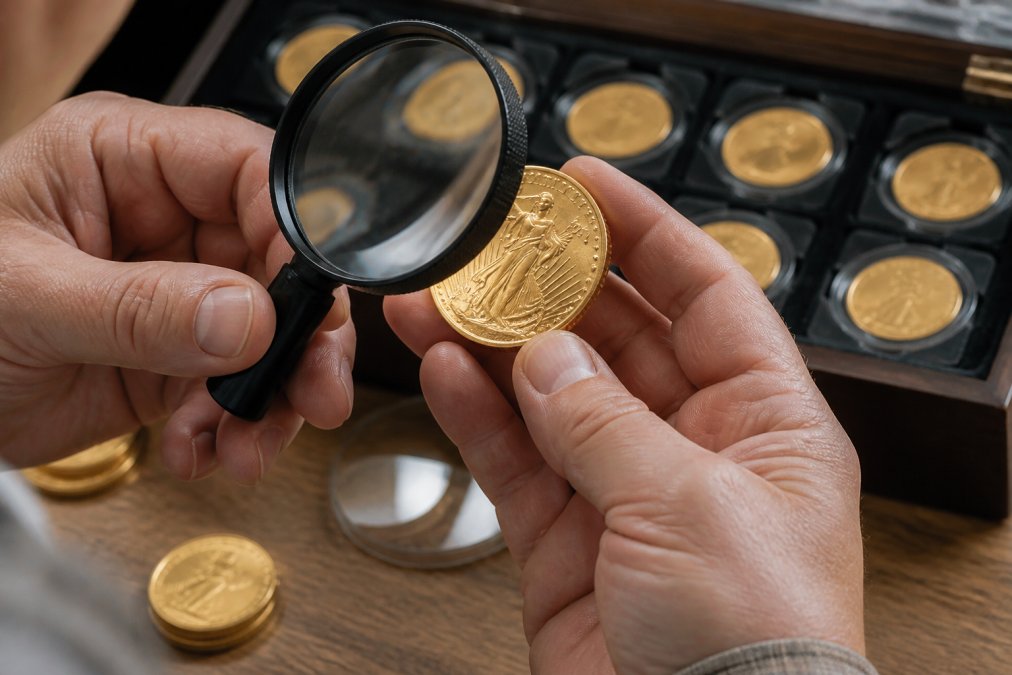
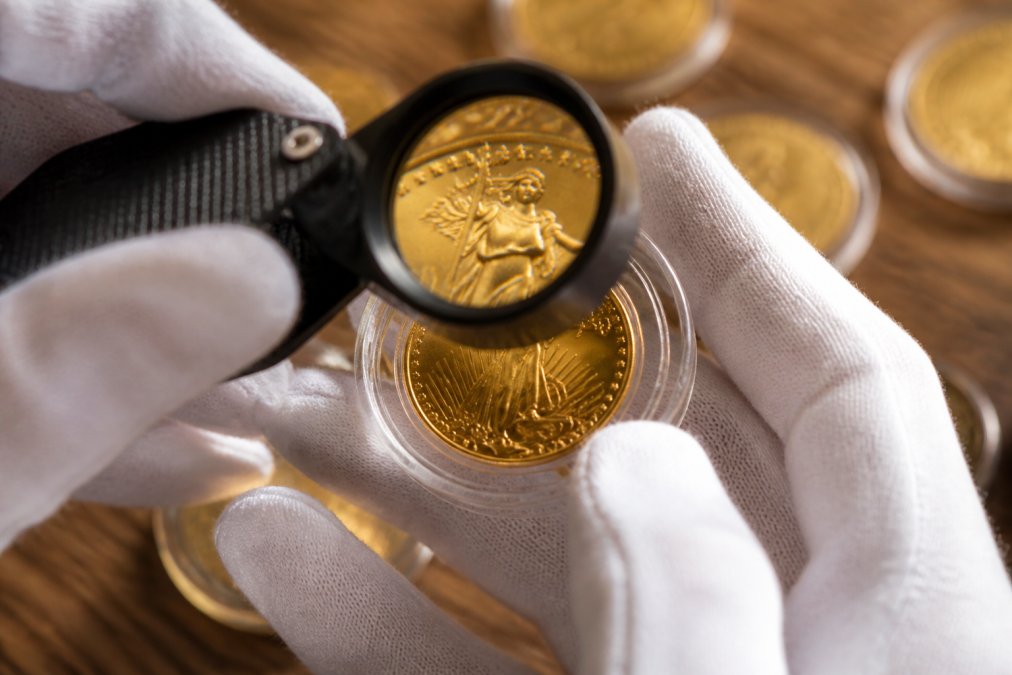
Visual inspection with a 10x loupe reveals much. Examine strike quality and design detail sharpness, counterfeiters struggle to replicate genuine die precision. Look for inconsistencies in letter spacing, uneven wear patterns, or blurred design elements. Check mint marks carefully and inspect edges for casting flaws or rough spots. Genuine minted coins have consistent, well-defined edges.
Magnet testing works for some counterfeits. Gold is non-magnetic, so genuine coins won’t attract a strong magnet. However, this test isn’t foolproof as skilled counterfeiters use non-magnetic metals.
For valuable numismatic coins, professional grading is worth the investment. Organizations like PCGS and NGC examine coins under magnification, test with specialized equipment, and encapsulate authenticated pieces in protective slabs, providing significant credibility and liquidity advantages.
How to Store Gold Coins at Home Safely
Proper storage protects your investment from theft, damage, and environmental degradation. Your method depends on collection size, value, and risk tolerance.
Home safes are accessible for beginners. A quality safe rated for fire and burglary provides reasonable protection for modest collections. Secure it to the floor or wall, keep its location discrete, and use a strong combination. A safe bolted to concrete in a basement offers more security than one in an obvious location.
Safety deposit boxes at banks offer institutional security with vault protection, climate control, and insurance coverage. Downsides include limited access hours and rental fees (typically $50-200 annually). For valuable numismatic pieces, this is often worth the cost.
Home storage best practices:
- Store coins in inert, PVC-free holders to prevent chemical corrosion
- Keep coins in cool, dry environments; humidity accelerates toning
- Avoid touching coins with bare hands; skin oils cause spotting
- Use archival-quality storage materials
- Maintain detailed records: photographs, grades, purchase prices, and acquisition dates
- Consider insurance specifically covering precious metals; standard homeowner policies often have limits
Insurance considerations are critical. Standard homeowner insurance typically covers precious metals only up to $1,500-2,500 (naic.org). For larger collections, add a rider or purchase specialized precious metals insurance. Document your collection thoroughly with photographs, grading certificates, purchase receipts, and appraisals, essential for claims.
Getting Started: Your First Gold Coins for Beginners
Start with widely available, relatively affordable coins that are easy to understand. These foundation pieces build knowledge without overwhelming your budget.
American Gold Eagles are ideal starter coins. Minted since 1986 in one-ounce, half-ounce, quarter-ounce, and tenth-ounce denominations, they’re struck in .9167 fine gold, backed by U.S. government guarantee, and highly liquid. Their value tracks closely to spot price with modest markup.
Canadian Gold Maple Leafs offer similar advantages. These one-ounce coins are .9999 fine gold, recognized worldwide, and equally liquid and easy to authenticate.
U.S. Gold Coins with historical appeal include American Gold Commemoratives, pre-1933 U.S. Gold Coins like Liberty Head Double Eagles, and Sovereign coins from Britain and other nations.
Your first purchase strategy:
Click Here To Order Your Copy →
- Start with one ounce of bullion to build familiarity
- Document the purchase: price, date, dealer, condition
- Practice authentication: weigh, measure, examine under magnification
- Store securely and maintain insurance
- Track value relative to spot price
- Once comfortable, explore numismatic pieces aligned with your interests
Avoid buying rare, high-value coins immediately. The knowledge gap between beginners and experienced collectors is vast. Build your foundation with accessible, liquid coins; your expertise will grow and benefit later acquisitions.
Tax Implications and Insurance for Your Collection
Gold coin ownership carries tax and insurance considerations beginners often overlook.
Tax implications depend on how you classify coins. The IRS distinguishes between bullion and collectibles. Bullion held as investments is generally treated as capital assets; you owe capital gains tax on profits when selling. Short-term gains (held less than one year) are taxed as ordinary income; long-term gains (held more than one year) qualify for preferential rates, typically 15-20%.
Numismatic coins are classified as collectibles with different tax treatment. Long-term gains on collectibles are taxed at a maximum rate of 28%, higher than standard long-term capital gains rates (irs.gov). This distinction matters when planning large acquisitions or sales. Consult a tax professional familiar with precious metals.
Reporting requirements apply to certain transactions. If you sell gold coins through a dealer exceeding specific thresholds, the dealer may file Form 8949 with the IRS. Maintain records of all transactions.
Insurance for your collection is essential. Specialized precious metals insurance covers coins against theft, damage, and loss, typically costing 1-2% of insured value annually. When applying for coverage, provide detailed inventory with type, date, mint mark, grade, photographs, purchase receipts, and storage location documentation.
Record-keeping is your best defense against loss and a tax compliance requirement. Maintain a spreadsheet with acquisition date, coin type, denomination, weight, mint mark, purchase price, current value, storage location, insurance details, and any grading certificates.
Collecting gold coins is an accessible entry point into precious metals ownership and numismatic history. Begin with widely available, easy-to-authenticate bullion coins to build foundational knowledge. Understand the difference between bullion value and numismatic premium, learn authentication techniques, and establish secure storage and insurance before your collection grows. As your expertise develops, explore rarer coins and specialized collecting areas.
My Gold Book’s "GOLD: The Most Precious of Metals" provides the historical context and balanced analysis you need to make informed collecting decisions. Whether motivated by investment fundamentals, historical interest, or inflation hedging, the book equips you with knowledge to build a collection with confidence. Click Here To Order Your Copy and start your journey into one of humanity’s oldest forms of wealth preservation.
=== FAQ ANSWERS (audit these too, same rules) ===
[1] Q: What coins should a beginner collect?
A: Beginners typically start with American Gold Eagles, Canadian Maple Leafs, or South African Krugerrands because they’re widely recognized, liquid, and carry consistent premiums over spot price. Choose based on your goal: pure bullion investment favors lower-premium coins, while collecting favors coins with historical significance or limited mintages. Start with one or two types to learn before expanding.
[2] Q: What is the difference between numismatic value and bullion value?
A: Bullion value is based on the troy ounce weight and purity of gold content, it tracks the spot price. Numismatic value reflects rarity, historical significance, mint marks, condition, and collector demand. A coin graded by a third-party service may sell for significantly more than melt value. Numismatic coins carry higher premiums but require expertise to authenticate and grade. Bullion coins are simpler for beginners but offer less upside potential.
[3] Q: How do I verify the authenticity of gold coins?
A: Check weight, dimensions, and sound against official specifications, counterfeit coins often feel lighter or sound different when dropped. Examine the strike quality, luster, and patina under magnification; counterfeits typically show poor detail. Verify mint marks and dates match production records. For valuable coins, use third-party grading services like PCGS or NGC, which authenticate and slab coins in protective holders. Buy from reputable dealers and request certificates of authenticity.
[4] Q: How should I store my gold coin collection for maximum security?
A: Home safes work for smaller collections but should be bolted down and hidden. Bank safe deposit boxes offer security but limit access. For larger collections, consider a private vault or depository. Store coins in protective holders to prevent damage that reduces numismatic value. Keep inventory records separately from the storage location. Avoid telling others about your collection. Insure your coins based on appraised value, not just spot price, especially for graded or numismatic coins.
[5] Q: Are there tax implications for owning gold coins?
A: Gold coins are treated as collectibles under federal tax law and subject to a 28% capital gains tax rate, higher than standard long-term capital gains rates. You must report gains when you sell. Inherited coins receive a stepped-up basis, potentially reducing tax liability. Keep detailed records of purchase dates, costs, and sales prices.
[6] Q: How do I determine the current market value of a gold coin?
A: Start with the spot price of gold per troy ounce, then add the dealer markup or premium. Bullion coins typically trade at 3-8% above spot; numismatic coins depend on rarity, condition, and demand. Check recent sales of identical coins on dealer websites or auction results. Third-party grading and certification affect value significantly, a slabbed coin may be worth 20-50% more than a raw coin. Use multiple sources to cross-check prices before buying or selling.
[7] Q: What makes this book different from free online information?
A: My Gold Book provides a comprehensive, researched framework covering gold’s history, economics, and role as an inflation hedge alongside modern comparisons like Bitcoin. Rather than scattered blog posts, it offers a balanced assessment from researcher Douglas Ginter that helps busy professionals understand collecting and investing fundamentals without requiring you to piece together information from dozens of sources. The book answers the ‘why’ behind gold’s value, not just the ‘how.’
Frequently Asked Questions
What coins should a beginner collect?
Beginners typically start with American Gold Eagles, Canadian Maple Leafs, or South African Krugerrands because they're widely recognized, liquid, and carry consistent premiums over spot price. Choose based on your goal: pure bullion investment favors lower-premium coins, while collecting favors coins with historical significance or limited mintages. Start with one or two types to learn before expanding.
What is the difference between numismatic value and bullion value?
Bullion value is based on the troy ounce weight and purity of gold content, it tracks the spot price. Numismatic value reflects rarity, historical significance, mint marks, condition, and collector demand. A coin graded by a third-party service may sell for significantly more than melt value. Numismatic coins carry higher premiums but require expertise to authenticate and grade. Bullion coins are simpler for beginners but offer less upside potential.
How do I verify the authenticity of gold coins?
Check weight, dimensions, and sound against official specifications, counterfeit coins often feel lighter or sound different when dropped. Examine the strike quality, luster, and patina under magnification; counterfeits typically show poor detail. Verify mint marks and dates match production records. For valuable coins, use third-party grading services like PCGS or NGC, which authenticate and slab coins in protective holders. Buy from reputable dealers and request certificates of authenticity.
How should I store my gold coin collection for maximum security?
Home safes work for smaller collections but should be bolted down and hidden. Bank safe deposit boxes offer security but limit access. For larger collections, consider a private vault or depository. Store coins in protective holders to prevent damage that reduces numismatic value. Keep inventory records separately from the storage location. Avoid telling others about your collection. Insure your coins based on appraised value, not just spot price, especially for graded or numismatic coins.
Are there tax implications for owning gold coins?
Gold coins are treated as collectibles under federal tax law and subject to a 28% capital gains tax rate, higher than standard long-term capital gains rates. You must report gains when you sell. Inherited coins receive a stepped-up basis, potentially reducing tax liability. Keep detailed records of purchase dates, costs, and sales prices.
How do I determine the current market value of a gold coin?
Start with the spot price of gold per troy ounce, then add the dealer markup or premium. Bullion coins typically trade at 3-8% above spot; numismatic coins depend on rarity, condition, and demand. Check recent sales of identical coins on dealer websites or auction results. Third-party grading and certification affect value significantly, a slabbed coin may be worth 20-50% more than a raw coin. Use multiple sources to cross-check prices before buying or selling.
What makes this book different from free online information?
My Gold Book provides a comprehensive, researched framework covering gold's history, economics, and role as an inflation hedge alongside modern comparisons like Bitcoin. Rather than scattered blog posts, it offers a balanced assessment from researcher Douglas Ginter that helps busy professionals understand collecting and investing fundamentals without requiring you to piece together information from dozens of sources. The book answers the 'why' behind gold's value, not just the 'how.'
This article was written using GrandRanker